
Introduction to the Brain and Its Four Main Parts
The human brain is one of the most complex and powerful organs in the body. It controls everything from breathing and movement to thoughts, emotions, and memory. Understanding the structure of the brain helps us better appreciate how it manages so many vital functions at once.
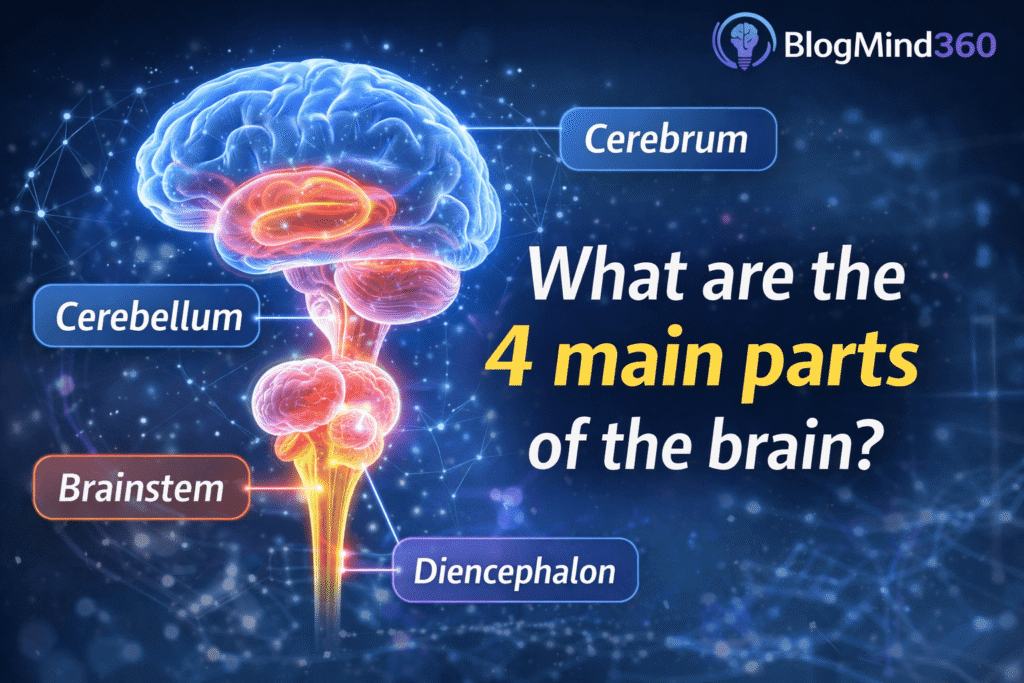
One of the most common questions in neuroscience and biology is: what are the 4 main parts of the brain? These major parts work together to regulate both voluntary and involuntary actions, allowing the human body to function smoothly.
The four main parts of the brain are:
- Cerebrum
- Cerebellum
- Brainstem
- Diencephalon
Each of these brain regions has unique responsibilities, yet they operate together as a highly integrated system. From controlling motor skills and decision making to regulating heart rate and body temperature, these brain parts form the foundation of human intelligence and survival.
The brain contains around 86 billion neurons, which are specialized cells responsible for transmitting electrical signals. These neurons communicate through complex networks that allow us to think, learn, move, and interact with the world around us.
Understanding the four main parts of the brain helps students, medical professionals, and curious learners gain deeper insight into how the nervous system functions.
Why the Brain Is the Most Important Organ
The brain serves as the central command center of the body. It constantly receives information from sensory organs, processes this information, and sends instructions back to different parts of the body.
This process happens within milliseconds, allowing humans to respond quickly to environmental changes.
For example, when you touch something hot, the brain immediately processes the signal and instructs your muscles to pull your hand away. This quick reaction protects the body from injury.
In addition to physical responses, the brain also manages complex mental processes such as:
- Thinking and reasoning
- Memory formation
- Emotional regulation
- Decision making
- Language processing
- Learning new skills
Because the brain controls both conscious and unconscious functions, damage to specific brain areas can significantly affect a person’s abilities.
How the Brain Is Structured
The brain is part of the central nervous system, which also includes the spinal cord. Together, they coordinate communication throughout the body.
Although the brain appears as a single organ, it is actually divided into several specialized regions. Each region performs distinct tasks but communicates continuously with other areas.
The brain is protected by several layers designed to prevent injury.
These protective structures include:
- The skull, which forms a hard outer shell around the brain
- Meninges, which are protective membranes covering the brain
- Cerebrospinal fluid, which cushions the brain and reduces shock
Inside this protective system, the brain is organized into multiple sections responsible for different neurological functions.
Among these sections, the four main parts of the brain play the most fundamental roles in maintaining life and supporting human behavior.
The Importance of Studying Brain Anatomy
Studying brain anatomy is essential for understanding neurological health and medical conditions. Scientists and doctors rely on this knowledge to diagnose and treat brain disorders such as tumors, strokes, epilepsy, and neurodegenerative diseases.
Medical imaging technologies like MRI and CT scans allow doctors to observe different brain regions and detect abnormalities.
Understanding brain structure also helps researchers develop treatments for conditions like Alzheimer’s disease, Parkinson’s disease, and traumatic brain injuries.
Students studying biology, psychology, or neuroscience often begin by learning about the four major brain regions and their functions.
This foundational knowledge helps explain how the brain processes information and controls the body.
Overview of the Four Main Parts of the Brain
Although the brain is made up of many smaller structures, four major parts form the core of its anatomy.
Cerebrum
The cerebrum is the largest and most developed part of the brain. It is responsible for higher thinking processes, voluntary movement, language, and memory.
The cerebrum is divided into two hemispheres and further divided into four lobes that control different functions.
Cerebellum
The cerebellum is located at the back of the brain and plays a critical role in coordination, balance, and motor control. It helps ensure that movements are smooth and precise.
Without the cerebellum, activities like walking, writing, or maintaining balance would be extremely difficult.
Brainstem
The brainstem connects the brain to the spinal cord and controls essential life functions such as breathing, heart rate, blood pressure, and digestion.
Because of its role in survival, the brainstem is one of the most vital parts of the brain.
Diencephalon
The diencephalon is located deep within the brain and includes structures such as the thalamus and hypothalamus. These structures regulate sensory signals, hormone production, body temperature, hunger, and sleep cycles.
Although smaller than other brain regions, the diencephalon plays a critical role in maintaining the body’s internal balance.
How the Four Brain Parts Work Together
While each brain region has specific functions, none of them operate independently. The brain works as a unified system in which different parts communicate constantly.
For example, when you decide to pick up a cup of coffee, several brain regions are involved in the process.
The cerebrum plans and initiates the movement.
The cerebellum coordinates the motion to ensure it is smooth and controlled.
The brainstem regulates breathing and heart rate while the action is performed.
The diencephalon helps process sensory feedback such as the temperature and weight of the cup.
This coordinated activity allows the body to perform complex tasks effortlessly.
Understanding these interactions highlights the remarkable efficiency of the human brain.
The Role of the Brain in Human Intelligence
One of the most fascinating aspects of the brain is its ability to support intelligence, creativity, and problem solving.
Human brains have evolved to handle advanced cognitive functions that allow us to communicate through language, develop technology, and build societies.
The cerebrum plays a major role in these abilities by processing complex information and storing memories.
At the same time, deeper brain structures regulate emotions and instincts that influence human behavior.
This combination of logical reasoning and emotional processing makes the human brain uniquely powerful.
Brain Development Throughout Life
The brain continues to develop from infancy through early adulthood. During childhood and adolescence, neural connections are constantly forming and strengthening.
This process allows children to learn new skills rapidly and adapt to changing environments.
Even in adulthood, the brain maintains the ability to reorganize itself through a process known as neuroplasticity.
Neuroplasticity allows the brain to adapt after injuries or learn new behaviors through repeated practice.
For example, people recovering from brain injuries can sometimes regain lost abilities through rehabilitation therapy.
This remarkable adaptability demonstrates how resilient and dynamic the human brain truly is.
The Beginning of a Deeper Exploration
Now that we understand the importance of the brain and its basic structure, we can explore each of the four main parts of the brain in greater detail.
Each section of the brain performs specialized functions that contribute to overall health, behavior, and cognition.
By examining these regions individually, we gain a clearer understanding of how the brain processes information and controls the body.
The next section will explore the cerebrum, the largest and most advanced part of the brain responsible for thinking, learning, and voluntary movement.
The Cerebrum – The Largest and Most Advanced Part of the Brain
Among the four main parts of the brain, the cerebrum is the largest and most developed structure. It occupies nearly 85 percent of the brain’s total mass and plays a central role in many of the functions that define human intelligence and behavior.
When people ask what are the 4 main parts of the brain, the cerebrum is often the first structure discussed because it controls the majority of conscious activities. It is responsible for thinking, reasoning, memory, language, voluntary movement, and decision making.
The cerebrum allows humans to learn new skills, interpret sensory information, and interact with the environment in complex ways. Without the cerebrum, advanced cognitive functions such as problem solving and emotional processing would not be possible.
Understanding how the cerebrum works provides valuable insight into how the brain processes information and controls human behavior.
Structure of the Cerebrum
The cerebrum is located in the uppermost part of the brain and consists of two large halves known as the left hemisphere and the right hemisphere. These hemispheres are connected by a thick band of nerve fibers called the corpus callosum, which allows the two sides of the brain to communicate with each other.
Each hemisphere controls the opposite side of the body. For example, the left hemisphere controls movement on the right side of the body, while the right hemisphere controls movement on the left side.
Although the hemispheres work together, they often specialize in different functions.
The left hemisphere is generally associated with logical thinking, language processing, and analytical reasoning.
The right hemisphere is more closely linked to creativity, visual perception, and spatial awareness.
Together, these hemispheres form a highly efficient system that supports both logical thinking and creative expression.
The Cerebral Cortex
The outer layer of the cerebrum is known as the cerebral cortex. This thin layer of gray matter contains billions of neurons and is responsible for many higher brain functions.
The cerebral cortex is highly folded, creating ridges and grooves that increase the surface area available for neural activity.
These folds are known as:
- Gyri, which are raised ridges
- Sulci, which are shallow grooves
- Fissures, which are deeper grooves separating large brain regions
The increased surface area allows the brain to accommodate more neurons, which enhances its ability to process complex information.
The cerebral cortex is the area of the brain most closely associated with consciousness, thought, and awareness.
The Four Lobes of the Cerebrum
The cerebrum is divided into four major lobes, each responsible for different functions. These lobes work together to process sensory input, control movement, and manage cognitive processes.
Frontal Lobe
The frontal lobe is located at the front of the brain and is responsible for many high level functions related to personality, planning, and voluntary movement.
This lobe plays a critical role in decision making, problem solving, and emotional regulation.
The frontal lobe also contains the motor cortex, which controls voluntary muscle movements throughout the body.
Damage to the frontal lobe can affect a person’s ability to plan, make decisions, or control impulses.
Functions of the frontal lobe include:
- Planning and reasoning
- Voluntary movement control
- Emotional regulation
- Personality expression
- Problem solving
Because of its role in higher thinking processes, the frontal lobe is considered one of the most important areas of the human brain.
Parietal Lobe
The parietal lobe is located near the upper middle section of the brain. It is primarily responsible for processing sensory information received from the body.
This region interprets signals related to touch, temperature, pain, and spatial awareness.
The parietal lobe allows individuals to understand where their body parts are positioned in relation to their surroundings.
For example, when you close your eyes and touch your nose, the parietal lobe helps coordinate this movement by interpreting sensory signals from your muscles and skin.
Functions of the parietal lobe include:
- Processing touch sensations
- Interpreting pain and temperature signals
- Understanding spatial relationships
- Coordinating sensory information
This lobe is essential for interacting with the physical environment.
Temporal Lobe
The temporal lobe is located on the sides of the brain near the ears. It plays a major role in hearing, memory formation, and language comprehension.
This region contains the auditory cortex, which processes sound signals received from the ears.
The temporal lobe also houses structures involved in memory storage, including the hippocampus.
Because of these functions, the temporal lobe is essential for learning new information and recognizing spoken language.
Functions of the temporal lobe include:
- Processing auditory information
- Language comprehension
- Memory formation
- Recognition of faces and objects
Damage to this area can affect memory and the ability to understand spoken language.
Occipital Lobe
The occipital lobe is located at the back of the brain and is primarily responsible for visual processing.
This region receives information from the eyes and converts it into images that the brain can interpret.
The occipital lobe allows individuals to recognize shapes, colors, and motion.
Without this region, the brain would not be able to interpret visual signals properly.
Functions of the occipital lobe include:
- Processing visual information
- Interpreting color and motion
- Recognizing objects and faces
Even though the eyes capture visual data, it is the occipital lobe that actually allows us to understand what we see.
Communication Within the Cerebrum
The cerebrum functions efficiently because of the vast network of neurons that transmit signals across different brain regions.
These neurons communicate using electrical impulses and chemical messengers called neurotransmitters.
Signals travel through neural pathways at extremely high speeds, allowing the brain to process information almost instantly.
For example, when you read a sentence, several areas of the cerebrum work together simultaneously.
The occipital lobe processes the visual appearance of the text.
The temporal lobe helps interpret the meaning of words.
The frontal lobe evaluates the information and makes decisions based on what you read.
This coordinated activity allows humans to process complex information rapidly.
The Role of the Cerebrum in Learning and Memory
One of the most remarkable abilities of the cerebrum is its role in learning and memory formation.
The brain constantly creates new neural connections when we learn new skills or acquire new information.
These connections strengthen with repeated practice, allowing knowledge to become more deeply embedded in memory.
For example, when someone learns to play a musical instrument, the cerebrum forms new neural pathways that improve coordination and recall of musical patterns.
This ability to adapt and reorganize neural connections is known as neuroplasticity.
Neuroplasticity enables the brain to adjust to new experiences and recover from certain types of injury.
Why the Cerebrum Is Essential for Human Behavior
The cerebrum is responsible for many characteristics that make humans unique among living species.
It allows individuals to think critically, create art, develop language, and solve complex problems.
Many aspects of human culture and society are possible because of the advanced capabilities of the cerebrum.
Without this region, humans would not possess the same level of intelligence, emotional awareness, or creative expression.
The cerebrum works alongside the other main parts of the brain to ensure that both cognitive and physical functions operate smoothly.
Understanding this region provides a deeper appreciation of how the brain supports everyday activities and complex behaviors.
The Cerebellum and Brainstem – Two Essential Parts of the Brain That Control Movement and Survival Functions
To fully understand what are the 4 main parts of the brain, it is important to explore not only the cerebrum but also two other critical structures: the cerebellum and the brainstem. While the cerebrum is responsible for higher thinking and decision making, the cerebellum and brainstem focus on coordination, balance, and vital life sustaining processes.
These two brain regions play a fundamental role in maintaining stability, controlling reflexes, and ensuring that the body continues to function properly without conscious effort.
Many of the body’s most important automatic processes such as breathing, heartbeat regulation, and posture control rely on these areas of the brain.
Although the cerebellum and brainstem are smaller than the cerebrum, they are absolutely essential for survival and daily movement.
The Cerebellum – The Brain’s Coordination Center
The cerebellum is located at the back of the brain, just below the cerebrum and behind the brainstem. Its name comes from Latin and means “little brain.” Despite its smaller size, the cerebellum contains a very high concentration of neurons and plays a vital role in controlling movement and balance.
The cerebellum ensures that body movements are smooth, precise, and well coordinated. It receives information from various parts of the body and fine tunes motor activity so that movements occur efficiently.
Without the cerebellum, simple actions such as walking, reaching for objects, or maintaining posture would become extremely difficult.
Structure of the Cerebellum
The cerebellum is divided into two hemispheres connected by a structure called the vermis. It also contains an outer layer of gray matter known as the cerebellar cortex, which processes signals related to movement and coordination.
Inside the cerebellum are deep structures called cerebellar nuclei, which send signals to other parts of the brain and spinal cord.
The cerebellum is connected to the brainstem through three bundles of nerve fibers known as cerebellar peduncles. These pathways allow the cerebellum to communicate with other brain regions.
Through these connections, the cerebellum receives information about body position, muscle activity, and sensory input.
This continuous communication allows the cerebellum to adjust movements in real time.
Functions of the Cerebellum
The cerebellum performs several important roles that help maintain body coordination and motor control.
Key functions of the cerebellum include:
- Coordinating voluntary movements
- Maintaining balance and posture
- Regulating muscle tone
- Supporting motor learning
- Improving movement precision
For example, when someone learns to ride a bicycle, the cerebellum helps refine balance and coordination through repeated practice.
Over time, the cerebellum allows movements to become automatic and efficient.
Motor Learning and the Cerebellum
One of the most important functions of the cerebellum is motor learning. This process allows the brain to improve movements through repetition and practice.
When someone practices a physical skill such as playing a sport or learning to dance, the cerebellum gradually refines muscle control.
As a result, movements become smoother and require less conscious effort.
Motor learning explains why experienced athletes and musicians are able to perform complex movements with remarkable precision.
Effects of Cerebellum Damage
Damage to the cerebellum can cause several coordination related problems. These problems occur because the brain loses its ability to properly regulate movement.
Common symptoms of cerebellar damage include:
- Difficulty maintaining balance
- Uncoordinated movements
- Tremors during voluntary actions
- Slurred speech
- Difficulty controlling eye movements
These symptoms are collectively known as ataxia, a condition characterized by loss of coordination.
Although the cerebellum does not initiate movement, it plays a critical role in refining and adjusting movements produced by other brain regions.
The Brainstem – The Body’s Life Support System
Another essential part of the brain is the brainstem. The brainstem connects the brain to the spinal cord and serves as a communication pathway between the brain and the rest of the body.
While the cerebrum handles conscious thought, the brainstem manages automatic processes that are necessary for survival.
These processes occur without conscious awareness and continue even during sleep.
Because of its role in regulating vital functions, the brainstem is often referred to as the body’s life support center.
Structure of the Brainstem
The brainstem consists of three main parts:
- Midbrain
- Pons
- Medulla oblongata
Each section performs specific functions that support communication between the brain and the body.
Midbrain
The midbrain is the uppermost part of the brainstem and plays a role in visual and auditory processing.
It helps control eye movement and allows the brain to respond quickly to visual or sound stimuli.
For example, when you suddenly turn your head toward a loud noise, the midbrain is involved in coordinating that reaction.
Pons
The pons is located between the midbrain and the medulla oblongata. It acts as a bridge that connects different parts of the brain.
The pons plays a role in regulating sleep cycles, breathing patterns, and facial movements.
It also helps transmit signals between the cerebrum and the cerebellum.
Medulla Oblongata
The medulla oblongata is the lowest part of the brainstem and controls many of the body’s most vital functions.
These include breathing, heart rate, blood pressure regulation, and swallowing.
Because these functions are essential for survival, severe damage to the medulla can be life threatening.
Vital Functions Controlled by the Brainstem
The brainstem is responsible for regulating several automatic functions that the body must perform continuously.
These include:
- Breathing control
- Heartbeat regulation
- Blood pressure maintenance
- Swallowing reflexes
- Digestive processes
Unlike voluntary actions such as walking or speaking, these functions occur automatically and require no conscious effort.
The brainstem constantly monitors signals from the body and adjusts these processes to maintain stability.
Communication Between Brain and Spinal Cord
Another critical role of the brainstem is transmitting signals between the brain and the spinal cord.
Nerve pathways within the brainstem carry information related to movement, sensation, and reflexes.
For example, when the brain sends a signal to move a muscle, the message travels through the brainstem before reaching the spinal cord and muscles.
Similarly, sensory signals from the body travel upward through the brainstem before reaching the cerebrum for interpretation.
This communication system allows the brain to coordinate complex body movements and respond to environmental changes.
Reflex Actions Controlled by the Brainstem
The brainstem also controls several protective reflexes that help safeguard the body.
These reflexes occur automatically in response to certain stimuli.
Examples include:
- Sneezing
- Coughing
- Vomiting
- Gag reflex
These responses protect the body from harmful substances or airway obstruction.
Because reflexes occur so quickly, they rely on the brainstem rather than higher brain regions.
Importance of the Cerebellum and Brainstem
Although the cerebrum is responsible for conscious thinking and reasoning, the cerebellum and brainstem ensure that the body functions efficiently and safely.
The cerebellum fine tunes movements and maintains balance, while the brainstem regulates life sustaining processes that occur automatically.
Together, these two structures support the body’s ability to move smoothly and maintain essential physiological stability.
Understanding the roles of the cerebellum and brainstem provides a deeper perspective on how the brain coordinates both voluntary and involuntary functions.
The Diencephalon – The Fourth Main Part of the Brain and Its Critical Functions
To fully understand what are the 4 main parts of the brain, the final region that must be explored is the diencephalon. Although it is smaller than the cerebrum and less visible from the outside of the brain, the diencephalon plays a crucial role in maintaining internal balance and regulating many essential body functions.
The diencephalon is located deep within the center of the brain, positioned between the cerebrum and the brainstem. It acts as a communication hub that processes sensory information, regulates hormones, and helps maintain the body’s internal environment.
Despite its compact size, the diencephalon contains several extremely important structures that influence many physical and emotional processes.
The main components of the diencephalon include:
- Thalamus
- Hypothalamus
- Epithalamus
- Subthalamus
Each of these structures contributes to the brain’s ability to regulate sensory signals, control hormonal systems, and maintain homeostasis.
Understanding the diencephalon completes the explanation of the four major parts of the brain and highlights how each region contributes to the overall functioning of the nervous system.
Location and Structure of the Diencephalon
The diencephalon is situated at the core of the brain, surrounded by the two hemispheres of the cerebrum. It lies just above the brainstem and forms a central link between higher brain structures and lower neural pathways.
This strategic location allows the diencephalon to serve as an important relay center for information traveling throughout the brain.
Many signals traveling from the sensory organs to the cerebral cortex must pass through the diencephalon before reaching their final destination.
Because of this role, the diencephalon is essential for organizing and directing sensory input.
The structures within the diencephalon are responsible for processing a wide range of neurological signals related to touch, vision, hearing, and internal body regulation.
The Thalamus – The Brain’s Sensory Relay Station
One of the most significant structures within the diencephalon is the thalamus. The thalamus functions as the brain’s primary relay center for sensory information.
Almost all sensory signals entering the brain pass through the thalamus before reaching the cerebral cortex.
This process allows the brain to filter, prioritize, and interpret incoming sensory data.
The thalamus helps process signals related to:
- Touch
- Pain
- Temperature
- Vision
- Hearing
- Body position
By directing sensory signals to the correct regions of the cerebral cortex, the thalamus ensures that the brain can interpret external stimuli accurately.
For example, when you touch an object, sensory receptors in your skin send signals to the thalamus. The thalamus then forwards these signals to the appropriate area of the cerebral cortex for interpretation.
This relay function allows the brain to quickly understand and respond to environmental stimuli.
The Hypothalamus – Regulating the Body’s Internal Balance
Another vital structure within the diencephalon is the hypothalamus. Although it is only about the size of an almond, the hypothalamus plays a powerful role in regulating many essential bodily functions.
The hypothalamus is responsible for maintaining homeostasis, which is the body’s ability to maintain stable internal conditions despite changes in the external environment.
The hypothalamus controls several critical processes, including:
- Body temperature regulation
- Hunger and appetite
- Thirst and water balance
- Hormone production
- Emotional responses
- Sleep cycles
The hypothalamus works closely with the endocrine system, particularly through its connection with the pituitary gland, which is often referred to as the master gland of the endocrine system.
Through this connection, the hypothalamus helps regulate hormone levels throughout the body.
Hormones controlled by the hypothalamus influence growth, metabolism, stress responses, and reproductive functions.
The Epithalamus – Regulating Sleep and Biological Rhythms
The epithalamus is another important structure within the diencephalon. This region includes the pineal gland, which produces the hormone melatonin.
Melatonin plays a crucial role in regulating the body’s circadian rhythm, also known as the sleep wake cycle.
The pineal gland releases melatonin in response to darkness, helping signal the body that it is time to sleep.
When light levels increase, melatonin production decreases, helping the body transition to wakefulness.
This cycle helps maintain healthy sleep patterns and supports overall brain function.
Disruptions in melatonin production can lead to sleep disorders and other health issues.
The Subthalamus – Supporting Motor Control
The subthalamus is another smaller but important part of the diencephalon. It plays a role in regulating motor control and movement coordination.
The subthalamus interacts with structures in the basal ganglia, which are responsible for controlling voluntary movements.
These connections help ensure that movements occur smoothly and without unnecessary muscle activity.
Damage to the subthalamus can contribute to movement disorders such as tremors or involuntary muscle contractions.
Although the subthalamus is less commonly discussed than other brain structures, it plays an important role in maintaining proper motor function.
How the Four Main Parts of the Brain Work Together
Now that all four major brain regions have been explored, it becomes easier to understand how they function as a coordinated system.
The four main parts of the brain are:
- Cerebrum
- Cerebellum
- Brainstem
- Diencephalon
Each region has specialized responsibilities, but they constantly communicate with one another through neural pathways.
For example, when a person decides to pick up a cup of coffee, several brain regions become involved.
The cerebrum plans the movement and sends signals to the muscles.
The cerebellum coordinates the motion to ensure the hand moves smoothly and accurately.
The brainstem maintains breathing and heart rate during the activity.
The diencephalon processes sensory feedback such as temperature and weight of the cup.
This coordinated interaction allows the body to perform complex tasks efficiently.
Importance of Understanding Brain Structure
Learning about the four main parts of the brain is essential for understanding how the nervous system functions.
This knowledge helps doctors diagnose neurological disorders and develop treatments for conditions that affect brain function.
Medical professionals rely on detailed knowledge of brain anatomy when performing procedures such as brain imaging, neurosurgery, and neurological assessments.
Students studying biology, psychology, and medicine also benefit from understanding brain structure because it provides insight into how behavior and cognition are controlled.
The brain’s remarkable complexity demonstrates how specialized structures can work together to support life, intelligence, and emotional experiences.
The Brain’s Ability to Adapt
One of the most fascinating characteristics of the brain is its ability to adapt through a process called neuroplasticity.
Neuroplasticity allows the brain to reorganize its neural connections in response to learning, experience, or injury.
This means that even if certain brain regions are damaged, other parts of the brain can sometimes take over lost functions.
Rehabilitation therapies often rely on neuroplasticity to help patients recover from strokes or brain injuries.
This adaptability highlights the resilience and flexibility of the human brain.
Frequently Asked Questions
What are the 4 main parts of the brain
The four main parts of the brain are the cerebrum, cerebellum, brainstem, and diencephalon. Each of these regions performs specific functions that help regulate movement, sensory processing, and vital body processes.
Which part of the brain is the largest
The cerebrum is the largest part of the brain and is responsible for higher cognitive functions such as thinking, reasoning, memory, and voluntary movement.
What does the cerebellum control
The cerebellum controls balance, coordination, and fine motor movements. It helps ensure that body movements are smooth and precise.
Why is the brainstem important
The brainstem regulates essential life functions including breathing, heart rate, and blood pressure. It also serves as the connection between the brain and the spinal cord.
What does the diencephalon do
The diencephalon processes sensory signals, regulates hormones, and helps maintain internal balance through structures such as the thalamus and hypothalamus.
How do the four brain parts work together
The four brain regions communicate constantly through neural pathways. This coordination allows the brain to control both voluntary actions like movement and involuntary processes such as breathing.
Can the brain repair itself
The brain has a limited ability to repair itself through neuroplasticity. This process allows healthy brain regions to adapt and compensate for certain types of injury.