
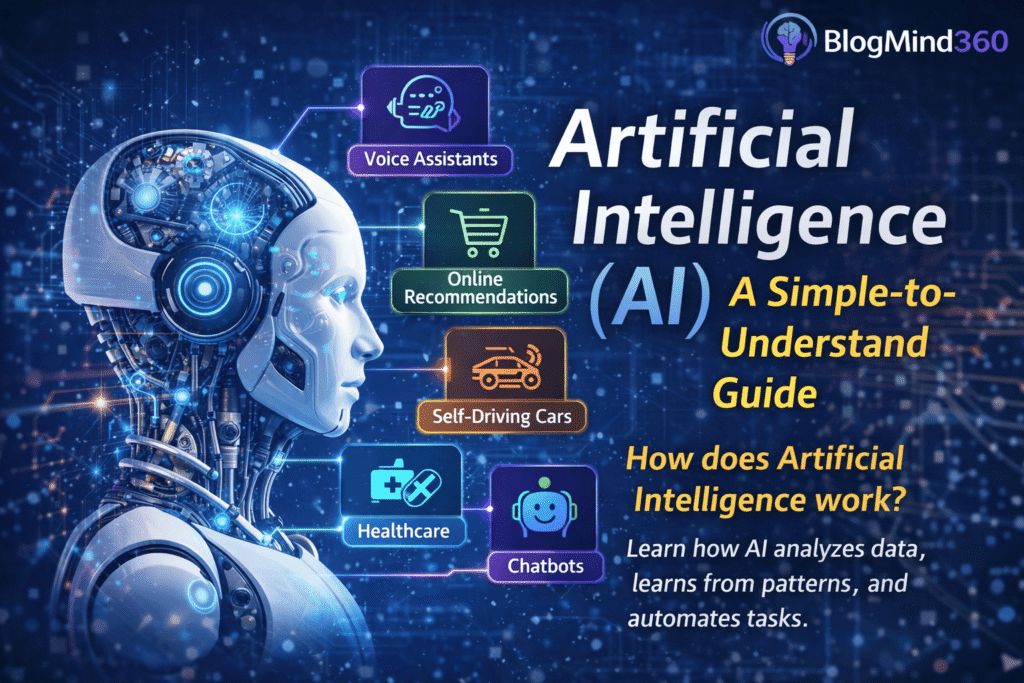
Introduction to Artificial Intelligence (AI) – A Simple-to-Understand Guide
Artificial Intelligence, commonly known as AI, is one of the most transformative technologies of the modern world. From voice assistants and recommendation systems to self-driving cars and medical diagnostics, AI is rapidly changing the way people interact with technology and the digital environment.
When people search for artificial intelligence (AI): a simple-to-understand guide, they are usually looking for a clear explanation of what AI is, how it works, and why it is becoming such an important part of everyday life.
In simple terms, artificial intelligence refers to computer systems designed to perform tasks that normally require human intelligence. These tasks include learning from experience, recognizing patterns, understanding language, making decisions, and solving problems.
Although AI may seem like a futuristic concept, it is already integrated into many of the tools and services we use every day.
Understanding artificial intelligence does not require advanced technical knowledge. With the right explanation, anyone can grasp the basic ideas behind how AI systems function and why they are becoming increasingly important.
What Is Artificial Intelligence
Artificial intelligence is a branch of computer science focused on creating machines or software that can simulate human intelligence.
Unlike traditional computer programs that follow fixed instructions, AI systems are capable of learning from data and improving their performance over time.
This ability to learn and adapt is what makes AI different from conventional software.
For example, a traditional program might follow strict rules to process information, but an AI system can analyze patterns in large datasets and make predictions based on those patterns.
This allows AI to perform tasks such as recognizing images, understanding spoken language, and recommending personalized content.
A Simple Definition of Artificial Intelligence
A simple way to define artificial intelligence is:
Artificial intelligence is the ability of a computer system to perform tasks that typically require human intelligence.
These tasks may include:
- Learning from experience
- Recognizing speech and images
- Understanding language
- Making decisions based on data
- Solving complex problems
Because AI systems can analyze massive amounts of data quickly, they are often used in situations where humans would struggle to process information efficiently.
Why Artificial Intelligence Is Important
Artificial intelligence is important because it allows computers to perform tasks faster, more accurately, and often more efficiently than humans.
Businesses, governments, and researchers use AI to solve problems that would otherwise require enormous amounts of time and resources.
Some key reasons why AI is becoming increasingly important include:
- Ability to process large amounts of data
- Automation of repetitive tasks
- Improved decision making through data analysis
- Faster problem solving
- Enhanced efficiency in many industries
These benefits have led to the rapid adoption of AI technologies in sectors such as healthcare, finance, transportation, education, and entertainment.
Examples of Artificial Intelligence in Everyday Life
Many people interact with AI systems without even realizing it. AI technologies are embedded in a wide range of everyday tools and services.
Some common examples include:
Voice Assistants
Digital assistants such as Siri, Alexa, and Google Assistant use artificial intelligence to understand spoken commands and respond to user requests.
These systems rely on natural language processing to interpret human speech and provide useful information.
Recommendation Systems
Streaming services like Netflix and Spotify use AI algorithms to recommend movies, shows, and music based on user preferences and viewing history.
These recommendation systems analyze large amounts of data to identify patterns in user behavior.
Email Spam Filters
AI powered spam filters automatically identify and block unwanted emails by analyzing patterns in email content and sender behavior.
This helps keep inboxes organized and protects users from malicious messages.
Navigation and Maps
Navigation applications such as Google Maps use AI to analyze traffic patterns and provide the fastest routes to destinations.
These systems continuously update route suggestions based on real time traffic conditions.
Online Shopping Suggestions
E commerce platforms use AI to recommend products based on browsing behavior, purchase history, and similar customer preferences.
These recommendations help users discover products that match their interests.
How Artificial Intelligence Works
Artificial intelligence systems operate by analyzing data and identifying patterns within that data.
Instead of relying on fixed instructions, AI algorithms learn from examples and adjust their behavior based on new information.
The basic process of AI typically involves three key components:
Data
AI systems require large amounts of data to learn and improve their performance.
For example, an AI system designed to recognize images must be trained using thousands or even millions of labeled images.
Algorithms
Algorithms are sets of instructions that allow AI systems to analyze data and identify patterns.
These algorithms determine how the AI system processes information and makes predictions.
Computing Power
AI systems often require significant computing power to process large datasets and perform complex calculations.
Advances in computing technology have made it possible to train AI systems much faster than in the past.
The Difference Between AI and Traditional Programming
Traditional computer programs follow explicit instructions written by programmers. These programs perform tasks according to predefined rules.
Artificial intelligence works differently.
Instead of relying solely on fixed rules, AI systems learn from data and adapt their behavior over time.
For example, a traditional program might use strict rules to identify spam emails. In contrast, an AI powered spam filter learns from millions of email examples and continuously improves its ability to detect unwanted messages.
This learning capability allows AI systems to handle more complex problems than traditional software.
The Origins of Artificial Intelligence
The concept of artificial intelligence dates back several decades. Early researchers believed that computers could eventually simulate human intelligence.
The term artificial intelligence was first introduced in the 1950s during a conference at Dartmouth College in the United States.
Scientists at the time began exploring ways to create machines that could mimic human thinking processes.
Although early AI systems were limited by computing power and data availability, advances in technology have greatly expanded the capabilities of AI.
Today, artificial intelligence is one of the fastest growing fields in computer science.
The Rapid Growth of AI Technology
In recent years, artificial intelligence has experienced rapid development due to improvements in computing power, data availability, and machine learning algorithms.
Large technology companies invest billions of dollars each year in AI research and development.
This investment has led to breakthroughs in areas such as:
- Medical image analysis
- Self driving vehicles
- Language translation systems
- Fraud detection in banking
- Personalized digital assistants
As AI technology continues to evolve, its impact on society will likely expand even further.
The Goal of Artificial Intelligence
The ultimate goal of artificial intelligence is to create systems capable of performing tasks that require human intelligence while operating efficiently and reliably.
Researchers continue to explore ways to make AI systems more accurate, adaptable, and capable of understanding complex information.
Some scientists believe that future AI systems may eventually reach levels of intelligence comparable to human cognition.
However, current AI technologies are primarily focused on specialized tasks rather than general intelligence.
Preparing to Explore Artificial Intelligence in More Detail
Now that we have introduced the basic concept of artificial intelligence, the next sections will explore how AI systems actually learn, the different types of AI technologies, and how these systems are transforming industries around the world.
How Artificial Intelligence Works and the Main Types of AI
After understanding the basic idea of artificial intelligence (AI), the next important step is learning how AI systems actually work. Many people imagine AI as something extremely complicated, but the core concept behind AI is quite simple.
Artificial intelligence works by analyzing large amounts of data, identifying patterns, and making predictions or decisions based on those patterns. Instead of being programmed with strict instructions for every situation, AI systems learn from experience and improve their performance over time.
This learning ability is what allows AI systems to perform complex tasks such as recognizing faces, understanding speech, translating languages, and recommending products.
In this section of the artificial intelligence (AI): a simple-to-understand guide, we will explore how AI works, the main technologies behind it, and the different types of AI used today.
The Basic Process Behind Artificial Intelligence
Artificial intelligence systems typically follow a structured process to analyze information and generate useful results. Although different AI applications may use different methods, most systems rely on three fundamental components.
Data
Data is the foundation of every AI system. Without data, AI cannot learn or make decisions.
AI models are trained using large datasets that contain examples related to the task they are designed to perform. For example, an AI system designed to recognize cats in images must first be trained using thousands or even millions of labeled images of cats.
The more high-quality data an AI system receives, the better it can learn and improve its accuracy.
Algorithms
Algorithms are mathematical instructions that allow AI systems to analyze data and detect patterns.
These algorithms guide the learning process by determining how the AI interprets information and makes predictions.
Different types of algorithms are used depending on the task. Some algorithms specialize in recognizing patterns in images, while others focus on understanding language or predicting future outcomes.
Computing Power
Artificial intelligence requires powerful computers capable of processing massive amounts of information quickly.
Modern AI systems often rely on advanced processors and cloud computing to perform complex calculations in a short amount of time.
Advances in computing power have played a major role in the rapid development of AI technologies in recent years.
Machine Learning: The Core of Modern AI
One of the most important technologies behind artificial intelligence is machine learning.
Machine learning is a method that allows computers to learn from data without being explicitly programmed for every situation.
Instead of following strict rules written by programmers, machine learning models analyze data and gradually learn patterns that help them make predictions.
For example, a machine learning system designed to detect fraudulent credit card transactions analyzes thousands of past transactions. By studying patterns in legitimate and fraudulent transactions, the system learns how to identify suspicious activity.
Over time, the system becomes more accurate as it processes more data.
Machine learning is used in many AI applications including recommendation systems, image recognition, and predictive analytics.
Types of Machine Learning
Machine learning can be divided into several categories depending on how the system learns from data.
Supervised Learning
Supervised learning is one of the most common machine learning approaches. In this method, AI models are trained using labeled datasets.
A labeled dataset contains input data along with the correct answers.
For example, an AI model trained to recognize animals might receive images labeled as cat, dog, bird, or horse.
The system studies these examples and learns how to classify new images based on the patterns it observed during training.
Supervised learning is commonly used in applications such as image recognition, speech recognition, and medical diagnosis.
Unsupervised Learning
Unsupervised learning works differently from supervised learning. Instead of using labeled data, the AI system analyzes data and identifies patterns on its own.
This method is often used for tasks such as clustering and data analysis.
For example, an unsupervised learning system might analyze customer purchasing behavior and group customers with similar buying patterns together.
Businesses use this information to improve marketing strategies and product recommendations.
Reinforcement Learning
Reinforcement learning is a machine learning approach in which AI systems learn through trial and error.
The system interacts with an environment and receives feedback based on its actions.
Positive outcomes result in rewards, while negative outcomes result in penalties.
Over time, the AI learns which actions lead to the best results.
Reinforcement learning is used in applications such as robotics, video games, and self driving cars.
Deep Learning and Neural Networks
Another important area of artificial intelligence is deep learning, a specialized form of machine learning that uses structures called neural networks.
Neural networks are inspired by the way the human brain processes information. They consist of layers of interconnected nodes that analyze data and extract patterns.
Deep learning models are particularly effective at handling complex tasks such as image recognition, speech recognition, and natural language processing.
For example, deep learning algorithms power technologies such as facial recognition systems and voice assistants.
These systems analyze vast amounts of data and learn to recognize patterns that help them perform specific tasks accurately.
Natural Language Processing
Natural language processing, often abbreviated as NLP, is a branch of AI focused on enabling computers to understand and interpret human language.
NLP allows machines to process spoken or written text and generate meaningful responses.
This technology is used in applications such as:
- Voice assistants
- Chatbots
- Language translation tools
- Text analysis software
Natural language processing combines machine learning and linguistic analysis to interpret language in a way that computers can understand.
As NLP technology continues to improve, machines are becoming better at understanding context and responding to human communication.
Computer Vision
Computer vision is another major area of artificial intelligence. This technology enables machines to interpret and analyze visual information from images or videos.
Computer vision systems are used in many modern applications including facial recognition, medical imaging analysis, and autonomous vehicles.
For example, self driving cars rely on computer vision to detect pedestrians, traffic signs, and other vehicles on the road.
By analyzing visual data in real time, AI systems can make decisions that help guide vehicle movement safely.
Types of Artificial Intelligence
Artificial intelligence can also be classified based on its level of capability.
Narrow AI
Most AI systems used today are considered narrow AI, also known as weak AI.
Narrow AI is designed to perform a specific task, such as recognizing speech or recommending products.
Examples of narrow AI include:
- Voice assistants
- Recommendation algorithms
- Image recognition software
- Fraud detection systems
Although narrow AI can perform certain tasks extremely well, it cannot perform tasks outside its specialized area.
General AI
General AI refers to a theoretical type of artificial intelligence that would have the ability to perform any intellectual task that a human can perform.
Unlike narrow AI, general AI would possess reasoning abilities, learning capabilities, and problem solving skills across a wide range of fields.
At present, general AI does not exist, and researchers continue to explore whether it is possible to develop such systems in the future.
Superintelligent AI
Superintelligent AI is a hypothetical concept describing an AI system that surpasses human intelligence in nearly every domain.
Such systems could potentially solve complex problems far beyond human capability.
However, superintelligent AI remains purely theoretical and has not yet been developed.
Why Artificial Intelligence Is Advancing So Quickly
Several factors have contributed to the rapid advancement of AI technology.
One major factor is the availability of large datasets generated through digital platforms and online activity.
Another factor is the development of powerful computing systems capable of processing enormous amounts of information.
In addition, improvements in machine learning algorithms have made AI models more efficient and accurate.
Together, these advancements have enabled artificial intelligence to expand into many new industries and applications.
Real-World Applications of Artificial Intelligence (AI)
Artificial intelligence is no longer just a futuristic idea. Today, AI technologies are used across many industries and everyday applications. From healthcare and finance to transportation and entertainment, artificial intelligence is helping businesses and organizations solve complex problems, improve efficiency, and create smarter systems.
In this section of artificial intelligence (AI): a simple-to-understand guide, we will explore how AI is used in real life and how it is transforming industries around the world.
Understanding these real-world applications helps explain why artificial intelligence has become one of the most important technological developments of the 21st century.
Artificial Intelligence in Healthcare
One of the most impactful uses of AI is in healthcare. Medical professionals and researchers are increasingly using artificial intelligence to analyze medical data, assist with diagnoses, and develop personalized treatment plans.
AI systems can process large amounts of medical data much faster than humans. This ability allows doctors to detect diseases earlier and make more accurate diagnoses.
Some common healthcare applications of AI include:
- Medical image analysis for detecting tumors and abnormalities
- Predicting disease risks using patient data
- Personalized treatment recommendations
- Drug discovery and medical research
- Virtual health assistants for patients
For example, AI-powered systems can analyze X-rays or MRI scans to identify signs of diseases such as cancer. These systems help doctors detect conditions earlier and improve patient outcomes.
AI is also being used to accelerate the development of new medicines by analyzing chemical compounds and predicting how they interact with the human body.
Artificial Intelligence in Finance
The finance industry relies heavily on artificial intelligence to analyze financial data, detect fraud, and manage risk.
Banks and financial institutions use AI algorithms to monitor transactions and identify suspicious activities that may indicate fraud.
AI systems can analyze millions of transactions in real time and flag unusual patterns that human analysts might miss.
Some major AI applications in finance include:
- Fraud detection and prevention
- Algorithmic trading
- Credit risk assessment
- Automated customer service
- Financial forecasting
For example, when a bank detects an unusual transaction on a credit card, AI systems can automatically flag the activity and alert the account holder.
AI-powered chatbots are also widely used by banks to assist customers with common inquiries and support requests.
Artificial Intelligence in Transportation
Transportation is another field where artificial intelligence is making significant progress. AI technologies are being used to improve traffic management, enhance vehicle safety, and develop autonomous vehicles.
Self-driving cars rely on AI systems that combine computer vision, machine learning, and sensor data to navigate roads and avoid obstacles.
These systems analyze information from cameras, radar, and other sensors to understand the surrounding environment.
Applications of AI in transportation include:
- Self-driving vehicles
- Traffic prediction systems
- Route optimization for logistics
- Smart traffic signals
- Driver assistance systems
Navigation apps such as Google Maps also use AI to analyze traffic patterns and provide the fastest routes for drivers.
By processing real-time traffic data, AI systems can help reduce congestion and improve travel efficiency.
Artificial Intelligence in Education
Artificial intelligence is also transforming the education sector by providing personalized learning experiences and improving access to educational resources.
AI-powered learning platforms can analyze student performance and adapt lesson plans based on individual learning needs.
This allows students to progress at their own pace and receive targeted support in areas where they need improvement.
AI applications in education include:
- Personalized learning platforms
- Automated grading systems
- Virtual tutors and teaching assistants
- Educational data analysis
- Language learning applications
For example, language learning apps use AI to analyze pronunciation and provide instant feedback to help students improve their speaking skills.
AI systems can also help teachers identify students who may need additional support.
Artificial Intelligence in E-Commerce
E-commerce companies use artificial intelligence to enhance customer experiences and optimize business operations.
AI systems analyze user behavior, browsing history, and purchase patterns to provide personalized product recommendations.
This technology helps customers discover products they are likely to be interested in.
Examples of AI in e-commerce include:
- Product recommendation engines
- Personalized marketing campaigns
- Inventory management systems
- Customer service chatbots
- Demand forecasting
Large online retailers rely on AI to predict which products customers are likely to purchase and ensure those products are available in warehouses.
AI-powered chatbots also help customers find products, answer questions, and track orders.
Artificial Intelligence in Entertainment
The entertainment industry uses AI to personalize content recommendations and create engaging experiences for users.
Streaming platforms such as Netflix, YouTube, and Spotify rely on AI algorithms to analyze user preferences and recommend movies, videos, or music.
These recommendation systems analyze factors such as viewing history, ratings, and user interactions.
AI applications in entertainment include:
- Content recommendation systems
- Music and video suggestions
- Video game AI opponents
- Content moderation on social media
- Automated video editing tools
AI is also being used to generate digital art, compose music, and assist in video production.
These technologies are opening new possibilities for creativity and digital storytelling.
Artificial Intelligence in Customer Service
Many companies now use AI-powered chatbots and virtual assistants to provide customer support.
These systems use natural language processing to understand customer questions and provide helpful responses.
Chatbots can answer common questions, guide users through troubleshooting steps, and even process transactions.
Benefits of AI in customer service include:
- Faster response times
- 24-hour customer support
- Reduced operational costs
- Improved customer satisfaction
While AI chatbots handle routine inquiries, human support agents can focus on more complex issues.
Artificial Intelligence in Manufacturing
Manufacturing companies use AI to improve production efficiency and monitor equipment performance.
AI-powered systems can analyze data from machines and predict when maintenance is needed.
This approach, known as predictive maintenance, helps prevent equipment failures and reduce downtime.
AI applications in manufacturing include:
- Quality control through computer vision
- Predictive maintenance systems
- Automated robotics
- Production optimization
- Supply chain management
These technologies allow manufacturers to improve productivity and reduce operational costs.
Artificial Intelligence in Cybersecurity
Cybersecurity is another area where AI plays a crucial role. As cyber threats become more sophisticated, organizations use AI to detect and prevent security breaches.
AI systems can monitor network activity and identify unusual patterns that may indicate cyber attacks.
Because AI systems can analyze massive datasets quickly, they are able to detect threats much faster than traditional security methods.
Applications of AI in cybersecurity include:
- Threat detection and analysis
- Malware identification
- Network monitoring
- Fraud prevention
AI-powered security systems help protect sensitive data and reduce the risk of cyber attacks.
Artificial Intelligence in Smart Homes
Artificial intelligence is also widely used in smart home technology.
Smart devices such as thermostats, lighting systems, and security cameras use AI to learn user preferences and automate household tasks.
For example, a smart thermostat can analyze temperature preferences and adjust heating or cooling automatically.
Examples of AI in smart homes include:
- Voice controlled assistants
- Smart security systems
- Automated lighting systems
- Energy management tools
These technologies improve convenience, energy efficiency, and home security.
The Growing Impact of Artificial Intelligence
The widespread adoption of AI technologies is reshaping how industries operate and how people interact with digital systems.
As AI systems continue to improve, their applications will expand into new areas of business, science, and everyday life.
Organizations around the world are investing heavily in AI research and development to remain competitive in an increasingly technology-driven economy.
Benefits, Challenges, and the Future of Artificial Intelligence (AI)
Artificial intelligence has already transformed many aspects of modern life. From healthcare and finance to transportation and entertainment, AI technologies are improving efficiency, automating tasks, and helping humans make better decisions.
However, while AI offers many advantages, it also presents challenges and ethical questions that society must carefully consider. Understanding both the benefits and risks of artificial intelligence helps provide a balanced view of how this technology will shape the future.
In this final section of artificial intelligence (AI): a simple-to-understand guide, we will explore the major benefits of AI, the potential challenges it creates, and how AI may evolve in the coming years.
Benefits of Artificial Intelligence
Artificial intelligence offers many advantages that make it valuable for businesses, researchers, and everyday users. These benefits come from AI’s ability to analyze large amounts of data quickly and perform tasks with high accuracy.
Increased Efficiency and Productivity
One of the biggest benefits of AI is its ability to automate repetitive tasks. Machines powered by AI can perform certain activities much faster than humans while maintaining consistent performance.
For example, AI systems can analyze large datasets, process customer requests, and manage complex logistics operations with minimal human intervention.
By automating routine tasks, organizations can focus more resources on innovation and strategic planning.
Improved Decision Making
AI systems can analyze massive amounts of data to identify patterns and trends. This allows businesses and researchers to make more informed decisions based on accurate insights.
For example, companies can use AI to predict customer behavior, forecast market trends, and optimize supply chains.
In healthcare, AI tools can help doctors analyze medical records and identify potential health risks earlier.
Accuracy and Error Reduction
AI systems are designed to perform tasks with high precision. When properly trained, AI can reduce the likelihood of human error in areas such as financial analysis, manufacturing processes, and medical diagnostics.
For instance, AI-powered image recognition systems can detect small abnormalities in medical scans that might be difficult for the human eye to identify.
This improved accuracy can lead to better outcomes in many industries.
24-Hour Availability
Unlike humans, AI systems can operate continuously without fatigue. This makes AI particularly useful for tasks that require constant monitoring or customer interaction.
Many businesses use AI-powered chatbots to provide round-the-clock customer support.
Similarly, cybersecurity systems powered by AI can monitor networks continuously to detect potential threats.
Personalization of Services
AI technology allows companies to deliver highly personalized experiences to users.
Streaming platforms recommend movies and music based on viewing history, while e-commerce websites suggest products tailored to individual preferences.
This level of personalization improves user satisfaction and engagement.
Challenges and Concerns of Artificial Intelligence
While artificial intelligence offers significant advantages, it also raises important concerns that must be addressed as the technology continues to develop.
Job Displacement
One of the most widely discussed concerns about AI is the possibility of job displacement.
As AI systems automate tasks that were traditionally performed by humans, certain types of jobs may become less common.
For example, automated systems may reduce the need for manual data entry, assembly line work, or basic customer service roles.
However, many experts believe that AI will also create new job opportunities in areas such as technology development, data science, and AI system management.
Ethical Considerations
AI systems must be designed carefully to ensure fairness and ethical decision making.
If AI models are trained on biased data, they may produce biased outcomes. This can lead to unfair treatment in areas such as hiring, lending, or law enforcement.
Researchers and policymakers are working to develop guidelines that ensure AI systems are transparent, accountable, and fair.
Privacy and Data Security
Artificial intelligence relies heavily on large datasets, which often include personal information.
Ensuring that user data is protected and used responsibly is an important challenge.
Organizations must implement strong data security measures to prevent misuse or unauthorized access to sensitive information.
Dependence on Technology
As AI systems become more integrated into daily life, society may become increasingly dependent on technology.
This raises questions about how humans will maintain control over automated systems and ensure that technology continues to serve human interests.
Maintaining a balance between technological advancement and human oversight will be important in the future.
The Future of Artificial Intelligence
Artificial intelligence is still evolving, and researchers continue to explore new possibilities for this technology.
In the coming years, AI is expected to play an even greater role in shaping industries, scientific research, and everyday life.
Several emerging trends highlight the potential future of artificial intelligence.
Advanced Healthcare Solutions
AI technologies are expected to improve medical research and treatment development.
Researchers are using AI to analyze genetic data, discover new medicines, and develop personalized treatment strategies for patients.
These advancements could significantly improve healthcare outcomes.
Autonomous Systems
Self-driving vehicles, automated drones, and intelligent robots are likely to become more common as AI technology advances.
These systems may help improve transportation safety, logistics efficiency, and industrial automation.
Smart Cities
AI may help cities manage resources more efficiently by optimizing traffic flow, reducing energy consumption, and improving public safety systems.
Smart city technologies could lead to more sustainable urban environments.
Human-AI Collaboration
Rather than replacing humans, many experts believe that the future of AI will involve collaboration between humans and intelligent machines.
AI systems can assist humans by analyzing complex information and providing insights, while humans contribute creativity, judgment, and emotional understanding.
This collaboration could lead to major breakthroughs in science, medicine, and technology.
Responsible Development of AI
As artificial intelligence continues to advance, responsible development will be essential.
Governments, researchers, and technology companies are working together to create guidelines that promote safe and ethical AI use.
These efforts focus on ensuring transparency, protecting user privacy, and preventing misuse of AI technologies.
Developing AI responsibly will help ensure that its benefits are shared widely across society.
Final Thoughts
Artificial intelligence is rapidly transforming the world by enabling machines to perform tasks that once required human intelligence.
By understanding artificial intelligence (AI): a simple-to-understand guide, we gain insight into how this technology works, where it is used, and how it may shape the future.
While AI offers powerful benefits, responsible development and ethical considerations will be essential as the technology continues to evolve.
Frequently Asked Questions
1. What is artificial intelligence in simple words
Artificial intelligence, or AI, refers to computer systems that can perform tasks normally requiring human intelligence. These tasks include learning from data, recognizing patterns, understanding language, and making decisions.
2. What are some common examples of artificial intelligence
Common examples of AI include voice assistants, recommendation systems on streaming platforms, self driving cars, facial recognition technology, and AI powered chatbots used in customer service.
3. How does artificial intelligence learn
Artificial intelligence learns through machine learning. AI systems analyze large amounts of data, identify patterns, and improve their performance over time based on the information they process.
4. What are the main types of artificial intelligence
There are three main types of artificial intelligence:
- Narrow AI designed for specific tasks
- General AI which would perform any intellectual task like humans
- Superintelligent AI which would surpass human intelligence
Currently, most AI systems are narrow AI.
5. Is artificial intelligence the same as machine learning
No. Machine learning is a part of artificial intelligence. AI is the broader concept of machines performing intelligent tasks, while machine learning focuses on systems that learn from data.
6. Where is artificial intelligence used today
Artificial intelligence is used in many industries including healthcare, finance, transportation, education, manufacturing, cybersecurity, and online shopping platforms.
7. Can artificial intelligence replace human jobs
Artificial intelligence may automate certain tasks, but it is also expected to create new jobs in fields such as data science, robotics, AI development, and technology management.
8. Is artificial intelligence safe
AI can be safe when developed responsibly. Governments and technology companies are working to create regulations and ethical guidelines to ensure AI systems are used safely and fairly.
9. How does artificial intelligence affect everyday life
AI affects daily life through services such as voice assistants, online recommendations, navigation apps, smart home devices, and automated customer support systems.
10. What is the future of artificial intelligence
The future of AI includes advancements in healthcare diagnostics, autonomous vehicles, smart cities, personalized education systems, and improved human machine collaboration.
11. Can artificial intelligence think like humans
Current AI systems cannot think like humans. They analyze data and follow algorithms but do not have emotions, consciousness, or independent reasoning abilities like people.
12. Why is artificial intelligence important for the future
Artificial intelligence is important because it helps solve complex problems, improves efficiency across industries, supports innovation, and enables new technologies that can improve quality of life.