| Quick Answer
On August 10, 2026, Aptoide Games became the first third-party app store to be listed directly inside the Google Play Store in the United States, ending more than a decade in which rival Android stores were only accessible through sideloading. The change is the result of a 2024 US court ruling in Google’s antitrust case with Epic Games, implemented through Google’s new Play Catalog Access Program launched July 22, 2026. Users can now search for Aptoide Games in Play, tap install, and get a second app store — no APK files or security warnings required. |
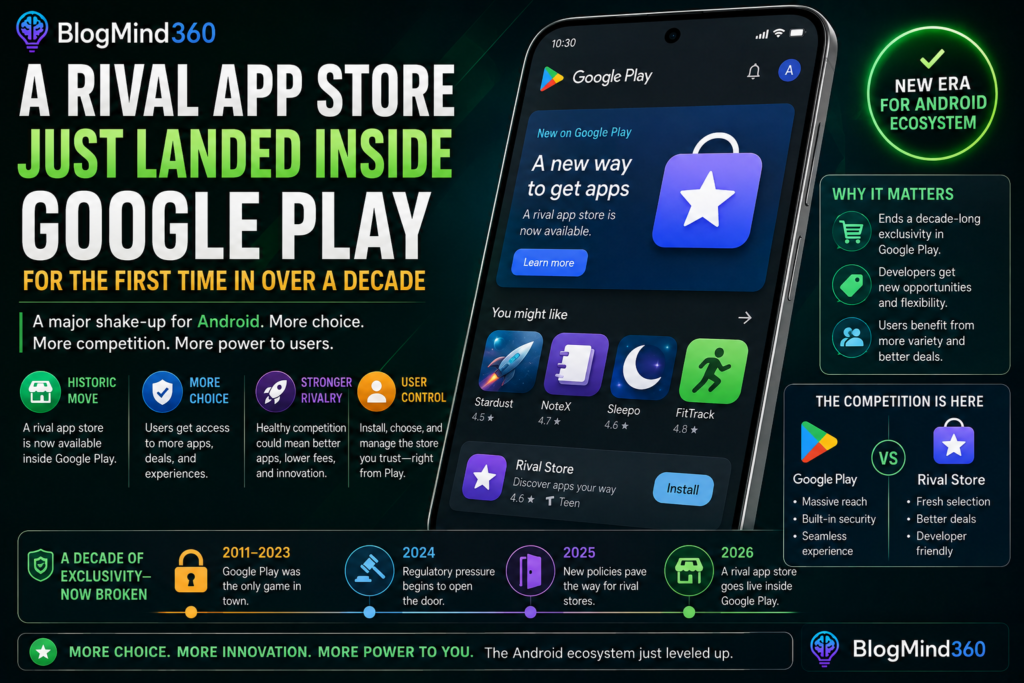
For more than ten years, trying a rival Android app store meant hunting down an APK file, dismissing a string of security warnings, and hoping you trusted the source enough to sideload it. As of this week, that friction is gone — at least for one store. Aptoide Games is now sitting right inside the Google Play Store itself, searchable and installable in a couple of taps, just like any other app.
It’s a small download on the surface, but it’s the first visible result of a six-year antitrust fight that could reshape how Android users discover and install apps going forward. Here’s what actually changed, why it took this long, and what it means for the apps you use every day.
What Actually Happened
Aptoide, a Portuguese app distributor founded in 2009, launched Aptoide Games — its mobile gaming marketplace — as a listing inside the US Google Play Store on August 10, 2026. Aptoide claims around 25 million monthly active users globally and a catalog of more than 400,000 Android applications, with the United States as its largest market.
What makes this notable isn’t that a third-party Android store exists — alternative stores have always technically been available on Android, unlike the tightly closed iOS ecosystem. What’s new is discoverability. Previously, installing a rival store required either a device that came with one pre-installed (like the Amazon Appstore on Fire tablets or Samsung’s Galaxy Store) or manually sideloading an APK file — a process most mainstream users never attempt. Now, a rival store can appear as a normal search result inside Google’s own marketplace.
The Backstory: A Six-Year Fight With Epic Games
This didn’t happen because Google decided to open up voluntarily. Epic Games — the maker of Fortnite — first sued Google in 2020, alleging the company ran the Play Store as an anticompetitive monopoly by making it deliberately difficult for users to discover or install alternative app stores. A jury sided with Epic in 2023.
In 2024, US District Judge James Donato ordered a series of sweeping changes to how Google runs the Play Store, including a requirement to let rival app stores be distributed and discovered through Google Play itself. Google appealed and lost. Rather than immediately comply, the company then pursued a global settlement proposal with Epic — but Judge Donato repeatedly expressed skepticism about that joint proposal, and in July 2026 both companies withdrew it entirely, leaving the original 2024 injunction as the binding order.
That injunction became operational on July 22, 2026, through what Google calls the Play Catalog Access Program — the specific mechanism third-party stores use to get listed inside Google Play. Aptoide Games is simply the first company to actually go through that process and launch.
How the Play Catalog Access Program Actually Works
It’s worth being precise about what changed and what didn’t. Installing Aptoide Games through Google Play doesn’t hand your device over to an entirely separate download pipeline — the technical relationship is more layered than that:
- Rival stores enrolled in the program appear as normal, searchable listings inside the Google Play Store app
- Users tap install just like they would for any other app — no security warning, no toggling on an “unknown sources” setting
- Under the hood, apps installed through an enrolled rival store still complete through Google Play’s own Inline Install API, meaning Google’s infrastructure still handles the download and installation process
- The rival store itself operates as an independent business — setting its own catalog, pricing, and policies — while relying on Google’s plumbing to actually deliver installs
In practical terms, this means Google has opened the discovery layer of Android app distribution without fully surrendering the underlying technical infrastructure. It’s a meaningful crack in a decade-old wall, but not a wholesale handover of the Play Store’s plumbing to competitors.
Timeline: The Epic vs. Google Legal Battle
This week’s launch is the latest chapter in one of the longest-running antitrust fights in the mobile industry. Here’s how it unfolded:
- 2020: Epic Games sues Google, alleging the Play Store operates as an illegal monopoly over Android app distribution
- 2023: A jury rules in Epic’s favor, finding Google violated antitrust law in how it ran the Play Store
- 2024: US District Judge James Donato orders Google to make sweeping changes, including opening Play Store discovery to rival app stores
- 2025: Google appeals and loses; the company then proposes a global settlement with Epic instead of complying immediately
- July 2026: Judge Donato, skeptical of the joint settlement proposal, watches both companies withdraw it — leaving the original 2024 injunction as the binding order
- July 22, 2026: The Play Catalog Access Program launches, the operative mechanism implementing the court’s order
- August 10, 2026: Aptoide Games becomes the first rival store listed inside Google Play in the US
What stands out about this timeline is how long the gap was between the legal ruling and a user-facing result — roughly two years passed between the original 2024 injunction and an actual product change reaching Android phones. That lag is fairly typical for major antitrust remedies, which often require detailed technical implementation plans, court oversight, and resolving disputes over exactly how compliance should work in practice.
What This Means for App Developers
The Play Catalog Access Program isn’t just a consumer-facing convenience — it changes the calculus for developers deciding where to distribute their apps. Historically, building outside Google Play meant accepting that almost no one would ever find your store without already knowing to look for it. That made investing in an independent storefront a hard sell for most developers, even ones frustrated with Google’s commission structure.
With discoverability now possible through Play itself, rival stores have a stronger pitch to offer developers: potentially lower commission rates, different content policies, or specialized audiences (as with Aptoide’s gaming focus), without sacrificing the reach that comes from being inside Google’s own marketplace. Whether this translates into meaningfully lower prices or better terms for end users will depend heavily on how many additional stores follow Aptoide’s lead and how aggressively they compete on fees.
The Play Store is a significant profit center for Google, historically taking a commission of up to 30 percent on app and in-app purchase revenue. Every rival store that successfully establishes itself inside Play represents a potential leak in that revenue stream, since developers and users gain an easier path to platforms that may charge lower fees or offer different terms.
It’s also a matter of control over the user experience and security narrative Google has built around Android over the years — the idea that sticking to Play keeps users safer from malware and scams, an argument Google has used publicly and in court to justify keeping the ecosystem relatively closed. Loosening that control, even partially, changes both the economics and the security story Google has told for over a decade.
What This Means for Everyday Android Users
For most people, the immediate practical impact is modest — Aptoide Games is a single, gaming-focused store, not a full replacement for Google Play. But the precedent matters more than this specific launch:
More competition on fees: If more rival stores follow Aptoide’s path, developers gain leverage to negotiate better distribution terms, which can translate into lower prices or more generous in-app offers for users.
Wider app availability: Some apps and games are unavailable on Google Play for policy reasons but are distributed through alternative stores. Easier access to those stores means easier access to that content, for better or worse.
A genuine security tradeoff to weigh: Rival stores set their own review policies, which may be looser or stricter than Google’s. The convenience of one-tap installation doesn’t remove the need to evaluate whether you trust a given store’s vetting process.
More competitors likely on the way: Industry observers widely expect Epic Games’ own store, along with others like Amazon and Microsoft, to pursue similar Play Store listings now that Aptoide has established the path.
How This Fits Into 2026’s Bigger App Ecosystem Shifts
This isn’t happening in isolation. 2026 has already seen a wave of change in how software gets built and distributed — from AI-assisted development tools lowering the barrier to building an app in the first place, to major platforms rethinking how they handle free versus paid access to their own products.
The same forces reshaping who gets to build apps are also reshaping how those apps reach users. Our coverage of the surge in vibecoding apps flooding the App Store in 2026 looked at the supply side of this shift — more people building apps than ever before. A more open Google Play changes the distribution side of the same equation, potentially giving those independently built apps more places to be discovered.
It also arrives during a period where major platforms are competing harder than ever for user attention and loyalty — see our recent coverage of ChatGPT’s free tier going unlimited as another example of a dominant platform loosening restrictions to hold onto users rather than risk losing them to more open alternatives.
Aptoide Games vs Google Play: What’s Actually Different
Catalog focus: Google Play covers every app category imaginable, while Aptoide Games specializes specifically in mobile games — closer to a curated gaming storefront than a general-purpose app marketplace.
Review and vetting policies: Google Play has its own app review process, and Aptoide Games operates under its own separate standards. Neither is inherently safer across the board; they’re simply different gatekeepers with different priorities.
Exclusive content and bonuses: Aptoide has marketed exclusive in-game bonuses and offers not available through Google Play as one incentive for users to install it, a common strategy alternative app stores use to justify the extra step of maintaining a second storefront on a device.
Underlying installation infrastructure: Despite being a separate business, installs through Aptoide Games still route through Google Play’s own Inline Install API — meaning Google retains a technical role in every install, even from a competitor’s storefront.
For most users, the practical decision comes down to whether Aptoide’s specific catalog or promotions offer something Google Play doesn’t already provide. It’s less a wholesale replacement and more an additional option sitting right next to the one you already have.
What Comes Next
Aptoide Games being first doesn’t mean it will remain the only option for long. Epic Games — the company whose lawsuit made this possible in the first place — has not yet brought its own storefront to Google Play, despite having already won a narrower fight earlier this year to get Fortnite itself listed on Play again. Given Epic’s stated goal throughout the litigation was open app store competition, its own store joining the Play Catalog Access Program seems like a matter of when, not if.
Samsung’s Galaxy Store, Amazon’s Appstore, and Microsoft’s storefront are all plausible candidates to follow, each already operating established alternative marketplaces that could benefit from the same discoverability boost Aptoide just received. Google has also reportedly added a dedicated section to the Play Store’s website for listing other app stores, suggesting the company is preparing for more than just a single rival to show up.
Whether this meaningfully shifts market share away from Google Play in the near term remains an open question — Aptoide’s own numbers, while sizable, are a small fraction of Google Play’s billions of installs. But as a proof of concept that court-ordered openness can translate into something an ordinary user can actually tap and install, this is a genuine milestone for Android as a platform.
Frequently Asked Questions About the Google Play Rival Store Change
What is Aptoide Games?
Aptoide Games is a mobile gaming marketplace operated by Aptoide, a Portuguese Android app distributor founded in 2009. It became the first third-party app store listed directly inside the US Google Play Store on August 10, 2026.
Why could you not get rival app stores on Google Play before?
For over a decade, Google’s Play Store policies prevented rival app stores from being discovered or installed directly through Play. Users could only get alternative stores if they came pre-installed on a device or were manually sideloaded via an APK file.
Why did Google open up the Play Store to competitors?
Google was legally required to. A 2024 US court ruling in Google’s antitrust case against Epic Games ordered Google to allow rival app stores to be distributed and discovered through Google Play, a requirement that became operational through the Play Catalog Access Program on July 22, 2026.
Is it safe to install a rival app store from Google Play?
Rival stores set their own app review and vetting policies, which may differ from Google’s. While installing through the Play Catalog Access Program removes the security warnings normally shown for sideloaded apps, it’s still worth researching a given store’s reputation before installing it.
Will Epic Games’ own store come to Google Play?
Epic has not yet listed its own storefront on Google Play as of this writing, though its lawsuit against Google is what made programs like this possible in the first place, making it a likely future candidate to follow Aptoide’s path.
Does this affect iPhone users too?
No. This change is specific to Android and Google Play in the United States. Apple’s iOS App Store operates under different legal rulings and, in most regions, remains more restrictive about third-party app store distribution.
Do apps cost less through a rival app store like Aptoide?
Not automatically. Pricing depends on each individual store’s own commission structure and the choices developers make about passing savings on to users. Increased competition may put downward pressure on prices over time, but there’s no guarantee of lower prices from day one.
Can I install rival app stores on any Android phone?
The Play Catalog Access Program applies to the Google Play Store in the United States specifically. Availability in other countries, and on Android forks that don’t use Google Play at all (like some devices in China), varies and isn’t governed by this particular court order.
Final Thoughts
A single gaming-focused app store showing up inside Google Play might not feel like a seismic shift today, but it’s the first tangible proof that years of antitrust litigation against Google can produce something an average Android user actually experiences — not just a headline about a court ruling, but a real search result they can tap and install. Whether Epic, Samsung, Amazon, or Microsoft follow soon will determine whether this becomes a genuine shift in how Android apps get distributed, or a narrow, one-off exception.
We’ll keep tracking which stores join the Play Catalog Access Program next and what it means for developers and everyday users. Bookmark this page and check back as the story develops.
Curious to try a rival Android app store yourself, or have thoughts on what this means for app pricing and choice? Let us know in the comments, and follow blogmind360 for ongoing coverage of the platforms shaping how you find and use apps.