
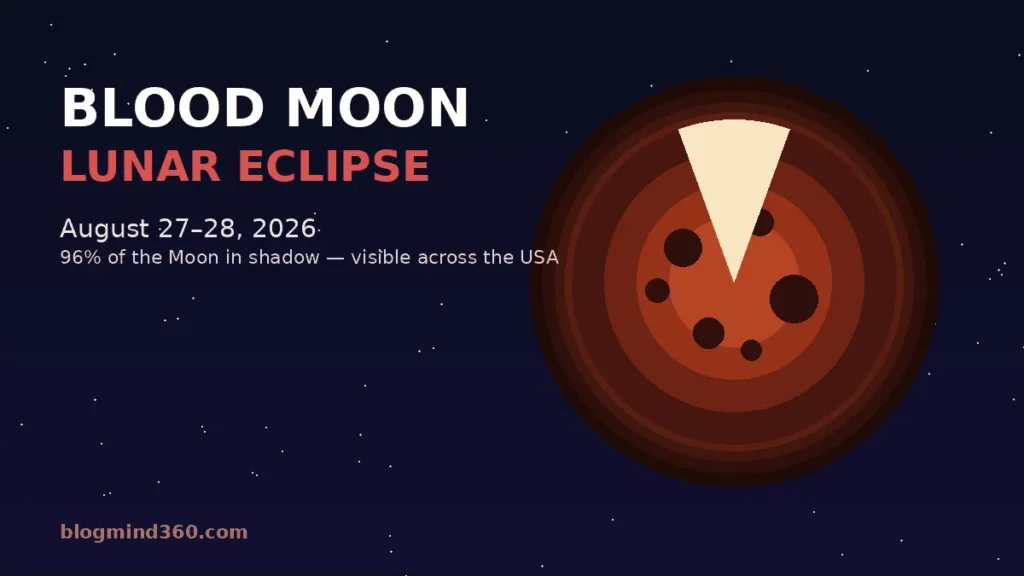
Quick Answer: A dramatic “blood moon” lunar eclipse will be visible across the entire United States on the night of Thursday, August 27 into the early hours of Friday, August 28, 2026. Technically a very deep partial lunar eclipse, about 96% of the Moon’s surface will slip into Earth’s shadow, turning it a coppery red or deep orange — visually almost indistinguishable from a total eclipse. The eclipse begins around 9:23 p.m. EDT on August 27, reaches maximum at 12:12 a.m. EDT on August 28, and wraps up by around 3:01 a.m. EDT. No special glasses or equipment are needed — it’s completely safe to view with the naked eye.
What’s Actually Happening on August 27–28
On the night of August 27 into August 28, 2026, the Moon will pass through Earth’s shadow in what astronomers call a deep partial lunar eclipse. Roughly 96% of the Moon’s disc will be swallowed by the umbra — the darkest, innermost part of Earth’s shadow — leaving only a thin bright sliver untouched. Because so little of the Moon escapes the shadow, the effect will look almost exactly like a full total lunar eclipse to the naked eye, even though it technically falls just short of one.
This event is being widely nicknamed an “almost blood moon” for that reason. The eclipsed portion of the Moon will take on a deep red, orange, or copper hue rather than disappearing from the sky entirely, and according to skywatching guides, this will be the most dramatic lunar eclipse visible from Earth until New Year’s Eve 2028.
The eclipse coincides with August’s full moon, traditionally known as the Sturgeon Moon, which is part of why the event is drawing so much attention this week.
Blood Moon August 2026 Timeline: Key Times
Here’s how the eclipse unfolds, based on Eastern Time (all times are for the night of August 27 continuing into the early morning of August 28):
- 9:23 p.m. EDT, Aug 27: Penumbral phase begins. The Moon enters the faint outer edge of Earth’s shadow — this stage is subtle and hard to notice with the naked eye.
- 10:33 p.m. EDT, Aug 27: Partial (umbral) phase begins. A visible dark “bite” starts to appear on the Moon as it slides into Earth’s deeper shadow. This is when the eclipse becomes obvious to watch.
- 12:12 a.m. EDT, Aug 28: Maximum eclipse. About 96% of the Moon is covered, and the coppery-red color is at its strongest. This is the moment worth setting an alarm for.
- 1:51 a.m. EDT, Aug 28: Partial phase ends as the Moon starts exiting the umbra.
- 3:01 a.m. EDT, Aug 28: Penumbral phase ends, closing out the eclipse.
The entire event, from the first faint shadow to the last, lasts about 5 hours and 38 minutes. The umbral (visibly dark) portion lasts roughly 3 hours and 18 minutes.
Best Viewing Time by US Time Zone
Because the eclipse happens at the same moment everywhere on Earth, only your local clock time changes depending on where you live. Here’s when to look up depending on your time zone:
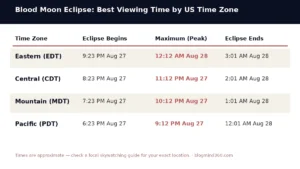
If you only have time to catch one part of the eclipse, aim for the maximum eclipse window in your time zone — that’s when the red color is deepest and most dramatic.
Is This a Total or Partial Lunar Eclipse?
Technically, this is a partial lunar eclipse, not a total one. A total lunar eclipse happens when the entire Moon passes into Earth’s umbra; a partial eclipse happens when only part of it does. In this case, though, the Moon will be so deeply immersed in the umbra — about 96.2% of its diameter, according to eclipse calculations — that the difference is barely noticeable to the eye. Only a thin bright crescent along one edge will remain outside the shadow at maximum eclipse.
That’s also why some outlets are calling it an “almost blood moon” rather than a true blood moon, since the “blood moon” nickname is technically reserved for total lunar eclipses. Whichever term you use, the visual result — a large, deeply reddened Moon — will look dramatic either way.
Where Will the Eclipse Be Visible?
The August 2026 lunar eclipse will be visible from the entire continental United States, as well as most of North and South America, and parts of Europe and Africa. It will not be visible from India, most of Asia, or Australia, since the Moon will be below the horizon during the eclipse for those regions.
Within the US, the eastern half of the country gets the best view, since the Moon will already be well up in the sky by the time the eclipse begins. On the West Coast, the Moon rises later in the evening, so western states may see the eclipse already in progress, or catch the later stages closer to moonset. Either way, the eclipse is visible from every US state, weather permitting.
How to Watch the Blood Moon Safely
Unlike a solar eclipse, a lunar eclipse involves no direct sunlight reaching your eyes — you’re simply watching Earth’s shadow pass across the Moon at night. That means there’s no eye-safety risk at all, and no need for eclipse glasses, solar filters, or any other protective gear. You can watch the entire event from start to finish with the naked eye.
That said, a few things will make the experience better:
- Find a clear view of the sky, away from bright lights. You don’t need a dark rural location, but streetlights and glare from nearby buildings can wash out the fainter early stages.
- Binoculars or a small telescope help, but aren’t required. They’ll sharpen the color and texture of the shadow as it crosses the lunar surface, though the eclipse is easily visible without any equipment.
- Give your eyes time to adjust. Stepping outside from a bright room, it can take 10–15 minutes for your eyes to adapt enough to appreciate the subtler color changes in the early penumbral phase.
- Check the weather forecast for August 27 in the afternoon. Clouds are the single biggest threat to a good view — far more than any equipment limitation.
Why Does the Moon Turn Red During a Lunar Eclipse?
The reddish color comes from the same basic physics that makes sunsets orange and red. As sunlight passes through Earth’s atmosphere, the shorter blue wavelengths scatter away, while the longer red and orange wavelengths bend around the edge of the Earth and continue on toward the Moon. During an eclipse, that filtered, reddened sunlight is essentially all that reaches the Moon’s surface, giving it the “blood moon” glow instead of making it go completely dark.
The exact shade — anywhere from bright orange-copper to a much darker, dimmer red — depends on how much dust, smoke, or cloud cover is in Earth’s atmosphere at the time. Major volcanic eruptions or heavy wildfire smoke in the preceding months can make an eclipsed Moon appear darker and more muted; a clearer atmosphere tends to produce a brighter, more vivid red.
How to Photograph the Blood Moon
You don’t need professional camera equipment to get a decent shot of the eclipse, though a few adjustments help:
- Use a tripod or stable surface. Even a small amount of camera shake will blur the Moon at the zoom levels needed to capture it well.
- Turn on night mode if you’re shooting on a phone. Most modern smartphone cameras handle low-light scenes far better with night mode engaged, and a longer exposure will pull in more of the reddish detail.
- Zoom in as much as your camera allows. The Moon is a small target in the sky; without significant zoom, it will appear as a tiny dot in your photo.
- Avoid using flash. It won’t reach the Moon and will only wash out your foreground.
If you’re shopping around for a phone with strong night-mode performance for events like this, our Best Smartphones 2026 roundup covers which current models handle low-light and zoomed astrophotography best.
The Science Behind Lunar Eclipses
A lunar eclipse happens when the Sun, Earth, and Moon line up almost perfectly, with Earth positioned directly between the Sun and the Moon. This can only happen during a full moon, since that’s the only point in the Moon’s orbit where it sits on the opposite side of Earth from the Sun. Earth’s shadow, cast out into space by sunlight, is made up of two parts: the penumbra, a lighter outer region where sunlight is only partially blocked, and the umbra, the darker, fully shadowed inner region.
Most full moons don’t produce an eclipse at all, because the Moon’s orbit is tilted slightly relative to Earth’s orbit around the Sun. Most months, the full moon passes above or below Earth’s shadow rather than through it. Eclipses only happen when a full moon lines up closely enough with one of the two points where the Moon’s orbital path crosses Earth’s — points astronomers call nodes. This particular eclipse happens near the Moon’s ascending node, which is also why it occurs roughly six months after and before the total lunar eclipses that bookend it in this eclipse cycle.
The size of the Moon at the time also plays a small role in how the eclipse looks. This eclipse occurs about six days after the Moon reached apogee — its farthest point from Earth in its slightly oval orbit — meaning the Moon will appear at a fairly average, unremarkable size rather than the larger “supermoon” appearance that happens near perigee.
How This Eclipse Fits Into a Larger Pattern
This eclipse is the final event in what astronomers describe as an “almost tetrad” — a sequence of four closely spaced lunar eclipses. The pattern started with a total lunar eclipse on March 14, 2025, continued with another total lunar eclipse on September 8, 2025, then a third total lunar eclipse on March 3, 2026, and now closes with this deep partial eclipse on August 27–28, 2026. Three total eclipses in a row followed by a near-miss partial is a distinctive enough pattern that skywatching communities have been tracking the whole sequence for over a year.
It’s also worth noting how this eclipse relates to this month’s earlier sky event. Just over two weeks before this lunar eclipse, on August 12, 2026, a total solar eclipse swept across Spain, with a partial solar eclipse visible across much of the rest of Europe and parts of North America. Solar and lunar eclipses tend to arrive in pairs roughly two weeks apart, since both occur when the Moon crosses close to a node — once during a new moon (producing a solar eclipse) and again during the following or preceding full moon (producing a lunar eclipse). That’s exactly the pattern playing out this August.
Blood Moon Folklore and Why the Name Persists
The “blood moon” name predates any scientific explanation of lunar eclipses, and it shows up across a wide range of historical and religious traditions, from ancient Mesopotamian omens to biblical references to a moon “turned to blood.” Long before astronomers understood atmospheric scattering, cultures around the world independently reached for similar language to describe the same basic observation: a full moon that reddens instead of vanishing.
The term has stuck around in modern usage mostly because it’s simply the most intuitive way to describe what you’re looking at — there’s no need to explain Rayleigh scattering or orbital mechanics for someone to understand what “the moon turns red” means. Astronomy publications and skywatching guides use the term freely today, even though, strictly speaking, “blood moon” more precisely refers to a total lunar eclipse rather than the deep partial eclipse happening this August.
What Happens After This Eclipse
This deep partial eclipse caps off what astronomers describe as an unusually active stretch of eclipses. It follows a total lunar eclipse on March 3, 2026, and a total solar eclipse on August 12, 2026, that crossed Spain and parts of Europe. Together, these four eclipses — two solar, two lunar — complete 2026’s full eclipse calendar.
Looking ahead, the next total lunar eclipse — a true blood moon where the entire Moon passes into Earth’s umbra — won’t occur until New Year’s Eve 2028, heading into January 1, 2029. That makes the August 2026 event the last opportunity for a dramatic reddened Moon for more than two years, which is part of why it’s generating so much attention right now.
Blood Moon vs Total Lunar Eclipse: What’s the Difference?
| Feature | August 2026 Eclipse | True Total Lunar Eclipse |
|---|---|---|
| Moon coverage | ~96% (deep partial) | 100% |
| Visible bright edge | Yes, thin sliver at maximum | No, fully covered |
| Color | Deep red/copper across most of disc | Uniform red/copper across entire disc |
| Official classification | Partial lunar eclipse | Total lunar eclipse |
| Common nickname | “Almost blood moon” | “Blood moon” |
| Eye protection needed | None | None |
Does Weather Affect Whether You Can See It?
Yes — cloud cover is the single biggest factor that can ruin your view of the eclipse, regardless of where you live within the visibility zone. Unlike the eclipse timing itself, which is fixed and predictable years in advance, local weather is only reliably forecastable a day or two out. It’s worth checking your local forecast on the afternoon of August 27 rather than assuming clear skies.
If clouds do roll in, several observatories and astronomy organizations, including NASA, typically stream lunar eclipses live online, giving you a backup way to watch the maximum eclipse moment even if your local sky isn’t cooperating.
Can You See the Blood Moon from a City?
Yes. Unlike deep-sky objects such as faint stars or galaxies, the Moon is bright enough that city light pollution has only a minor effect on how visible a lunar eclipse is. You don’t need to travel to a dark-sky location to see this event clearly — a backyard, balcony, or even a city rooftop with a relatively unobstructed view toward the sky will work fine. The main thing to avoid is direct glare from streetlights or building lights shining straight into your eyes, which can make it harder for them to adjust.
What to Bring If You’re Watching With Others
Since no equipment is strictly required, this is an easy event to turn into a casual group activity — a backyard gathering, a rooftop meetup, or a park outing with friends or family. A few simple additions can make the couple of hours more comfortable: a blanket or reclining chairs for looking straight up without neck strain, warm layers since late-August nights can still cool off noticeably after dark, and a red-light flashlight if you want to check a star chart or phone without ruining everyone’s night vision (a phone screen set to night mode or low brightness works nearly as well).
If you have binoculars lying around, this is a good excuse to bring them out — a lunar eclipse is one of the few astronomical events where basic binoculars genuinely improve the view without needing any special solar filters or setup, since you’re just looking at a normally-lit Moon that happens to be passing through shadow.
Frequently Asked Questions
What time is the blood moon eclipse on August 27, 2026?
The eclipse begins around 9:23 p.m. EDT on August 27, 2026, with the partial (visibly dark) phase starting around 10:33 p.m. EDT. Maximum eclipse, when the Moon is reddest, occurs at 12:12 a.m. EDT on August 28.
Is the August 2026 eclipse a total lunar eclipse?
No. It’s officially classified as a very deep partial lunar eclipse, with about 96% of the Moon covered by Earth’s shadow. Visually, it looks nearly identical to a total eclipse.
Do I need special glasses to watch the lunar eclipse?
No. Lunar eclipses are completely safe to view with the naked eye from start to finish — no glasses, filters, or protective equipment are needed, unlike a solar eclipse.
Will the blood moon be visible from my state?
Yes, the eclipse will be visible from every US state, weather permitting. The eastern half of the country gets the fullest view since the Moon is already high in the sky when the eclipse begins.
What causes the Moon to look red during an eclipse?
Sunlight passing through Earth’s atmosphere gets filtered so that mostly red and orange wavelengths bend around the Earth and reach the Moon, giving it a reddish glow instead of going completely dark.
When is the next total lunar eclipse after this one?
The next true total lunar eclipse occurs on New Year’s Eve 2028, continuing into January 1, 2029, making the August 2026 event the most dramatic lunar eclipse for more than two years.
Can I watch the eclipse from a city with light pollution?
Yes. The Moon is bright enough that city lights have only a minor impact on eclipse visibility, unlike fainter astronomical events. A clear view of the sky is more important than a dark location.
How long does the whole eclipse last?
The full event, including the faint penumbral phases at the start and end, lasts about 5 hours and 38 minutes. The visibly dark, umbral portion of the eclipse lasts roughly 3 hours and 18 minutes.
Why is it called an “almost tetrad” instead of a full tetrad?
A true tetrad is four consecutive total lunar eclipses in a row with no partial eclipses between them. This sequence includes three total lunar eclipses — March 2025, September 2025, and March 2026 — but ends with a deep partial rather than a fourth total eclipse, which is why astronomers describe it as an “almost tetrad” rather than a complete one.
Is this the same eclipse as the “Sturgeon Moon”?
The Sturgeon Moon is simply the traditional name for August’s full moon. This year, that full moon happens to coincide with the deep partial lunar eclipse, so the two terms describe the same event from different angles — one is the seasonal name for the full moon, the other describes the eclipse itself.