
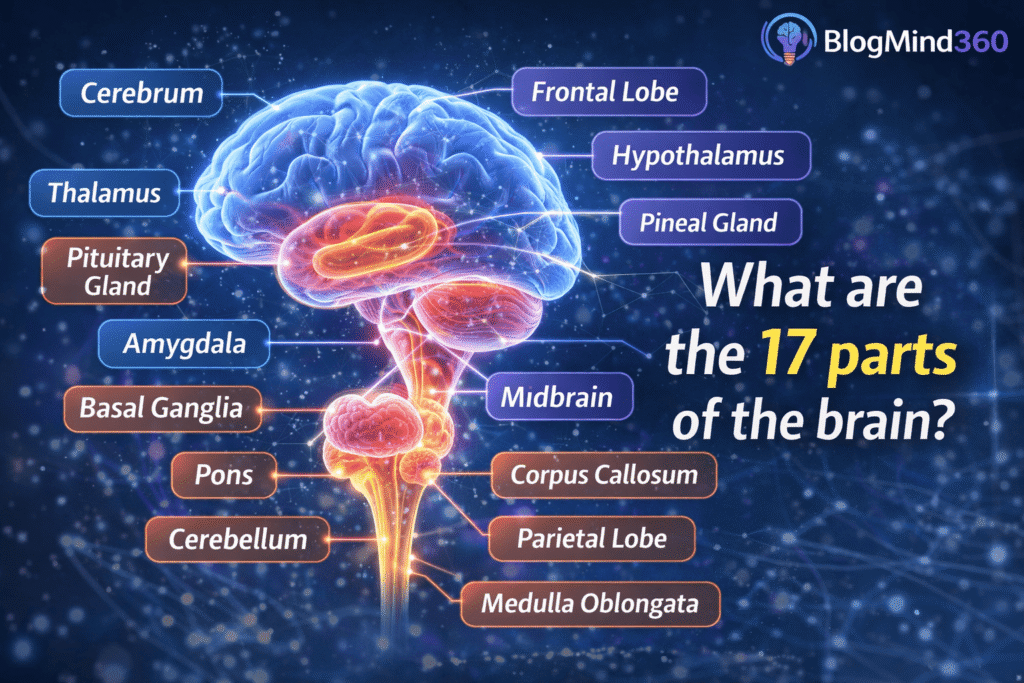
Introduction to the Brain and Understanding Its 17 Major Parts
The human brain is one of the most complex and fascinating organs in the body. It controls every thought, emotion, movement, and bodily function. Scientists and medical experts have spent decades studying the brain to understand how it works and how its different regions interact with each other.
A common question in neuroscience and biology is what are the 17 parts of the brain. While the brain is made up of many smaller structures and neural networks, researchers often categorize it into several key components to simplify understanding of brain anatomy.
These 17 main parts of the brain help explain how the brain manages everything from breathing and heart rate to memory, learning, and decision making.
Understanding these brain parts is important for students, medical professionals, and anyone interested in learning how the human nervous system functions.
Why the Brain Is the Most Important Organ
The brain acts as the central command center of the body. It constantly processes information from the environment and sends signals to muscles, organs, and glands.
This communication occurs through a network of billions of neurons that transmit electrical signals throughout the nervous system.
These signals allow the brain to perform functions such as:
- Controlling voluntary movements
- Processing sensory information
- Regulating breathing and heart rate
- Managing emotions and behavior
- Supporting learning and memory
Because the brain controls so many functions, damage to certain brain regions can significantly affect a person’s physical or mental abilities.
Learning about the 17 parts of the brain and their functions helps us understand how this remarkable organ operates.
Overview of the 17 Main Parts of the Brain
The brain is typically divided into several major sections, and within those sections are specific structures responsible for particular functions.
The 17 important parts of the brain often discussed in anatomy and neuroscience include:
- Cerebrum
- Cerebellum
- Brainstem
- Midbrain
- Pons
- Medulla Oblongata
- Thalamus
- Hypothalamus
- Pituitary Gland
- Pineal Gland
- Amygdala
- Hippocampus
- Basal Ganglia
- Corpus Callosum
- Frontal Lobe
- Parietal Lobe
- Occipital Lobe
Each of these brain structures performs specialized roles that contribute to overall brain function.
Some regions control movement and coordination, while others manage emotions, sensory processing, and hormonal regulation.
Together, these parts form an intricate network that allows the brain to process information and maintain the body’s internal balance.
How the Brain Is Organized
To better understand the 17 parts of the brain, it is helpful to understand how the brain is organized into larger regions.
The brain can generally be divided into three major sections:
- Forebrain
- Midbrain
- Hindbrain
Each section contains structures that perform specific neurological functions.
The forebrain includes the cerebrum, thalamus, hypothalamus, and several other structures involved in higher cognitive functions.
The midbrain helps coordinate movement and visual or auditory processing.
The hindbrain includes structures such as the cerebellum and brainstem that regulate balance, coordination, and vital survival functions.
These sections work together to ensure the brain operates efficiently.
The Cerebrum – The Largest Part of the Brain
The cerebrum is the largest and most developed part of the brain. It is responsible for many advanced functions including thinking, decision making, and voluntary movement.
The cerebrum is divided into two hemispheres and several lobes that control different activities.
Functions of the cerebrum include:
- Reasoning and problem solving
- Language processing
- Memory formation
- Sensory perception
- Voluntary movement
Because of its size and complexity, the cerebrum plays a major role in shaping human intelligence and behavior.
The Cerebellum – Controlling Balance and Coordination
The cerebellum is located at the back of the brain and is responsible for coordinating movement and maintaining balance.
Although it is smaller than the cerebrum, the cerebellum contains a very high concentration of neurons.
Its main functions include:
- Maintaining posture
- Coordinating muscle movements
- Supporting motor learning
- Improving movement precision
Without the cerebellum, even simple tasks such as walking or picking up objects would become difficult.
The Brainstem – Regulating Life Sustaining Functions
The brainstem connects the brain to the spinal cord and controls several vital functions required for survival.
These functions occur automatically without conscious effort.
The brainstem helps regulate:
- Breathing
- Heart rate
- Blood pressure
- Digestive processes
Because the brainstem controls these essential processes, severe damage to this area can be life threatening.
Why Understanding Brain Anatomy Matters
Studying the parts of the brain is essential for understanding neurological health and disease.
Medical professionals rely on detailed knowledge of brain anatomy to diagnose conditions such as:
- Brain tumors
- Stroke
- Parkinson disease
- Alzheimer’s disease
- Epilepsy
Advanced medical technologies like MRI scans allow doctors to observe different brain regions and identify abnormalities.
Understanding how different brain parts function also helps researchers develop treatments for neurological disorders.
The Complexity of Brain Communication
The brain works through a vast network of neurons that transmit signals between different regions.
These neurons communicate through chemical messengers known as neurotransmitters.
Signals travel through neural pathways at extremely high speeds, allowing the brain to process information almost instantly.
For example, when a person touches something hot, sensory signals travel to the brain where they are interpreted. The brain then sends instructions to the muscles to quickly withdraw the hand.
This entire process occurs in a fraction of a second.
The Forebrain Structures – Key Components Among the 17 Parts of the Brain
To fully understand what are the 17 parts of the brain, it is important to explore the major structures that belong to the forebrain, the largest and most complex region of the human brain. The forebrain is responsible for advanced cognitive functions such as thinking, decision making, memory formation, emotional regulation, and sensory interpretation.
Most of the brain’s higher level processes occur in this region. The forebrain includes several important structures that work together to process information and maintain internal balance within the body.
Among the 17 important parts of the brain, many belong to this section, including the cerebrum, thalamus, hypothalamus, pituitary gland, pineal gland, amygdala, hippocampus, basal ganglia, and corpus callosum.
These structures form an intricate network that allows the brain to coordinate behavior, emotions, learning, and sensory perception.
The Cerebrum – The Brain’s Largest and Most Complex Structure
The cerebrum is the largest part of the brain and plays a central role in intelligence, voluntary movement, and sensory processing. It occupies most of the upper portion of the brain and is divided into two hemispheres.
Each hemisphere controls the opposite side of the body. The left hemisphere is often associated with analytical thinking and language, while the right hemisphere is more involved in creativity and spatial awareness.
The cerebrum contains a thin outer layer called the cerebral cortex, which is responsible for higher mental functions such as reasoning, planning, and conscious awareness.
Key functions of the cerebrum include:
- Thinking and reasoning
- Language processing
- Voluntary muscle movement
- Sensory perception
- Problem solving
- Memory storage
The cerebrum is essential for complex human behavior and advanced cognitive abilities.
The Thalamus – The Brain’s Sensory Relay Center
The thalamus is located deep within the brain and acts as a relay station for sensory signals. Almost all sensory information traveling from the body to the brain passes through the thalamus before reaching the cerebral cortex.
This structure helps filter and organize incoming sensory data so that the brain can process it effectively.
The thalamus processes signals related to:
- Touch and pressure
- Pain and temperature
- Vision
- Hearing
- Body movement
For example, when sensory receptors in the skin detect heat or pressure, the signals travel through the thalamus before reaching the appropriate areas of the cerebral cortex for interpretation.
Because of this role, the thalamus is essential for accurate sensory perception.
The Hypothalamus – Regulating Body Balance
Another critical structure within the forebrain is the hypothalamus. Despite being very small, the hypothalamus plays a powerful role in maintaining the body’s internal stability.
The hypothalamus helps regulate homeostasis, which refers to the body’s ability to maintain stable internal conditions.
This structure controls several vital processes including:
- Body temperature regulation
- Hunger and appetite
- Thirst and hydration levels
- Sleep and wake cycles
- Hormone production
- Emotional responses
The hypothalamus also connects directly to the pituitary gland, allowing it to influence hormone release throughout the body.
The Pituitary Gland – The Master Hormone Controller
The pituitary gland is a small but extremely important structure located just below the hypothalamus. It is often called the master gland of the endocrine system because it regulates many other hormone producing glands in the body.
Hormones released by the pituitary gland influence processes such as growth, metabolism, reproduction, and stress responses.
Some of the hormones controlled by the pituitary gland include:
- Growth hormone
- Thyroid stimulating hormone
- Adrenocorticotropic hormone
- Prolactin
- Luteinizing hormone
Because the pituitary gland controls many other glands, it plays a major role in maintaining hormonal balance.
The Pineal Gland – Regulating Sleep Cycles
The pineal gland is another structure within the forebrain that helps regulate the body’s biological rhythms. This small gland produces the hormone melatonin, which influences the sleep wake cycle.
Melatonin levels typically increase during the night and decrease during the day. This cycle helps the body maintain a healthy circadian rhythm.
Proper functioning of the pineal gland is important for maintaining healthy sleep patterns and overall well being.
The Amygdala – Processing Emotions
The amygdala is a small almond shaped structure located deep within the brain. It plays a key role in emotional processing and behavioral responses.
The amygdala helps the brain interpret emotional signals and react appropriately to potential threats.
Functions of the amygdala include:
- Processing fear and anxiety
- Recognizing emotional expressions
- Triggering fight or flight responses
- Forming emotional memories
For example, when a person encounters a dangerous situation, the amygdala quickly activates the body’s stress response.
This rapid reaction helps prepare the body to respond to threats.
The Hippocampus – Forming and Storing Memories
The hippocampus is another important structure within the forebrain. It is essential for forming new memories and organizing information for long term storage.
The hippocampus helps convert short term memories into long term memories.
It also plays a role in spatial navigation and learning.
For example, when someone learns a new route to work, the hippocampus helps store that information so it can be recalled later.
Damage to the hippocampus can affect memory formation and learning ability.
The Basal Ganglia – Supporting Movement Control
The basal ganglia are a group of structures that help regulate voluntary movements and motor control.
These structures work closely with the cerebrum and cerebellum to ensure that movements occur smoothly and efficiently.
Functions of the basal ganglia include:
- Initiating voluntary movement
- Regulating muscle activity
- Controlling posture
- Coordinating movement patterns
Disorders affecting the basal ganglia can lead to movement problems such as tremors or muscle stiffness.
Conditions such as Parkinson disease are linked to abnormalities within this region.
The Corpus Callosum – Connecting the Brain Hemispheres
The corpus callosum is a thick bundle of nerve fibers that connects the left and right hemispheres of the cerebrum.
This structure allows the two sides of the brain to communicate with each other.
Through this connection, information processed in one hemisphere can be shared with the other.
For example, visual information processed in one hemisphere can be combined with language processing from the other hemisphere.
This communication allows the brain to function as a unified system rather than two separate halves.
Why Forebrain Structures Are So Important
The structures within the forebrain play a central role in shaping human behavior, intelligence, and emotional responses.
They allow individuals to think, learn, remember experiences, and respond to sensory information.
Without these brain structures, humans would not possess the advanced cognitive abilities that define our species.
Understanding these components helps answer the question what are the 17 parts of the brain and their functions.
Midbrain and Hindbrain Structures – Important Components Among the 17 Parts of the Brain
Continuing the explanation of what are the 17 parts of the brain, the next group of structures belongs to the midbrain and hindbrain regions. These areas play a crucial role in controlling movement, maintaining balance, and regulating essential life functions such as breathing and heart rate.
While the forebrain is responsible for higher cognitive processes like thinking and memory, the midbrain and hindbrain focus on coordination, reflex actions, and communication between the brain and spinal cord.
These regions ensure that the body can respond quickly to environmental changes and maintain stability during everyday activities.
Several structures from the list of the 17 parts of the brain are located in these regions, including the midbrain, pons, medulla oblongata, cerebellum, and the major lobes that contribute to sensory processing and motor control.
Understanding these brain parts helps explain how the body maintains balance, movement coordination, and automatic life sustaining processes.
The Midbrain – A Key Control Center for Vision and Movement
The midbrain is located between the forebrain and the hindbrain. Although it is relatively small compared to other brain regions, it plays an important role in coordinating movement and processing visual and auditory information.
The midbrain acts as a communication bridge between different parts of the brain and the spinal cord.
One of the main functions of the midbrain is controlling eye movement and visual reflexes. It helps the brain quickly respond to visual or sound stimuli.
For example, when a person suddenly hears a loud noise and turns their head toward the source of the sound, the midbrain is involved in coordinating that reaction.
The midbrain also plays a role in regulating motor movement and transmitting signals between the brain and spinal cord.
Functions of the midbrain include:
- Controlling eye movements
- Processing visual and auditory signals
- Coordinating reflex responses
- Supporting motor control
Because of these functions, the midbrain contributes to the brain’s ability to respond quickly to environmental changes.
The Pons – The Communication Bridge of the Brain
The pons is another structure that forms part of the brainstem. It sits between the midbrain and the medulla oblongata.
The name “pons” comes from a Latin word meaning bridge, which reflects its role in connecting different parts of the brain.
The pons helps transmit signals between the cerebrum, cerebellum, and spinal cord. This communication allows the brain to coordinate complex movements and maintain balance.
In addition to signal transmission, the pons also helps regulate breathing patterns and sleep cycles.
Functions of the pons include:
- Relaying signals between brain regions
- Regulating breathing rhythms
- Supporting sleep and dreaming
- Controlling facial movements
- Assisting in sensory processing
Because the pons helps coordinate communication between several brain regions, it plays an essential role in maintaining efficient brain function.
The Medulla Oblongata – Controlling Vital Life Functions
The medulla oblongata is the lowest part of the brainstem and connects directly to the spinal cord. This structure controls many automatic processes that are essential for survival.
Unlike voluntary actions such as speaking or walking, the functions regulated by the medulla occur automatically and require no conscious effort.
The medulla controls several critical body functions including breathing, heart rate, and blood pressure.
Because these processes are necessary for life, severe damage to the medulla can be fatal.
Functions of the medulla oblongata include:
- Regulating breathing
- Controlling heart rate
- Maintaining blood pressure
- Coordinating swallowing and digestion
- Controlling protective reflexes
These reflexes include coughing, sneezing, vomiting, and the gag reflex, which help protect the body from harmful substances.
The medulla constantly monitors signals from the body and adjusts these processes to maintain stable internal conditions.
The Cerebellum – Coordinating Balance and Movement
The cerebellum is located at the back of the brain beneath the cerebrum. Its name means little brain, but despite its smaller size, it plays a major role in coordinating movement and maintaining balance.
The cerebellum ensures that movements are smooth, precise, and well timed.
It receives information from muscles, joints, and sensory organs about body position and movement. This information allows the cerebellum to fine tune motor actions.
For example, when a person walks or runs, the cerebellum constantly adjusts muscle movements to maintain balance and coordination.
Functions of the cerebellum include:
- Maintaining balance and posture
- Coordinating voluntary movements
- Regulating muscle tone
- Supporting motor learning
- Improving movement accuracy
Without the cerebellum, everyday movements would become uncoordinated and unstable.
The Frontal Lobe – Responsible for Thinking and Decision Making
Among the 17 parts of the brain, several structures are actually divisions of the cerebrum known as lobes. The first of these is the frontal lobe, located at the front of the brain.
The frontal lobe is responsible for many advanced cognitive functions, including reasoning, planning, and decision making.
It also contains the motor cortex, which controls voluntary muscle movements.
Functions of the frontal lobe include:
- Decision making
- Problem solving
- Emotional control
- Voluntary movement
- Personality and behavior
Because of its role in higher thinking processes, the frontal lobe plays a major role in shaping human personality and intelligence.
The Parietal Lobe – Processing Sensory Information
The parietal lobe is located near the upper middle part of the brain and is responsible for processing sensory information from the body.
This region helps the brain interpret signals related to touch, pressure, temperature, and body position.
The parietal lobe allows individuals to understand spatial relationships and interact effectively with their surroundings.
Functions of the parietal lobe include:
- Processing touch and pressure sensations
- Interpreting temperature and pain signals
- Understanding spatial awareness
- Integrating sensory information
These functions help the brain coordinate movements based on sensory feedback from the environment.
The Occipital Lobe – Interpreting Visual Information
The occipital lobe is located at the back of the brain and is primarily responsible for processing visual information.
This region receives signals from the eyes and converts them into images that the brain can understand.
The occipital lobe helps interpret colors, shapes, motion, and spatial relationships.
Functions of the occipital lobe include:
- Processing visual signals
- Interpreting color and light
- Recognizing objects and shapes
- Detecting motion
Although the eyes capture visual data, it is the occipital lobe that allows the brain to interpret what we see.
How These Brain Structures Work Together
Although each of these brain parts has specific responsibilities, they constantly communicate with one another through complex neural networks.
For example, when someone catches a ball, several brain regions work together.
The occipital lobe processes the visual information about the ball’s movement.
The cerebellum coordinates the muscles required to move the hands accurately.
The frontal lobe plans the movement and initiates action.
The brainstem ensures that breathing and heart rate remain stable during the activity.
This coordination allows the body to perform complex tasks efficiently.
Understanding these structures brings us closer to completing the explanation of what are the 17 parts of the brain and their functions.
Summary of the 17 Parts of the Brain and How They Work Together
After exploring the different structures of the human brain, it becomes easier to understand the full answer to the question what are the 17 parts of the brain. Each of these brain structures performs a unique role, but none of them function independently. The brain operates as a highly coordinated system in which different regions constantly communicate through neural pathways.
These 17 parts of the brain help regulate everything from breathing and movement to memory, emotions, and decision making. Together, they form a complex network that allows the brain to process information and control the entire body.
Understanding these brain parts provides valuable insight into how the nervous system functions and how different neurological conditions affect brain activity.
Complete List of the 17 Parts of the Brain
The human brain contains many structures, but the following 17 important parts are commonly highlighted when studying brain anatomy and neurological functions.
- Cerebrum
- Cerebellum
- Brainstem
- Midbrain
- Pons
- Medulla Oblongata
- Thalamus
- Hypothalamus
- Pituitary Gland
- Pineal Gland
- Amygdala
- Hippocampus
- Basal Ganglia
- Corpus Callosum
- Frontal Lobe
- Parietal Lobe
- Occipital Lobe
These structures can be grouped into larger brain regions that support different types of functions.
Major Brain Regions and Their Roles
To better understand how these 17 structures interact, it helps to organize them into broader categories based on their functions.
Forebrain
The forebrain contains structures responsible for advanced cognitive functions, emotions, and sensory interpretation.
Parts of the brain belonging to the forebrain include:
- Cerebrum
- Thalamus
- Hypothalamus
- Pituitary Gland
- Pineal Gland
- Amygdala
- Hippocampus
- Basal Ganglia
- Corpus Callosum
- Frontal Lobe
- Parietal Lobe
- Occipital Lobe
These structures allow humans to think, learn, remember information, and interpret sensory signals.
Midbrain
The midbrain serves as a communication link between the forebrain and hindbrain. It helps coordinate movement and process visual and auditory information.
The midbrain also contributes to reflex actions that help the body respond quickly to environmental stimuli.
Hindbrain
The hindbrain controls many of the body’s most essential functions. It helps regulate balance, coordination, and life sustaining processes.
Structures in the hindbrain include:
- Cerebellum
- Pons
- Medulla Oblongata
- Brainstem
These parts of the brain ensure that the body maintains stability, proper breathing patterns, and heart function.
How the Brain Coordinates Complex Activities
Although each brain structure has specialized responsibilities, the brain functions as an integrated system. Neural pathways connect different brain regions, allowing information to travel quickly between them.
For example, when a person decides to pick up a glass of water, several brain regions work together simultaneously.
The frontal lobe plans the movement and sends signals to the muscles.
The parietal lobe processes sensory information about the position of the hand and the location of the glass.
The occipital lobe interprets visual information to guide the hand toward the object.
The cerebellum coordinates muscle movements so the motion remains smooth and controlled.
The brainstem ensures that vital processes such as breathing and heart rate continue uninterrupted during the activity.
This coordination occurs within fractions of a second, demonstrating the incredible efficiency of the human brain.
Communication Through Neurons
The brain communicates through specialized cells called neurons. These cells transmit electrical impulses and chemical signals throughout the nervous system.
The human brain contains approximately 86 billion neurons, each forming connections with thousands of other neurons.
These connections create complex neural networks that allow the brain to process large amounts of information quickly.
Neurons communicate through chemical messengers known as neurotransmitters.
These chemicals allow signals to travel from one neuron to another, enabling the brain to coordinate movement, thoughts, emotions, and sensory responses.
The Brain’s Ability to Adapt
One of the most remarkable features of the brain is its ability to adapt and reorganize itself through a process known as neuroplasticity.
Neuroplasticity allows the brain to form new neural connections in response to learning, experience, or injury.
For example, when someone learns a new skill such as playing a musical instrument or speaking a new language, the brain creates new neural pathways to support that activity.
This adaptability also allows certain brain regions to compensate for damage in other areas.
Because of neuroplasticity, patients recovering from strokes or brain injuries can sometimes regain lost abilities through rehabilitation and therapy.
Importance of Studying Brain Anatomy
Understanding the 17 parts of the brain and their functions is essential for scientists, doctors, and students studying neuroscience, psychology, and medicine.
Knowledge of brain anatomy helps medical professionals diagnose and treat neurological conditions such as:
- Brain tumors
- Stroke
- Parkinson disease
- Alzheimer disease
- Epilepsy
- Traumatic brain injuries
Advanced imaging technologies such as MRI and CT scans allow doctors to observe different brain structures and identify abnormalities.
This information helps guide treatment decisions and improve patient outcomes.
Brain Health and Protection
Because the brain controls every aspect of human life, maintaining brain health is extremely important.
Several lifestyle habits can help protect brain function and support long term cognitive health.
These include:
- Maintaining a balanced diet rich in nutrients
- Engaging in regular physical exercise
- Getting adequate sleep
- Managing stress effectively
- Keeping the mind active through learning and mental challenges
These habits help promote healthy brain function and reduce the risk of neurological disorders.
Frequently Asked Questions About the 17 Parts of the Brain
What are the 17 parts of the brain
The 17 commonly studied parts of the brain include the cerebrum, cerebellum, brainstem, midbrain, pons, medulla oblongata, thalamus, hypothalamus, pituitary gland, pineal gland, amygdala, hippocampus, basal ganglia, corpus callosum, frontal lobe, parietal lobe, and occipital lobe.
Which part of the brain controls thinking
The cerebrum, particularly the frontal lobe, is responsible for higher cognitive functions such as thinking, decision making, reasoning, and problem solving.
What part of the brain controls balance
The cerebellum is responsible for maintaining balance, posture, and coordination of body movements.
Why is the brainstem important
The brainstem controls vital functions such as breathing, heart rate, blood pressure, and communication between the brain and spinal cord.
Which brain structure regulates hormones
The hypothalamus and pituitary gland work together to regulate hormone production and maintain hormonal balance throughout the body.
What part of the brain controls memory
The hippocampus plays a key role in forming new memories and organizing information for long term storage.
How do brain parts communicate with each other
Different brain regions communicate through neural pathways made up of billions of neurons that transmit electrical and chemical signals.
Can the brain repair itself
The brain has some ability to repair and reorganize itself through neuroplasticity, which allows it to adapt after learning new skills or recovering from certain types of injuries.
Why is learning about brain anatomy important
Studying brain anatomy helps scientists and doctors understand how the brain works, diagnose neurological diseases, and develop treatments for brain related disorders.
Final Thoughts
The human brain is one of the most extraordinary organs in the body. By studying what are the 17 parts of the brain, we gain a deeper understanding of how different brain structures contribute to movement, thought, emotions, and survival.
Each brain region performs specialized functions, yet all parts work together to create the complex system that allows humans to think, learn, and interact with the world.