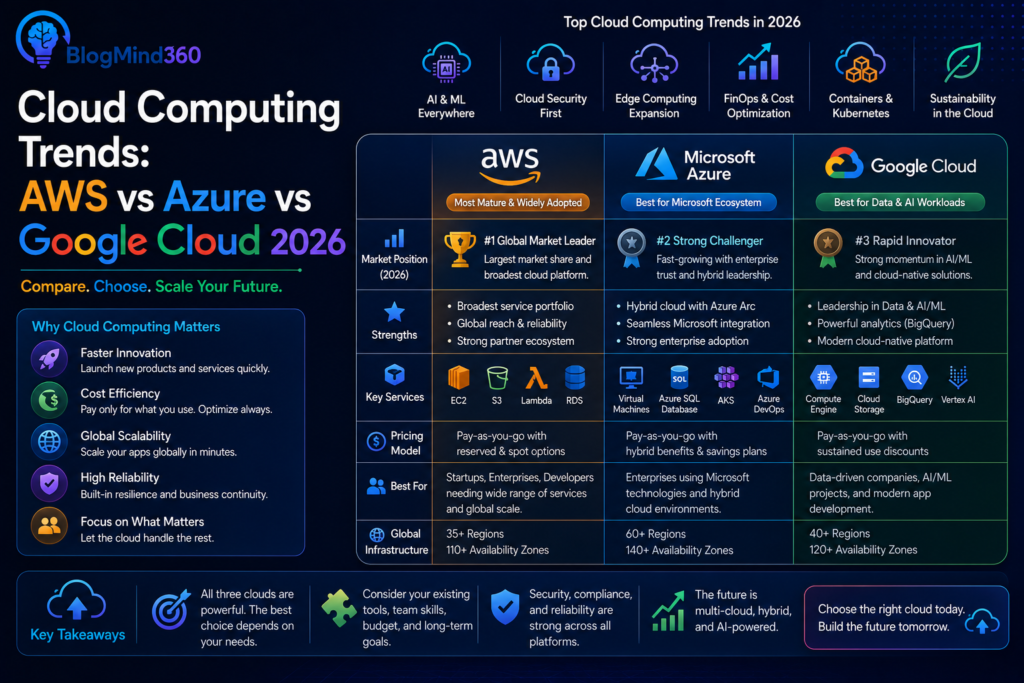
Cloud computing continues to be the backbone of modern business technology, and the competition between the three major providers — Amazon Web Services (AWS), Microsoft Azure, and Google Cloud — keeps shaping what features and pricing businesses have access to. This article compares the three platforms and covers the broader trends defining cloud computing in 2026.
AWS: The Market Leader
AWS remains the largest cloud provider by market share, offering the broadest range of services and the most mature ecosystem of third-party integrations and tools. Its extensive service catalog covers everything from basic compute and storage to specialized AI, analytics, and Internet of Things tools, making it a common default choice for companies of all sizes.
AWS’s scale also means extensive documentation, a large talent pool of experienced engineers, and a mature partner ecosystem, which can reduce the friction of finding skilled staff or third-party solutions.
Microsoft Azure: Enterprise Integration
Azure has built a strong position particularly among enterprises already using Microsoft products like Windows Server, Active Directory, and Microsoft 365, since Azure integrates tightly with this existing ecosystem. This makes Azure a natural fit for large organizations with established Microsoft infrastructure looking to extend into the cloud without a complete platform overhaul.
Azure has also invested heavily in hybrid cloud capabilities, supporting organizations that want to maintain some infrastructure on their own servers while extending other workloads to the cloud.
Google Cloud: Data and AI Strength
Google Cloud has carved out a strong reputation particularly in data analytics and AI, leveraging Google’s own deep expertise in these areas. Its tools for big data processing and machine learning are frequently cited as differentiators, appealing to organizations with data-intensive workloads or a strong focus on AI development.
Google Cloud has generally been considered the smallest of the three major providers by market share, though it has continued to grow, particularly among companies specifically prioritizing AI and data capabilities.
Key Trends Across All Three Platforms
All three providers have heavily expanded their AI and machine learning offerings, integrating AI capabilities directly into their broader service catalogs rather than treating them as a separate, niche offering. Multi-cloud strategies — using more than one provider to avoid dependency on a single vendor — have also grown more common among larger enterprises, even though it adds management complexity.
Sustainability commitments have become a more visible factor as well, with all three providers publishing goals around renewable energy use and carbon-neutral operations.
How Businesses Choose Between Them
The right choice often depends less on which provider is objectively ‘best’ and more on practical factors: existing technology investments, in-house team expertise, specific service needs, and pricing structures for a company’s particular workload patterns. Businesses already invested in Microsoft tools often lean toward Azure, while data-heavy or AI-focused companies frequently find Google Cloud’s tools compelling, and businesses prioritizing the broadest range of mature services often default to AWS.
Frequently Asked Questions
Which cloud provider is the cheapest?
Pricing depends heavily on usage patterns and negotiated agreements, so there’s no single cheapest option across the board.
Can I use more than one cloud provider at once?
Yes, this is called a multi-cloud strategy, commonly used to avoid dependency on a single vendor.
Is switching cloud providers difficult?
Migration can be complex and costly depending on integration depth, which is why provider choice is often carefully evaluated upfront.
Do small businesses need enterprise-level cloud services?
Not necessarily, all three providers offer scaled-down pricing suitable for small businesses and startups.
Which provider is best for AI development?
Google Cloud is frequently cited for AI and analytics tools, though AWS and Azure have both expanded significantly in this area.
Is cloud computing more secure than on-premises servers?
Major providers invest heavily in security infrastructure, though security still depends on how well a business configures its environment.
Conclusion
AWS, Azure, and Google Cloud each bring distinct strengths — AWS’s breadth and maturity, Azure’s enterprise and Microsoft integration, and Google Cloud’s data and AI capabilities. Rather than searching for a single universal winner, businesses generally get the best results by matching provider strengths to their specific technical needs, existing infrastructure, and team expertise.