
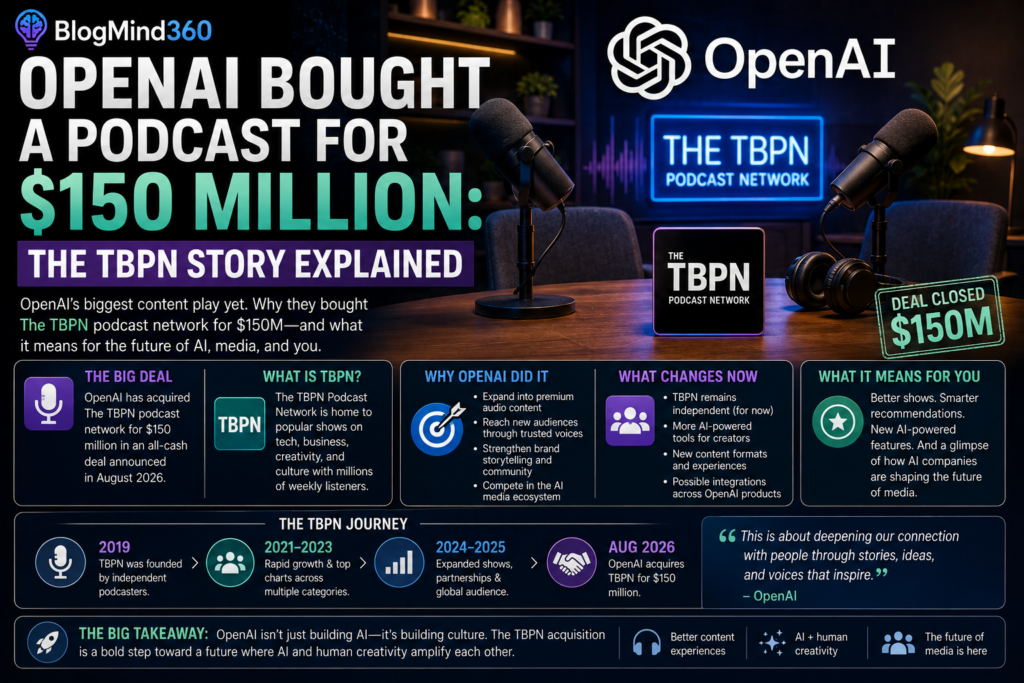
In one of the most surprising media deals of 2026, OpenAI acquired TBPN — a scrappy, bootstrapped daily tech talk show that started as a text message between two friends and, in just 18 months, grew into a reported $150 million acquisition by the company behind ChatGPT. It’s a story that says as much about the state of podcasting in 2026 as it does about OpenAI’s evolving media strategy.
Here’s the full story: who TBPN is, how the deal came together, what OpenAI actually bought, and what it signals for the future of independent podcasting.
Quick Answer: What Happened With OpenAI and TBPN?
OpenAI acquired TBPN (Technology Business Programming Network), a daily live tech and business talk show hosted by John Coogan and Jordi Hays, in a deal announced on April 2, 2026. While OpenAI and TBPN did not officially disclose the purchase price, reporting from the Financial Times and other outlets put the figure at “low hundreds of millions,” with some estimates specifically citing around $150 million in cash and stock. TBPN will continue operating with editorial independence, maintaining its daily three-hour live format, while Coogan, Hays, and their team also work with OpenAI’s communications and strategy organization. The show launched in October 2024 as a text message idea between two friends with no studio, no sponsors, and no audience — making this one of the fastest bootstrapped-to-acquisition stories in modern media history.
That’s the short version. Here’s the complete story, including the show’s origin, the timeline to acquisition, and what it means for where podcasting is headed.
What Is TBPN?
TBPN (Technology Business Programming Network) is a daily, live tech and business talk show hosted by former tech founders and investors John Coogan and Jordi Hays. The show airs live on YouTube, X, and Substack every weekday from 11 a.m. to 2 p.m. Pacific Time — a genuinely demanding three-hour daily commitment that’s part of what’s given the show its reputation.
TBPN has been widely described as “SportsCenter for the tech industry” — a fast-paced, irreverent format where the hosts react to tech news in real time, interview major industry figures, and cover everything from AI and startups to business and defense. One of its signature bits: the hosts hit a gong whenever a company announces a new funding round, capturing the show’s playful, insider tone.
Despite its casual energy, TBPN has attracted a genuinely remarkable guest list, including Sam Altman, Mark Zuckerberg, Satya Nadella, Marc Benioff, Mark Cuban, and documentarian Ken Burns, alongside senior tech policy officials from Washington. The New York Times has described TBPN as “Silicon Valley’s newest obsession.”
From a Text Message to a $150 Million Deal: The Full Timeline
What makes this story remarkable isn’t just the acquisition itself — it’s how fast it happened, and how little outside help it took to get there.
- October 4, 2024: Jordi Hays texts John Coogan an idea: “The name of the podcast is Technology Brothers.” They record their first episode within two weeks — no studio, no sponsors, no audience.
- Late 2024: The show ramps up to three episodes per week as an early audience starts to form.
- March 2025: The show rebrands to TBPN (Technology Business Programming Network), adopting the daily live-streaming format and SportsCenter-for-tech identity that would come to define it.
- Mid-2025: Viral clips of the show start circulating on X, generating millions of views and pulling in a growing stream of high-profile guests.
- September 2025: TBPN hits $5 million in annualized ad revenue, fully profitable, with zero outside investors. The team hires Dylan Abruscato — a former Postmates and HQ Trivia executive — as President to help scale the business side.
- December 2025: TBPN signs a partnership with the NYSE, a clear signal the show had become institutionally significant within the finance and tech world.
- January 2026: TBPN signs with talent agency CAA.
- February 2026: TBPN runs a regional Super Bowl ad — a striking milestone for what began as a podcast with no budget.
- April 2, 2026: OpenAI announces its acquisition of TBPN, roughly 18 months after that first text message.
By the time of the acquisition, industry reporting pegged TBPN’s revenue trajectory at roughly $30 million for 2026 (per The Wall Street Journal, cited by TechCrunch), with other reports suggesting a run rate closer to $60 million (per The Information). Whatever the precise figure, the show had scaled from zero to a serious media business entirely through its own momentum — no venture funding, no parent media company, just two co-hosts and a growing audience.
Why Did OpenAI Buy a Podcast?
This is the question that’s dominated coverage of the deal, and OpenAI’s own explanation is worth taking at face value alongside the more strategic reading of the move.
OpenAI’s Official Reasoning
In the acquisition announcement, Fidji Simo, OpenAI’s CEO of Applications (also referred to in coverage as CEO of AGI Deployment), described TBPN as “one of the places where the conversation about AI and builders is actually happening day to day.” Simo argued that “the standard communications playbook just doesn’t apply” to a company like OpenAI, given how central AI has become to public discourse, and that rather than trying to build a similar show internally from scratch, “it made a lot of sense to bring them in, support what they’re doing, and help them scale — while keeping what makes them special.”
Sam Altman’s Personal Connection
The deal also has a personal dimension. Sam Altman had previously invested in John Coogan’s first company, Soylent, and the two had known each other for roughly 13 years before the acquisition. Altman posted on X following the announcement: “TBPN is my favorite tech show. We want them to keep that going and for them to do what they do so well. I don’t expect them to go any easier on us, am sure I’ll do my part to help enable that with occasional stupid decisions.”
The Strategic Reading
Beyond the stated rationale, media analysts have framed the deal as something closer to an “acqui-hire” for narrative infrastructure rather than a traditional media acquisition — particularly notable given OpenAI’s timing, having just closed a massive $122 billion funding round at an $852 billion post-money valuation around the same period. With the company facing what’s likely to be an eventual IPO and increasing regulatory scrutiny, having genuine credibility and reach within the tech and builder community — rather than relying purely on traditional PR — carries obvious strategic value. TBPN now sits within OpenAI’s Strategy organization, reporting to Chris Lehane, OpenAI’s chief global affairs officer.
What Actually Changes — and What Doesn’t
One of the most closely watched aspects of any acquisition like this is whether the acquired product stays true to what made it successful in the first place. Here’s what’s been confirmed:
What Stays the Same
- TBPN continues its daily live format — three hours, every weekday, as Coogan put it directly on the show following the announcement: “TBPN is not going away. We’re going to be live every day, three hours, long as we want. We have a lot of flexibility.”
- Editorial independence remains intact, according to both OpenAI and the hosts — TBPN continues choosing its own guests and running its own programming without OpenAI dictating content.
- Coogan and Hays remain the hosts, with Abruscato continuing to lead the business side of the operation.
What’s Changing
- Sponsorship display: Viewers noted that following the announcement, the show’s on-screen banner no longer displayed its running list of company sponsors — a small but symbolically significant shift for a show that built its early identity partly around scrappy, sponsor-driven independence.
- Organizational structure: TBPN now formally sits within OpenAI’s Strategy organization, giving the show’s leadership a direct line into how OpenAI approaches public communication and messaging.
- Broader mandate: Beyond continuing the show itself, Coogan, Hays, and the TBPN team are expected to help OpenAI’s communications and marketing functions more broadly, described by Simo as helping the company “innovate on how we bring AI to the world in a way that helps people understand the full impact” of the technology.
Notably, co-host Jordi Hays addressed the show’s historically critical stance toward parts of the AI industry directly, saying that while TBPN had been “critical of the industry at times,” getting to know Altman and the OpenAI team left him convinced of their “openness to feedback and commitment to getting this right.” He suggested the show would be shifting from pure commentary toward what he described as “real impact” in helping distribute and explain the technology globally.
What This Means for the Podcasting Industry
The TBPN acquisition arrives amid a genuinely turbulent period for podcasting more broadly. The same year saw the closures of Wondery and Pineapple Street, the ending of WTF with Marc Maron after more than a decade, and a wave of acquisitions involving Sounds Profitable, Red Seat Ventures, Lemonada, and The Free Press — alongside layoffs at outlets like The Ringer and Headgum. Against that backdrop of consolidation and right-sizing, TBPN’s trajectory stands out as a genuine counter-narrative: a completely independent, bootstrapped show reaching a nine-figure acquisition without ever taking outside investment.
The Rise of Founder-Led, Niche-Audience Media
TBPN’s success reflects a broader shift industry watchers have been tracking closely: podcasts built around a specific, highly engaged niche audience can be worth more than shows chasing mass reach. Podcaster and NYU professor Scott Galloway, who interviewed Coogan and Hays about the deal on his own show, has pointed to this exact dynamic — TBPN’s audience, while smaller than many mainstream podcasts, consists disproportionately of the exact tech industry decision-makers, founders, and investors that advertisers and, apparently, acquirers like OpenAI are willing to pay significantly for direct access to.
AI Companies Entering the Media Business
The deal also fits into a broader pattern of AI companies directly acquiring or building media properties, rather than simply advertising within existing media or relying on traditional press relationships. As AI increasingly shapes public conversation and policy, companies like OpenAI appear to be concluding that owning trusted, credible channels for that conversation is now a meaningful strategic asset — not dissimilar to how tech companies in earlier eras invested directly in developer relations or open-source ecosystems to shape industry sentiment from the inside rather than purely through external marketing.
A Signal for Independent Creators
For independent podcasters and creators more broadly, the TBPN story offers a genuinely compelling case study: starting with zero budget, zero investors, and zero audience is still a viable path to a life-changing outcome, provided the format, consistency, and audience-market fit come together. Eighteen months from an idea texted between two friends to a nine-figure acquisition is an extreme outlier, but it’s a real, recent example that’s likely to keep shaping how aspiring podcast creators think about bootstrapping versus seeking outside investment from the start.
TBPN in Context: How It Compares to Other Major Podcast Deals
To understand how unusual the TBPN deal is, it helps to see it against the backdrop of the broader podcasting economy in 2026. Recent Forbes reporting on the highest-paid podcasters of the year highlighted several other notable structures worth comparing:
- One major wellness-focused podcaster reportedly fielded $100 million offers from four different suitors before landing a combined deal with Spotify and Netflix.
- A prominent hip-hop podcast has built the largest show on Patreon, with more than 70,000 paid subscribers funding an independent network directly, rather than relying primarily on advertising.
- TBPN itself was specifically cited in that same Forbes piece as an example of a show whose audience demographics mattered as much as its size — going from $5 million in advertising revenue in its first full year to a projected $30 million in year two.
What sets the TBPN deal apart from most of these comparisons is the acquirer: rather than a traditional media or streaming company buying distribution rights or a partnership stake, an AI company bought the entire operation outright, integrating it into its own strategic communications function — a structurally different kind of deal than the licensing and platform-partnership arrangements more common elsewhere in the current podcast economy.
What’s Next for TBPN and OpenAI
As of this writing, TBPN continues its daily three-hour live broadcasts on schedule, with Coogan and Hays maintaining their hosting duties and editorial control over guest selection and programming. The bigger open question is how the relationship evolves over time — whether TBPN’s identity as an independent-feeling, occasionally critical voice within tech media can be sustained long-term now that it sits formally within the strategy arm of one of the industry’s most consequential companies.
For readers interested in the broader dynamic between OpenAI and its position within the tech industry, it’s worth noting the acquisition came during a period of significant legal and competitive tension for the company more broadly — including Apple’s ongoing trade secrets lawsuit against OpenAI, which has made headlines throughout the same year. Whether TBPN’s expanded role in OpenAI’s communications strategy shapes how stories like that are covered and discussed within the tech media ecosystem is exactly the kind of dynamic worth watching as this relationship matures.
If you’re curious about the underlying AI technology and companies driving stories like this one, our explainer on what artificial intelligence actually is is a useful starting point, and our roundup of top AI writing assistants covers the practical tools shaping this same industry from a different angle.
Inside TBPN’s Format: Why It Resonated So Fast
Part of what makes TBPN’s rapid rise worth studying is the format itself, which differs meaningfully from most successful podcasts. Rather than the typical weekly or twice-weekly release schedule most shows follow, Coogan and Hays committed early to a grueling daily three-hour live format — a much higher production cadence than almost any comparable independent show attempts, let alone sustains.
That format choice turned out to be central to the show’s growth. A daily live show covering fast-moving tech and business news creates a natural reason for an audience to return every single day rather than waiting for a weekly release, while also generating a much larger volume of clippable, shareable moments — reactions to breaking news, unscripted guest exchanges, and recurring bits like the funding-announcement gong — that could circulate independently on platforms like X and build audience awareness well beyond people who were already watching the live stream.
The live, unscripted nature of the show also became part of its appeal to guests. For tech executives increasingly wary of edited, gotcha-style media coverage, appearing on a live show with a friendly-but-informed host duo offered a lower-risk way to engage directly with an audience of peers and industry insiders, which likely helped TBPN build the kind of high-profile guest list — from sitting Fortune 500 CEOs to White House science policy officials — that a similarly new show without that access might have taken years longer to attract.
The Bigger Picture: Media Consolidation Meets the Creator Economy
The TBPN deal is also worth understanding against a broader tension playing out across media in 2026: traditional podcast networks and legacy media companies have been consolidating, cutting costs, and in some cases shutting down entirely, even as individual creator-led shows increasingly rival or exceed the reach of institutional media brands. Shows built around a single host or hosting duo — from major independent interview podcasts to niche vertical shows like TBPN — have shown an ability to move faster, build more direct audience relationships, and monetize more flexibly than many traditionally structured media organizations carrying larger overhead and more layers of editorial process.
For companies like OpenAI looking to participate meaningfully in public conversation without being weighed down by that same institutional overhead, acquiring an already-successful, nimble, creator-led show is a fundamentally different strategic move than trying to build an equivalent internal media operation from scratch — and the speed of TBPN’s own rise, from a text message to national relevance in under two years, is exactly the kind of case study that makes buying rather than building look increasingly attractive to companies with the capital to do so.
Frequently Asked Questions About the OpenAI-TBPN Acquisition
What is TBPN?
TBPN (Technology Business Programming Network) is a daily, live tech and business talk show hosted by John Coogan and Jordi Hays, airing weekdays from 11 a.m. to 2 p.m. Pacific Time on YouTube, X, and Substack.
How much did OpenAI pay for TBPN?
OpenAI and TBPN have not officially disclosed the purchase price. Reporting from the Financial Times described it as “low hundreds of millions,” with some sources citing a figure of approximately $150 million in cash and stock.
When did OpenAI acquire TBPN?
The acquisition was announced on April 2, 2026.
Who are John Coogan and Jordi Hays?
John Coogan and Jordi Hays are former tech founders and investors who co-created TBPN. Coogan previously founded Soylent, in which OpenAI CEO Sam Altman was an early investor, and the two have known each other for roughly 13 years.
Will TBPN change after the OpenAI acquisition?
According to both OpenAI and the TBPN hosts, the show maintains editorial independence and continues its daily three-hour live format with the same hosts. TBPN now sits within OpenAI’s Strategy organization and is expected to also contribute to the company’s broader communications and marketing efforts.
How long did it take TBPN to grow from launch to acquisition?
Approximately 18 months. The show began as a text message idea between Coogan and Hays in October 2024 and was acquired by OpenAI in April 2026, having grown entirely through its own momentum without outside investment.
How much revenue was TBPN generating before the acquisition?
Reports varied: The Wall Street Journal cited a trajectory toward roughly $30 million in 2026 revenue, while The Information reported TBPN was on track for closer to $60 million. The show reached $5 million in annualized ad revenue by September 2025 while remaining fully profitable with no outside investors.
Why did OpenAI want to buy a podcast instead of just advertising on it?
OpenAI’s leadership described TBPN as one of the genuine hubs of day-to-day conversation about AI and builders, arguing that a “standard communications playbook” doesn’t apply to a company facing OpenAI’s level of public and regulatory scrutiny. Acquiring the show, rather than simply sponsoring it, gives OpenAI a more direct strategic stake in how that conversation develops.
Is this OpenAI’s first media acquisition?
Yes. Multiple reports describe the TBPN deal as OpenAI’s first acquisition of a media company, distinct from its various AI model, infrastructure, and hardware-related acquisitions.
What does the TBPN deal signal for independent podcast creators?
It demonstrates that a podcast can go from zero budget, zero outside investment, and zero audience to a nine-figure acquisition in a relatively short period, provided the format and audience fit come together — though the speed and scale of TBPN’s growth remain an exceptional outlier rather than a typical outcome.
Conclusion: A New Kind of Media Deal for the AI Era
The OpenAI-TBPN acquisition is a genuinely unusual story on multiple levels — a podcast that started as a text message between friends, grew entirely on its own momentum without a dollar of outside investment, and ended up acquired by one of the most valuable private companies in the world for what’s likely a nine-figure sum, all in under two years. It’s also a clear signal of how seriously AI companies are now taking their role in shaping public conversation about the technology they’re building, moving beyond traditional PR and advertising into directly owning the media properties where that conversation already happens.
Whether TBPN can maintain the independent, occasionally critical voice that made it successful in the first place — now as part of OpenAI’s own strategic communications operation — is likely to be one of the more interesting media stories to watch as 2026 continues. For now, the show remains exactly what made it popular in the first place: two hosts, three hours, live every weekday, reacting to the tech news of the day.
For more on the companies and technology driving stories like this one, explore our Podcasts section or check out our deep dive into the Apple vs OpenAI lawsuit for more on OpenAI’s eventful 2026.