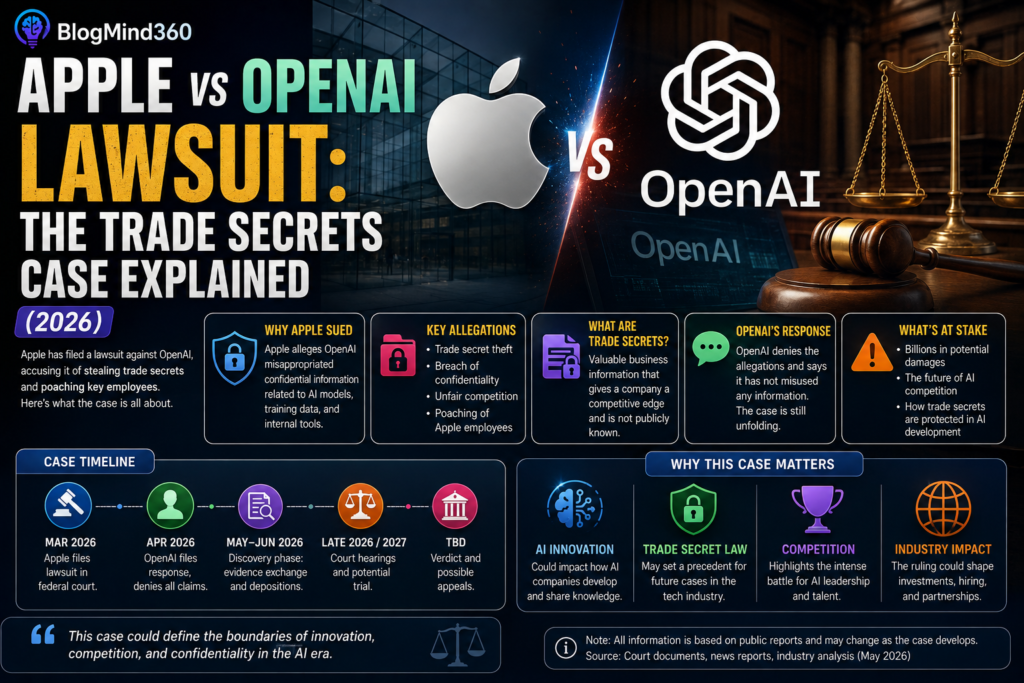
One of the most unexpected tech stories of 2026 is playing out in a California courtroom right now: Apple is suing OpenAI, the very company whose ChatGPT is built into iPhones through Apple Intelligence. What started as a trade secrets complaint in July has escalated fast — with Apple seeking an emergency injunction in early August, and OpenAI firing back with a public rebuttal and a formal motion to dismiss within days of each other.
This guide breaks down exactly what Apple is alleging, who’s involved, what OpenAI is saying in response, and what it could mean for the products millions of people already use every day.
Quick Answer: What Is the Apple vs OpenAI Lawsuit About?
Apple sued OpenAI on July 10, 2026, in the U.S. District Court for the Northern District of California, alleging trade secret theft and breach of contract. Apple claims former employees — including OpenAI’s Chief Hardware Officer Tang Tan, a 24-year Apple veteran — used confidential Apple information to help build OpenAI’s own consumer hardware device, reportedly connected to the venture co-founded by former Apple design chief Jony Ive. Apple is seeking damages, injunctions, and an order forcing OpenAI to stop using its trade secrets. In early August, Apple escalated by requesting a preliminary injunction and expedited discovery, while OpenAI responded publicly, calling the lawsuit “careless, aggressive and oddly personal,” and formally asked the court to dismiss the case on August 6.
That’s the short version. Here’s the full story, including the specific allegations, the timeline of events, and both sides’ arguments.
What Exactly Is Apple Alleging?
Apple’s complaint, filed in federal court, accuses OpenAI of running a coordinated scheme to extract confidential Apple information through former employees who joined the AI company — allegedly directed by senior OpenAI leadership. In its filing, Apple didn’t mince words: “At every level, from members of its Technical Staff to its Chief Hardware Officer, and in coordination with business partners, OpenAI has been stealing Apple’s trade secrets and confidential information.”
The 41-page complaint is packed with specific, colorful allegations, including internal messages. One cited communication reportedly reads: “LOL, I found out I can access the [network storage], so funny” — the kind of detail that has made this lawsuit unusually attention-grabbing even by Silicon Valley legal standards.
The Core Claims
According to court filings, Apple alleges that OpenAI, through its hardware leadership, engaged in several specific practices:
- Using Apple’s internal confidential project code names during recruiting conversations with candidates who still worked at Apple
- Asking job candidates to bring actual Apple hardware components — batteries, logic boards, and system-in-package (SIP) parts — to interviews for “show and tell”
- Circulating an internal “Need to Know” document originally tied to Apple’s own employee offboarding process, allegedly used to coach new OpenAI hires on how to evade Apple’s exit security procedures
- Soliciting details about Apple’s unannounced products from employees who had not yet left the company
Apple is asking the court for damages, injunctive relief, and an order requiring OpenAI to return any confidential materials and stop using the alleged trade secrets going forward.
Who Are Tang Tan and Chang Liu?
Two former Apple employees sit at the center of the case.
Tang Tan: OpenAI’s Chief Hardware Officer
Tang Tan spent 24 years at Apple, most recently serving as VP of product design for the iPhone and Apple Watch — about as senior and central a hardware role as exists at the company. Apple’s complaint alleges Tan personally used the company’s confidential internal codenames during OpenAI’s recruiting process and circulated internal Apple security-evasion guidance to new hires.
Chang Liu: The Laptop Allegation
Chang Liu, a former senior systems electrical engineer who spent eight years at Apple, is accused of a more specific act: allegedly failing to return an Apple-issued laptop after leaving the company for OpenAI, and using that device to download confidential Apple technical documents. According to the complaint, Liu accessed and downloaded dozens of confidential files — many explicitly labeled as confidential — while simultaneously developing hardware for OpenAI.
The Jony Ive Connection: OpenAI’s Hardware Ambitions
This lawsuit doesn’t exist in isolation — it’s tied directly to OpenAI’s push into consumer hardware, a venture with deep Apple roots of its own.
Jony Ive, Apple’s legendary former chief design officer, began collaborating with OpenAI in 2023 after departing Apple. Ive co-founded io Products — the dedicated hardware venture that Tang Tan also helped launch — and in May 2025, OpenAI announced its acquisition of io. Ive now leads OpenAI’s device work entirely.
Notably, Ive himself was not officially named as a defendant in Apple’s lawsuit, even though io — the company he co-founded — is named. That distinction has been widely noted by tech press covering the case: Apple’s legal action targets the alleged conduct of specific former employees and io as a corporate entity, rather than Ive personally.
OpenAI has separately confirmed plans for new hardware, with the company’s chief global affairs officer previously indicating a device launch was expected in the first half of 2026 — underscoring just how much is riding on this venture for OpenAI, and why Apple’s allegations strike directly at a major strategic bet for the AI company.
Timeline: How the Apple vs OpenAI Lawsuit Escalated
- July 10, 2026: Apple files its lawsuit against OpenAI in the U.S. District Court for the Northern District of California, alleging trade secret theft and breach of contract tied to Tang Tan, Chang Liu, and io Products.
- July 13, 2026: Detailed reporting surfaces on the specific allegations in the 41-page complaint, including the internal messages cited above.
- August 3–4, 2026: Apple escalates by filing a motion for a preliminary injunction, seeking to bar OpenAI and the two named former employees from accessing, using, or disclosing Apple’s alleged confidential information, alongside a request for expedited discovery. Apple’s filing states: “Apple will be irreparably harmed absent a preliminary injunction.”
- August 4, 2026 (evening): OpenAI responds within hours, publishing a blog post titled “Apple is getting this wrong,” disputing Apple’s account and publishing internal email correspondence.
- August 6, 2026: OpenAI formally files a Motion to Dismiss, arguing Apple’s allegations are meritless and that the lawsuit “falsely portrays” the actions of its employees.
OpenAI’s Response: “Apple Is Getting This Wrong”
OpenAI’s public rebuttal, published as a company blog post, is notably direct in tone. The company describes Apple’s lawsuit as “careless, aggressive and oddly personal,” and makes several specific counter-claims:
Disputing the Pre-Litigation Contact
OpenAI’s central factual dispute involves how — and whether — Apple actually raised its concerns before filing suit. According to OpenAI, Apple’s outside counsel emailed the wrong person entirely back in February 2026, apparently confusing two similar Asian last names. OpenAI published the underlying email chain as part of its rebuttal, which reportedly shows an acknowledgment and apology from Apple’s own counsel over the mix-up. OpenAI says it then heard nothing further about the specific allegations for five months before Apple filed suit in July — undercutting, in OpenAI’s view, Apple’s claim of urgency.
Denying Interest in Trade Secrets
OpenAI’s blog post directly addresses Apple’s request for a preliminary injunction, calling it “both based on false information and completely unnecessary because we do not have, nor want, any of their trade secrets.” The company adds: “We’re much more interested in building innovative products and technologies that push the frontier.”
The Internal Messages Apple Cited
OpenAI’s rebuttal includes iMessage screenshots reportedly showing Chang Liu — whose last day at Apple was January 22, 2026 — being asked by former Apple colleagues to help them locate files and information related to their own ongoing Apple work, rather than Liu proactively taking confidential material for OpenAI’s benefit. This detail directly challenges one of the more specific allegations in Apple’s complaint.
The Formal Motion to Dismiss
On August 6, OpenAI escalated its defense with a formal Motion to Dismiss, asking the presiding federal judge to throw out Apple’s case entirely. OpenAI’s lawyers argue Apple’s allegations are meritless and that the suit mischaracterizes the actions of the startup’s employees. As of this writing, the motion is pending before the court, alongside Apple’s competing request for a preliminary injunction — meaning both sides currently have significant, unresolved motions in front of the judge simultaneously.
The Bigger Picture: Apple and OpenAI’s Complicated Relationship
What makes this lawsuit especially striking is the existing relationship between the two companies. Apple and OpenAI entered a high-profile partnership in 2024, under which ChatGPT was integrated directly into iOS through Apple Intelligence — giving iPhone users built-in access to OpenAI’s chatbot for tasks Siri couldn’t handle on its own. That partnership, by most accounts, remains active even as the trade secrets lawsuit plays out, though Apple has not commented publicly on whether the legal dispute will affect it.
The lawsuit also lands at a sensitive moment for OpenAI more broadly. It comes just two months after OpenAI won a high-profile trial against Elon Musk, in which a federal jury found that Musk — an OpenAI co-founder — had waited too long to sue the company over claims that CEO Sam Altman, co-founder Greg Brockman, and the company had reneged on commitments to run OpenAI as a nonprofit. Musk has said he intends to appeal that ruling. On top of that, OpenAI is reportedly gearing up for what’s expected to be a historic IPO, meaning any prolonged, high-profile legal battle with a partner as significant as Apple carries real reputational and financial stakes beyond the courtroom itself.
The Musk and xAI Angle: A Separate but Related Lawsuit
Complicating the picture further, this isn’t the only active lawsuit connecting Apple and OpenAI. Separately, Elon Musk’s xAI sued both Apple and OpenAI in August 2025, alleging the two companies were colluding to favor ChatGPT’s placement in the iPhone’s App Store rankings at the expense of competitors like Musk’s own Grok chatbot. That case has continued to move forward: a federal judge has since ruled that xAI’s lawsuit against Apple and OpenAI can proceed, despite Apple’s attempts to have it dismissed.
xAI’s core argument is that because Apple integrated ChatGPT into iOS, iPhone users have effectively been steered away from other AI chatbots — including allegations of favoritism in App Store rankings and delays approving updates for competing AI apps. While legally distinct from Apple’s trade secrets case against OpenAI, the two lawsuits together paint a picture of an AI industry increasingly willing to fight out competitive disputes in federal court rather than behind closed doors — with Apple, notably, positioned as a defendant in one case and a plaintiff in the other, both involving OpenAI.
What This Means for Apple Intelligence and ChatGPT on Your iPhone
For the average iPhone user, the immediate practical impact of this lawsuit is minimal — ChatGPT integration within Apple Intelligence continues to function as normal, and neither company has indicated the partnership itself is at risk in the near term. However, the case is worth watching for a few reasons:
- It signals real strain in a high-profile AI partnership. Apple relying on a company it’s simultaneously suing in federal court for trade secret theft is an unusual arrangement, even by tech industry standards.
- It highlights how central former-employee talent flow has become to AI hardware competition. Apple’s specific allegations — around recruiting practices, security-evasion coaching, and confidential document handling — reflect just how aggressively AI companies are competing for hardware design talent with deep device-manufacturing experience.
- A ruling either way could set precedent. Depending on how the court rules on Apple’s preliminary injunction request and OpenAI’s motion to dismiss, the case could influence how trade secret disputes involving departing employees at major tech companies are litigated going forward — particularly in cases involving fast-moving AI hardware ventures.
If you’re interested in how the underlying AI technology at the center of this dispute actually works, our explainer on what artificial intelligence (AI) is is a good starting point, and our comparison of top AI writing assistants covers how tools like ChatGPT stack up against competitors in practical, everyday use.
What Happens Next in the Apple vs OpenAI Case
With both Apple’s motion for a preliminary injunction and OpenAI’s motion to dismiss now pending before the same federal judge, the next major development in the case will likely be a court ruling on one or both of these motions. A few scenarios are worth watching:
- If the judge grants Apple’s injunction request, OpenAI and the named former employees could be barred from using or disclosing the disputed information while the broader case continues — a significant near-term setback for OpenAI’s hardware timeline.
- If the judge grants OpenAI’s motion to dismiss, some or all of Apple’s claims could be thrown out before the case ever reaches discovery or trial, though Apple would likely have the opportunity to refile an amended complaint addressing any deficiencies the court identifies.
- If both motions are denied or only partially granted, the case would move into a more traditional discovery phase, where both sides exchange evidence — a process that could take months and potentially surface further internal communications from both companies.
Given the scale of both companies involved and the sensitivity of the underlying hardware venture, expect continued detailed coverage from major outlets as court dates are set and additional filings become public.
Why This Case Is Different From a Typical Trade Secrets Dispute
Trade secret litigation between tech companies isn’t new — but a few elements make the Apple vs OpenAI case stand out from the usual pattern of these disputes.
The Personal Nature of the Allegations
Most corporate trade secret cases focus narrowly on documents, code, or technical specifications changing hands improperly. Apple’s complaint goes further, alleging a recruiting culture problem at OpenAI’s hardware division — coaching new hires on evading security checks, soliciting unannounced product details from still-employed Apple staff, and asking candidates to physically bring in hardware components. That framing shifts the narrative from “an employee took some files” to “leadership allegedly built a system for extracting information,” which is part of why Apple’s complaint has drawn so much attention from tech and business press alike.
The Speed of OpenAI’s Public Response
It’s also worth noting how unusually fast and public OpenAI’s response has been. Rather than limiting its defense to court filings, OpenAI chose to publish a detailed blog post addressed directly to the public within hours of Apple’s injunction request, complete with screenshots of internal communications. That kind of public-facing legal strategy — essentially litigating in the court of public opinion alongside the actual courtroom — has become increasingly common among major tech companies, but the speed and detail of OpenAI’s rebuttal here was notable even by that standard.
The Stakes for Both Companies’ Reputations
For Apple, the case touches directly on the company’s long-standing reputation for operational secrecy and security around unreleased products — arguably one of its most closely guarded competitive advantages for decades. For OpenAI, defending against allegations that senior leadership personally orchestrated a scheme to poach confidential competitor information arrives at a particularly sensitive moment, given the company’s ongoing efforts to position itself as a responsible, trustworthy steward of increasingly powerful AI technology ahead of a widely anticipated public offering.
Frequently Asked Questions About the Apple vs OpenAI Lawsuit
Why is Apple suing OpenAI?
Apple filed suit on July 10, 2026, alleging that OpenAI, through former Apple employees including Chief Hardware Officer Tang Tan and engineer Chang Liu, stole confidential Apple trade secrets to help develop OpenAI’s own consumer hardware device.
Who are the key people named in Apple’s lawsuit?
The two central former-Apple employees named are Tang Tan, OpenAI’s Chief Hardware Officer and a 24-year Apple veteran, and Chang Liu, a former senior systems electrical engineer who spent eight years at Apple. Jony Ive, Apple’s former chief design officer who now leads OpenAI’s device work, was not personally named as a defendant, though io Products, the venture he co-founded, is referenced in the case.
What is io Products, and why does it matter to this lawsuit?
io Products is the hardware venture co-founded by Jony Ive and Tang Tan, which OpenAI acquired in May 2025. Apple alleges that confidential Apple information was used to help develop io’s hardware, which Ive now leads as part of OpenAI’s broader device ambitions.
How has OpenAI responded to Apple’s lawsuit?
OpenAI published a public rebuttal on August 4, 2026, titled “Apple is getting this wrong,” disputing Apple’s claims and publishing internal correspondence. On August 6, 2026, OpenAI formally filed a Motion to Dismiss, arguing Apple’s allegations are meritless.
Did Apple ask the court for an injunction against OpenAI?
Yes. In early August 2026, Apple filed a motion for a preliminary injunction seeking to bar OpenAI and the two named former employees from accessing, using, or disclosing Apple’s alleged confidential information, along with a request for expedited discovery.
Does this lawsuit affect ChatGPT’s integration with Apple Intelligence?
As of this writing, there’s no indication the lawsuit has affected the existing Apple-OpenAI partnership that brings ChatGPT into Apple Intelligence on iPhones. Apple has not commented publicly on whether the legal dispute could affect that arrangement going forward.
Is this the only lawsuit involving Apple and OpenAI right now?
No. Separately, Elon Musk’s xAI sued both Apple and OpenAI in August 2025, alleging the companies colluded to favor ChatGPT’s placement in the iPhone App Store over competitors like Grok. A federal judge has ruled that lawsuit can proceed.
What is Apple asking for in its lawsuit against OpenAI?
Apple is seeking damages, injunctive relief, an order requiring OpenAI to return any confidential Apple materials, and a court order preventing OpenAI from using the alleged trade secrets going forward.
When was Apple’s lawsuit against OpenAI filed?
Apple filed its original complaint on July 10, 2026, in the U.S. District Court for the Northern District of California.
What happens next in the case?
Both Apple’s request for a preliminary injunction and OpenAI’s motion to dismiss are currently pending before the court. A ruling on either motion would represent the next major development, potentially followed by a discovery phase if the case proceeds.
Conclusion: A High-Stakes Legal Fight Between Two AI Giants
The Apple vs OpenAI lawsuit is a rare case of two companies with an active, high-profile consumer partnership simultaneously locked in a bitter federal court battle over allegations of stolen trade secrets. With Apple accusing OpenAI’s hardware leadership — up to and including its Chief Hardware Officer — of running a coordinated scheme to extract confidential information, and OpenAI firing back with a detailed public rebuttal and a motion to dismiss within days, this case has escalated faster and more publicly than most corporate trade secret disputes.
Whatever the court ultimately decides, the lawsuit has already offered an unusually candid look at how aggressively AI companies are competing for hardware talent with deep experience at established device makers — and how personal, and public, those disputes can become once they land in federal court. With both sides’ major motions still pending, the next few weeks are likely to bring further developments worth watching closely.
For more technology news, AI explainers, and buying guides, explore our full Technology section or check out our breakdown of what artificial intelligence actually is.