
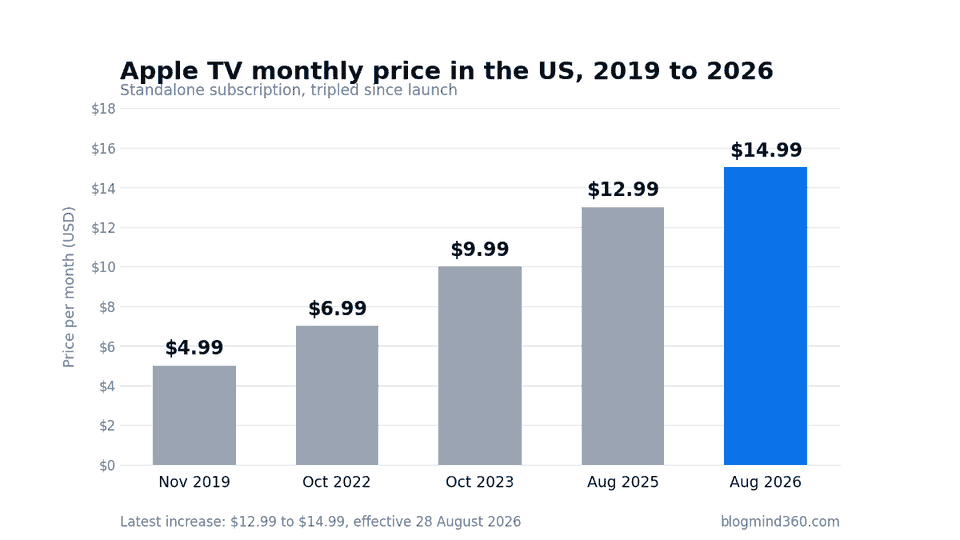
Quick Answer: The Apple TV price increase 2026 took effect on Friday, August 28, 2026. The standalone US subscription now costs $14.99 per month, up from $12.99, and the annual plan jumped to $119 from $99. Apple One Individual, the cheapest bundle that includes Apple TV, moved to $21.95 per month from $19.95. New subscribers pay the new rates immediately. Existing subscribers keep their old price until Apple notifies them, usually about a month before the higher charge hits their billing cycle. This is the fourth US price rise in four years for a service that launched at $4.99 in 2019.
What exactly changed in the Apple TV price increase 2026
Apple confirmed the new pricing on the morning of August 28 and switched it on the same day. There was no long lead-in and no advance campaign. If you signed up for Apple TV that afternoon, you paid the new rate.
Two products moved. The standalone Apple TV subscription went up, and the Individual tier of the Apple One bundle went up alongside it. The Family and Premier tiers of Apple One were left where they were, because those two had already been raised back in July when Apple Music got more expensive.
| Plan | Old US price | New US price | Increase |
|---|---|---|---|
| Apple TV monthly | $12.99 | $14.99 | $2.00 per month |
| Apple TV annual | $99 | $119 | $20 per year |
| Apple One Individual | $19.95 | $21.95 | $2.00 per month |
| Apple One Family | $27.95 | $27.95 | No change in August |
| Apple One Premier | $39.95 | $39.95 | No change in August |
The increase was not limited to the United States. Apple TV prices also moved in Brazil, Chile and Mexico on the same day. No other markets were listed as affected at launch, which suggests Apple is adjusting territory by territory rather than pushing a single global reset.
It also helps to see this alongside what happened six weeks earlier. On July 17, Apple raised Apple Music across the board: Individual went from $10.99 to $11.99, Family from $16.99 to $19.99, and Student from $5.99 to $6.99. Apple One Family and Premier each went up $2 in that round, while Individual was deliberately left alone. August’s Apple TV increase is what finally pushed the cheapest bundle higher, which means Apple has now raised the price of every subscription tier it sells in the space of six weeks.
When will you actually be charged the new price?
This is the part most people get wrong, and it matters if you are trying to decide whether to cancel.
New subscribers were charged $14.99 from August 28. Existing subscribers were not. Apple’s standard practice with subscription price changes is to email affected customers roughly one month before the new rate applies, and the higher charge then lands on the first billing cycle after that notice period ends.
In practice that means the exact date varies by account. Someone who renews on the 3rd of the month will see the increase at a different time than someone who renews on the 27th. If you are on the annual plan, you will not feel anything until your renewal date comes round, which could be as much as eleven months away.
The practical advice is simple. Do not assume your next charge will be $14.99. Open your Apple Account subscription settings, check the renewal date shown there, and wait for the email. If you want to switch to the annual plan or cancel, doing it before that notice period ends is the cheapest moment to act.
Why did Apple raise the price again?
Apple did not publish a detailed justification for the Apple TV increase the way it did in July, when it told music industry partners that rising licensing costs were behind the Apple Music rise. For Apple TV, the reasoning has to be read from what the service has become.
Over the past year, Apple has been stuffing content into a subscription that used to be a small originals library. It became the exclusive US broadcast partner for Formula 1, and that racing coverage is included in the standard Apple TV price rather than sold as an add-on. Major League Soccer streaming was folded in this year too, which removed the separate MLS Season Pass paywall for subscribers. Add a steady run of high-profile originals and the cost base looks very different from 2019.
The business context helps as well. Apple’s services division has been the reliable growth engine, with revenue up 12 percent to $30.7 billion in the June quarter. Executives have said Apple TV viewership hit an all-time high, though the company still refuses to break out subscriber numbers or streaming revenue. When a service is growing and management believes it has pricing power, a $2 increase is a low-risk way to convert that into margin.
There is also a wider inflationary story running through consumer tech in 2026. Component shortages driven by AI data centre demand have pushed hardware prices up across the board, something we covered in detail in our breakdown of the 2026 GPU price hike. Subscriptions are following the same direction, just more quietly.
How the Apple TV price has changed since 2019
Apple TV launched in November 2019 at $4.99 a month. It held that price for nearly three years, which felt generous at the time because the library was thin and Apple was buying market entry.
The increases since then have come faster and larger:
- October 2022: $4.99 to $6.99, a 40 percent rise
- October 2023: $6.99 to $9.99, a 43 percent rise
- August 2025: $9.99 to $12.99, a 30 percent rise
- August 2026: $12.99 to $14.99, a 15 percent rise
The monthly price has tripled in under seven years. What is notable is that the percentage jumps are getting smaller even as the dollar amounts stay similar, which is what you would expect from a service moving out of land-grab pricing and into normal streaming economics.
The annual plan tells a slightly different story. Apple left it at $99 during the 2025 increase, which made twelve months of Apple TV a genuinely good deal for a year. That gap has now been partly closed, though as we will see below, the annual plan is still where the savings are.
How does Apple TV compare with Netflix, Peacock and Paramount+?
At $14.99, Apple TV is no longer a budget option. It now sits above most rivals’ headline tiers and below only Netflix’s ad-free plans.
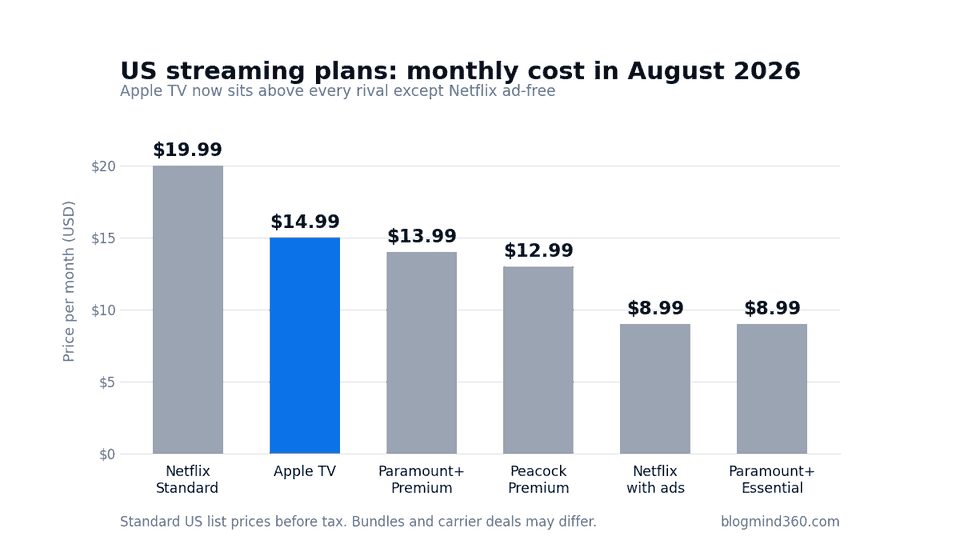
Here is where the major services stand after a year of near-continuous increases:
| Service | Entry tier | Ad-free or standard tier | Last US increase |
|---|---|---|---|
| Netflix | $8.99 with ads | $19.99 Standard, $26.99 Premium | March 26, 2026 |
| Apple TV | No ad tier | $14.99 | August 28, 2026 |
| Paramount+ | $8.99 Essential | $13.99 Premium with Showtime | January 15, 2026 |
| Peacock | $8.99 Select | $12.99 Premium, $19.99 Premium Plus | August 18, 2026 |
Two things stand out. First, Apple TV is now the most expensive major service that has no advertising tier at all. Netflix, Peacock and Paramount+ all offer a cheaper way in for viewers willing to sit through commercials. Apple does not, so $14.99 is the floor rather than the ceiling.
Second, the increases are clustering. Peacock raised every tier ten days before Apple moved. ESPN’s Unlimited plan is scheduled to go up next month. Netflix raised prices in March and YouTube Premium followed in April. If you subscribe to four or five services, your total bill has almost certainly moved twice this year without you deciding anything.
Is Apple One still worth it after the increase?
Counterintuitively, the August increase made the Apple One Individual bundle look slightly better, not worse, for anyone who already pays for two Apple services.
Apple One Individual costs $21.95 and includes Apple TV, Apple Music, Apple Arcade and 50GB of iCloud+ storage. Buy just the first two separately and you are at $26.98 per month, because Apple Music Individual is now $11.99 after July’s increase. The bundle saves you just over $5 a month before you count Arcade or the storage at all.
The Family tier tells a similar story. Apple One Family is $27.95. Apple Music Family alone is $19.99. Adding Apple TV on top puts you at $34.98 for two services, against $27.95 for four plus 200GB of shared iCloud+.
The catch is the one every bundle has. Savings are only real if you would have paid for the services anyway. If nobody in your household opens Apple Arcade and you already have a Google or Dropbox storage plan, you are paying $21.95 for two things you actually use rather than $26.98. That is still a saving, but it is a smaller one than the marketing suggests.
The shared storage limit is worth checking too. On Family, the 200GB iCloud+ allowance is pooled across everyone rather than allocated per person. A household of five with heavy photo and video habits can hit that ceiling in months.
Is Apple TV worth $14.99 a month in 2026?
The honest answer depends on whether you watch sport.
If you follow Formula 1 in the United States, Apple TV is close to essential now, and $14.99 for a full season of racing plus everything else is defensible. The same logic applies to MLS fans, who used to pay separately for Season Pass and now get it inside the base subscription.
If you are here purely for the originals, the calculation is harder. Apple TV has a genuinely strong hit rate. Shows like Severance, Ted Lasso, Slow Horses and The Morning Show have carried the platform, and the library keeps expanding. But it remains a small catalogue by volume compared with Netflix or the Disney and Hulu combination. You are paying premium prices for curation rather than depth.
For most households the sensible framing is not “is this worth $14.99 every month” but “is this worth $14.99 during the months something I want is airing.” Apple TV is unusually well suited to rotation, because its releases are concentrated around specific season premieres rather than spread thin across a huge back catalogue.
What you actually get for $14.99
It is worth being precise about what the single subscription now covers, because Apple has quietly turned Apple TV into a bundle of its own:
- The full Apple Originals catalogue of series, films and documentaries
- Exclusive US Formula 1 coverage for the season, with no separate sports add-on
- Major League Soccer streaming, previously sold as MLS Season Pass
- Ad-free playback on every title, since there is no advertising tier
- Offline downloads and up to six family members through Family Sharing
Measured against a service that charges extra for sport, the sports inclusions alone account for a meaningful share of the price. Measured against a general entertainment library, it looks expensive. Which comparison you use decides whether the increase feels fair.
Seven ways to pay less for Apple TV
The price went up, but almost nobody has to pay the full monthly rate if they plan ahead.
1. Switch to the annual plan
This is the single biggest saving available. Twelve months at $14.99 comes to $179.88. The annual plan is $119. That is a saving of $60.88 a year, which works out to roughly $9.92 per month. Even after the increase, the annual plan is cheaper per month than Apple TV was before the increase.
2. Move to Apple One if you use two or more Apple services
As shown above, Individual at $21.95 beats buying Apple TV and Apple Music separately at $26.98. If Apple Music is already in your budget, the bundle is close to a free upgrade.
3. Use the student route
Students on the Apple Music Student plan get Apple TV included at no extra charge. Apple Music Student is $6.99 per month after July’s increase, which makes it the cheapest legitimate path to Apple TV by a wide margin. You need to verify enrolment through Apple’s verification partner, and the discount runs for up to four years or until you graduate.
4. Claim the device trial
Buying a new iPhone, iPad, Mac or Apple TV box from Apple or an authorised reseller gets you three months of Apple TV free. The offer generally needs to be redeemed within 90 days of activating the device, and it is one offer per Family Sharing group. If you are already planning a purchase around the September 2026 Apple event, that timing lines up well.
5. Start with the free trials
New subscribers get a seven-day free trial through the Apple TV app. New Apple One subscribers who have not used the included services before typically get a full month. Neither is a long-term fix, but a month of Apple One costs nothing and lets you test whether the bundle maths works for your household.
6. Check your carrier and streaming bundles
Mobile carriers regularly discount Apple TV as a retention perk, and the terms change often. It is worth checking what your current plan already includes before paying Apple directly. Our guide to the best cell phone plans in 2026 covers which carriers bundle streaming and how those perks compare. Cross-platform streaming bundles that pair Apple TV with another service also exist and can undercut buying both separately.
7. Rotate instead of subscribing year-round
Pick the two or three months when the shows you actually want are airing, subscribe, watch, and cancel. Because Apple TV releases weekly rather than dumping full seasons, a single subscription month usually covers most of a season. Set a calendar reminder for the day before renewal so you do not drift into paying for months you did not use.
How to cancel Apple TV
Cancelling is straightforward, and you keep access until the end of the period you have already paid for.
On the web: Go to tv.apple.com, click the account icon in the top right, then open Settings, find Subscriptions, choose Manage, and select Cancel Subscription.
On iPhone or iPad: Open Settings, tap your name at the top, tap Subscriptions, select Apple TV, then tap Cancel Subscription.
On a Mac: Open the Apple TV app, click your account in the menu bar, choose Account Settings, sign in, then manage your subscription from there.
One thing to watch. If you subscribed through a third party such as Amazon Channels, a carrier, or a smart TV app store, you have to cancel through that provider rather than through Apple. The billing relationship sits with whoever charged your card, which is also why prices sometimes look different across platforms.
What this means for your total streaming bill
The individual increase is small. The cumulative one is not.
Run the numbers on a common four-service household: Netflix Standard at $19.99, Apple TV at $14.99, Peacock Premium at $12.99 and Paramount+ Essential at $8.99. That is $56.96 a month, or $683.52 a year, before tax. Every one of those four prices moved upward in 2026.
Three habits keep that number under control. Audit what you are paying quarterly rather than annually, because subscription creep is invisible month to month. Move anything you keep year-round onto annual billing, where the discount is usually equivalent to two free months. And treat everything else as rotational rather than permanent.
It is also worth doing the same audit on the software subscriptions people forget about. Security software in particular tends to auto-renew at rates well above what new customers pay, and our comparison of the best antivirus software in 2026 shows how wide that gap can get.
Frequently asked questions
How much does Apple TV cost now?
Apple TV costs $14.99 per month or $119 per year in the United States as of August 28, 2026. There is no ad-supported tier, so $14.99 is the cheapest standalone monthly option.
Will my Apple TV price go up immediately?
Only if you are a new subscriber. Existing subscribers keep their current rate until Apple sends a notification, typically about a month before the higher price applies to their next billing cycle. Annual subscribers will not see any change until renewal.
Did Apple One go up in price too?
The Individual tier rose from $19.95 to $21.95 on August 28. The Family tier stayed at $27.95 and Premier stayed at $39.95, because both had already been increased by $2 in July alongside the Apple Music rise.
Is the Apple TV annual plan worth it?
Yes, if you plan to keep the subscription for more than eight months. At $119 a year against $179.88 for twelve monthly payments, the annual plan saves $60.88 and brings the effective cost below $10 per month.
Can I still get Apple TV for free?
Yes, temporarily. New subscribers get a seven-day trial through the app, buyers of new Apple devices get three months free if they redeem within 90 days of activation, and students on the Apple Music Student plan get Apple TV included at no additional cost.
Why does Apple keep raising the Apple TV price?
Apple has significantly expanded what the subscription includes, adding exclusive US Formula 1 coverage and MLS streaming at no extra charge, alongside a growing originals slate. Rising content and licensing costs across the streaming industry have pushed nearly every major service to increase prices in 2026.
The bottom line
The Apple TV price increase 2026 is modest in isolation and significant in aggregate. Two dollars a month will not break anyone’s budget, but it is the fourth rise in four years, it arrives in a year when almost every competitor has done the same, and it lands on a service with no cheaper ad-supported escape hatch.
If you are keeping Apple TV, switch to the annual plan or check whether Apple One already makes sense for your household. If you are on the fence, use the window before your notification email arrives to decide. Apple is unlikely to be finished, and history suggests the next increase will arrive around this time next year.
For more on what Apple has coming, read our preview of the iPhone 18 series, and see how Apple is changing everyday payments in our look at Walmart finally accepting Apple Pay. If security is on your mind, our explainer on Apple’s spyware threat notifications is worth ten minutes.