
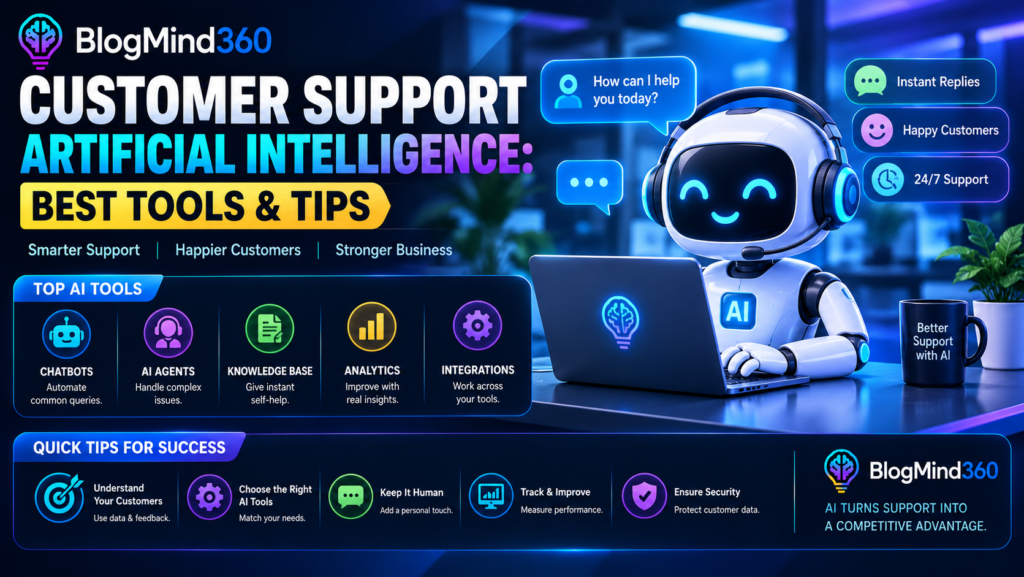
Quick Answer: Customer support artificial intelligence tools now handle a large share of routine inquiries automatically, using chatbots to answer common questions instantly while routing complex issues to human agents. Platforms like Zendesk, Intercom, and Tidio use AI to resolve 30-50% of support tickets without any human involvement, cutting response times from hours to seconds for common questions. Businesses using AI-assisted support typically see both lower support costs and higher customer satisfaction, provided the handoff to human agents stays smooth for anything the AI can’t handle well.
How AI Is Changing Customer Support
Customer support artificial intelligence has moved past simple scripted chatbots that could only handle exact keyword matches. Modern AI support tools understand natural language, pull relevant information from a company’s knowledge base in real time, and can handle genuinely complex, multi-step conversations, not just simple FAQ lookups.
This matters because customer expectations around response time have risen sharply. Customers increasingly expect an immediate response, something a human support team simply can’t provide around the clock without AI handling the routine volume that would otherwise overwhelm available staff.

What AI Customer Support Tools Actually Do
- Instant chatbot responses for common questions like order status, return policies, and basic troubleshooting, available 24/7 without wait times.
- Smart ticket routing, automatically directing complex or sensitive issues to the right specialized human agent instead of a generic queue.
- Sentiment analysis, flagging frustrated or upset customers for priority human attention before a situation escalates further.
- Agent assist features, suggesting relevant knowledge base articles or response drafts to human agents in real time, speeding up their response without fully automating the interaction.
Best AI Customer Support Platforms
Our help desk software comparison covers detailed pricing, but at a high level, a few platforms stand out specifically for their AI capabilities:
- Zendesk combines AI-powered ticket routing with a robust knowledge base integration, well-suited for mid-size to larger support teams.
- Intercom focuses heavily on conversational AI chatbots that can handle fairly complex, multi-turn conversations before escalating to a human.
- Tidio offers a more accessible entry point for smaller businesses, with AI chatbot features built into affordable plans.

Getting the Human Handoff Right
The biggest risk with AI customer support isn’t the technology itself, it’s a poor handoff when AI can’t resolve an issue. Customers get frustrated quickly when forced to repeat information they already gave a chatbot, or when stuck in an automated loop with no clear way to reach a human. Well-designed AI support systems make escalating to a human agent simple and preserve full conversation context, so customers never have to start over.
This handoff design matters as much as the AI’s actual capability, since a technically impressive chatbot that traps frustrated customers in automated responses can do more damage to customer satisfaction than having no chatbot at all.
Measuring AI Customer Support Success
| Metric | What to Track |
|---|---|
| Deflection rate | Percentage of inquiries fully resolved by AI without human involvement |
| Escalation satisfaction | Customer satisfaction specifically for tickets that got handed off to a human |
| Response time | Time to first response, both for AI and human-handled tickets |
| Resolution accuracy | How often AI-provided answers are actually correct and helpful |
Common AI Customer Support Mistakes
- Making the chatbot too hard to escape, frustrating customers who need genuine human help for a complex issue.
- Deploying AI without a solid knowledge base behind it, resulting in inaccurate or unhelpful automated answers.
- Ignoring sentiment signals, missing opportunities to proactively route upset customers to a human before the situation escalates.
- Never reviewing AI conversation transcripts, missing recurring issues the AI struggles to handle well.
Frequently Asked Questions
Will AI customer support fully replace human support agents?
Unlikely for most businesses. AI handles routine, repetitive inquiries well, but complex, sensitive, or emotionally charged issues still benefit significantly from human judgment and empathy.
How accurate are AI customer support chatbots?
Accuracy depends heavily on the quality of the underlying knowledge base. Well-maintained systems can achieve high accuracy on common questions, while poorly maintained ones frequently give outdated or incorrect answers.
Is AI customer support affordable for small businesses?
Yes. Tools like Tidio offer AI chatbot features at accessible price points specifically designed for smaller support volumes and budgets.
Do customers actually prefer AI chatbots over waiting for a human?
For simple questions, most customers prefer the instant response of a chatbot. For complex or sensitive issues, most still strongly prefer reaching a human agent.
Bottom Line
Customer support artificial intelligence genuinely improves response times and reduces support costs when implemented well, but success depends heavily on a solid knowledge base and a smooth handoff to human agents when AI reaches its limits. Focus on deflecting routine, simple inquiries with AI while keeping a clear, frustration-free path to human support for everything else.