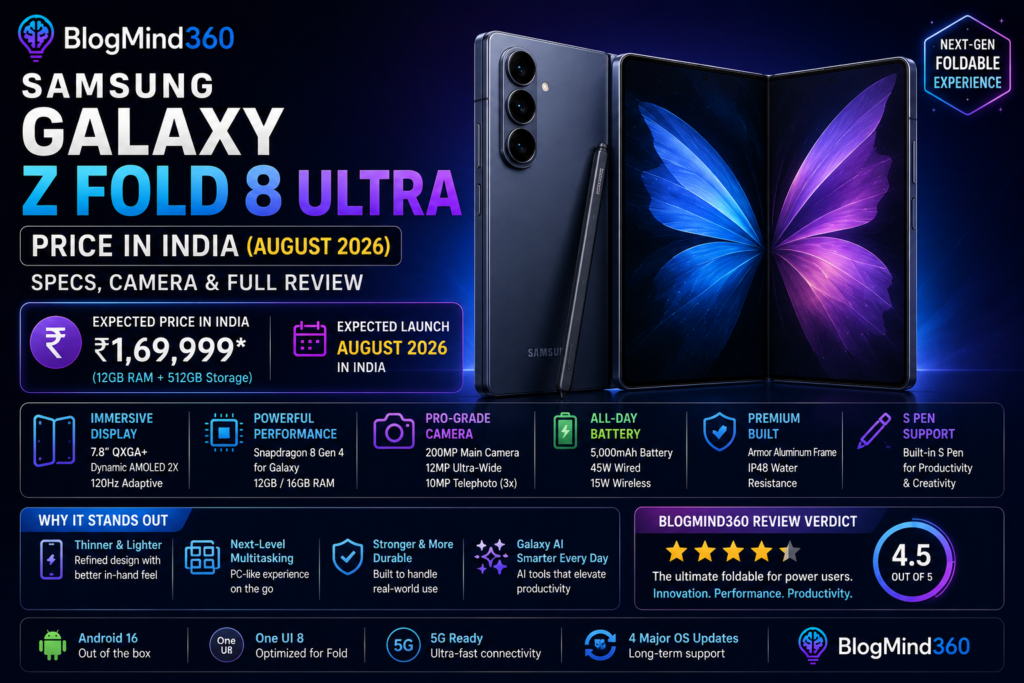
Quick Answer: The Samsung Galaxy Z Fold 8 Ultra price in India starts at ₹1,99,999 for the 12GB+256GB variant, going up to ₹2,59,999 for the top 16GB+1TB configuration. Alongside it, the standard Galaxy Z Fold 8 starts at ₹1,79,999. Both launched in India on August 7, 2026, following a July 22 Unpacked event that racked up 271,000 pre-orders in just 72 hours. This is Samsung’s biggest and most differentiated foldable lineup yet — the Fold 8 gets a genuinely wider cover screen to fix foldables’ long-standing usability complaint, while the Ultra pushes further into flagship territory with a 200MP camera and Flex Titanium hinge. Here’s everything you need to know before buying.
If you’ve been searching for the Samsung Galaxy Z Fold 8 Ultra price in India, you’re looking at what might be the most significant foldable phone update Samsung has shipped in years — not because of a single headline spec, but because Samsung has finally split its Fold lineup into two genuinely different devices rather than one phone with a storage bump. This guide covers pricing, specs, and which of the two new Folds actually makes sense for you.
Galaxy Z Fold 8 Ultra Price in India (August 2026)
Samsung unveiled the Galaxy Z Fold 8 series at its Unpacked event in London on July 22, 2026, with sales in India beginning August 7 following a two-week pre-order window.
| Variant | Price in India |
|---|---|
| 12GB RAM + 256GB Storage | ₹1,99,999 |
| 12GB RAM + 512GB Storage | ₹2,19,999 |
| 16GB RAM + 1TB Storage | ₹2,59,999 |
Launch offers include an upgrade bonus of up to ₹10,000, bank cashback of ₹9,000, and no-cost EMI options stretching up to 30 months — worth factoring in given how steep the sticker price is even for Samsung’s foldable category. If this is well outside your budget, our coverage of the Samsung Galaxy S26 Ultra covers Samsung’s standard (non-folding) flagship at a considerably lower starting price.
The Standard Galaxy Z Fold 8: A Genuinely Different Phone This Year
What makes 2026 different from previous Fold generations is that Samsung didn’t just launch one Fold and an Ultra variant with more storage — it built a second, meaningfully distinct device. The standard Galaxy Z Fold 8 (starting at ₹1,79,999) now features a notably wider cover screen than any previous generation, directly addressing the single biggest usability complaint foldable owners have had for years: a cramped, unusably narrow outer display that made the phone feel like two separate compromises rather than one great device.
This wider-cover-screen approach appears to be a direct response to competitive pressure, including anticipation of Apple’s rumoured foldable iPhone. Early reviews have specifically praised the change, with several outlets noting this is the first Fold that “finally feels like a real phone” rather than a folding tablet with an awkward secondary display bolted on.
What Makes the Ultra Different
The Z Fold 8 Ultra sits above the standard Fold 8 as Samsung’s most premium foldable, and the differences go beyond just storage tiers this year. The Ultra retains the taller, more traditional book-style aspect ratio geared toward productivity and multitasking, rather than the wider cover screen of the standard model — a deliberate choice for buyers who prioritize the inner tablet-style display experience over cover-screen usability. It also gets Samsung’s most advanced camera system, additional RAM headroom, and Flex Titanium construction for improved durability at the hinge, historically the most failure-prone part of any foldable phone.
Display Specifications
- Main display: 8-inch Dynamic AMOLED 2X with Flex Titanium technology, reducing visible crease compared to previous generations
- Refresh rate: 120Hz
- Peak brightness: Up to 3,000 nits, based on real-world testing
- Thermal management: Expanded graphite chamber for effective heat dissipation during heavy multitasking
The 3,000-nit peak brightness figure is a genuine step up for the foldable category, where display brightness has historically lagged behind flat-screen flagships due to the added complexity of a folding panel.
Performance: Snapdragon 8 Elite Gen 5 for Galaxy
The Z Fold 8 Ultra runs on the same Snapdragon 8 Elite Gen 5 for Galaxy chipset found in the standard Galaxy S26 Ultra, built on a 3nm process and paired with 12GB or 16GB of RAM. Storage goes up to a substantial 1TB using UFS 4 for fast app launches and file transfers. This puts the Fold 8 Ultra solidly at true flagship performance levels — there’s no meaningful compromise here compared to Samsung’s non-folding flagship, which historically hasn’t always been true of foldable phones relative to their flat-screen counterparts.
Camera: A Genuine Step Up
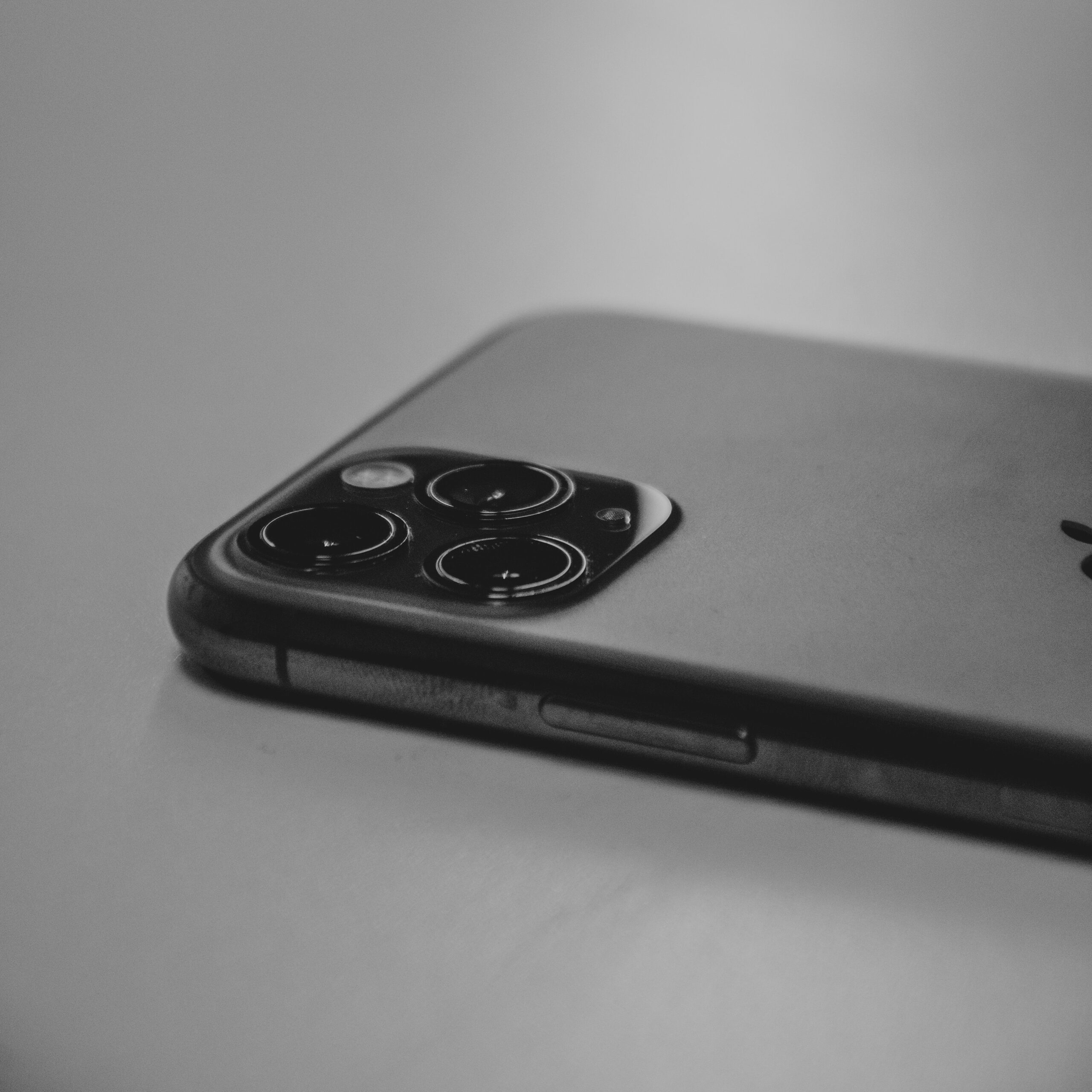
The Z Fold 8 Ultra features a 200MP main sensor, a 50MP secondary lens, and a 10MP telephoto lens, paired with a 10MP front camera. This is a meaningful upgrade over the Z Fold 7’s camera system, which topped out at 200MP main with less capable supporting lenses. The camera also supports 8K APV video recording — a feature previously reserved for Samsung’s non-folding flagships — bringing the Fold line’s imaging capabilities much closer to parity with the standard Galaxy S-series rather than treating the camera as a secondary consideration behind the folding mechanism.
Battery and Charging
The Z Fold 8 Ultra packs a 5,000mAh battery, up from the Z Fold 7’s 4,400mAh — a genuinely welcome capacity increase for a phone that runs two power-hungry displays. Charging is handled via 65W fast wired and wireless charging, reaching roughly 65% in 30 minutes according to Samsung’s figures. This is a category where foldables have traditionally trailed flat-screen flagships, so the combined battery and charging improvements this generation are a meaningful quality-of-life upgrade rather than a marginal spec bump.
Full Specifications at a Glance
| Spec | Galaxy Z Fold 8 Ultra |
|---|---|
| Main Display | 8-inch Dynamic AMOLED 2X, Flex Titanium, 120Hz, 3,000 nits |
| Chipset | Snapdragon 8 Elite Gen 5 for Galaxy (3nm) |
| RAM | 12GB / 16GB |
| Storage | 256GB / 512GB / 1TB (UFS 4) |
| Rear Camera | 200MP + 50MP + 10MP, 8K APV video |
| Front Camera | 10MP |
| Battery | 5,000mAh, 65W wired/wireless charging |
| Software | Android 17 |
| Starting Price (India) | ₹1,99,999 |
Galaxy Z Fold 8 Ultra vs Standard Z Fold 8: Which Should You Buy?
This is the key decision this generation, and it’s genuinely not obvious which is “better” — the two phones are built around different priorities rather than one simply being a scaled-down version of the other. The standard Z Fold 8 (₹1,79,999) is the better pick if you specifically want the wider, more usable cover screen and don’t mind a smaller 4,800mAh battery and simpler dual-camera setup. The Ultra (₹1,99,999) is the better pick if you prioritize the inner display experience, want the strongest possible camera system, and value the larger battery and Flex Titanium build over cover-screen width. If you split time roughly evenly between the cover screen and unfolded use, it’s worth handling both in person before deciding, since the difference in daily usability between the two cover screen designs is significant enough to shape which one actually fits your habits.
Galaxy Z Fold 8 Ultra vs Galaxy S26 Ultra
Against Samsung’s non-folding flagship, the Galaxy S26 Ultra, the Fold 8 Ultra costs roughly ₹60,000 more at the entry tier, and that premium buys you the tablet-style unfolded display and productivity multitasking that a traditional flagship simply can’t offer. Camera performance, chipset, and general day-to-day polish are broadly comparable between the two now that the Fold’s camera system has closed much of the gap with Samsung’s standard flagship. The decision essentially comes down to whether the foldable form factor’s productivity and multitasking benefits are worth the substantial price premium for your specific use case.
Pros and Cons
What We Like
- Genuine camera upgrade with 200MP main sensor and 8K video, closing the gap with Samsung’s flat-screen flagship
- Larger 5,000mAh battery, a meaningful jump from the Z Fold 7’s 4,400mAh
- Flex Titanium construction improves hinge durability and reduces crease visibility
- Fast 65W wired and wireless charging, unusually strong for the foldable category
- 3,000-nit peak display brightness, a genuine step up for foldable displays
What Could Be Better
- Starting price of ₹1,99,999 remains firmly in ultra-premium territory
- Retains the taller, narrower cover screen rather than the wider one on the standard Fold 8
- Choosing between the Ultra and standard Fold 8 requires understanding genuinely different trade-offs, adding purchase complexity
- Foldables remain a considered, higher-risk purchase given the mechanical hinge, even with durability improvements
Who Should Buy the Galaxy Z Fold 8 Ultra?
This phone is built for buyers who genuinely use the unfolded tablet-style display for productivity — multitasking between apps, reading and annotating documents, or content creation — and who want the strongest possible foldable camera system alongside it. It’s a strong pick for professionals who’ve been waiting for a foldable camera experience that doesn’t meaningfully compromise compared to a standard flagship. If your primary use case is quick, cover-screen-first interactions rather than frequent unfolding, the standard Z Fold 8’s wider cover screen will likely serve you better for a lower price.
Flex Titanium: What It Actually Changes
The hinge has historically been the single biggest reliability concern for foldable phones, and Samsung’s Flex Titanium construction on the Z Fold 8 Ultra is a direct response to that. Titanium is significantly stronger and more fatigue-resistant than the aluminum alloys used in earlier Fold generations, meaning the hinge mechanism should hold up better to years of repeated folding without the mechanical looseness or crease deepening that affected some older Fold models over extended use. The visible crease on the inner display is also reduced compared to previous generations, addressing a cosmetic complaint that, while not affecting functionality, has been a consistent point of criticism in foldable reviews across the industry. For buyers planning to keep their Fold for the traditional two-to-three year upgrade cycle, this durability improvement is arguably as important as any single spec bump this generation.
Software and Multitasking Features
The Z Fold 8 Ultra ships with Android 17, and Samsung’s multitasking software has continued to mature alongside the hardware — split-screen app pairs, drag-and-drop between windows, and S Pen support (with a compatible stylus) for note-taking directly on the unfolded display all remain core to the Fold experience. For buyers coming from a standard flagship phone, the adjustment period to using a larger, book-style unfolded display for productivity tasks is real but generally short, and most reviewers who’ve spent extended time with recent Fold generations describe the multitasking capability as a genuine, hard-to-replicate advantage over flat-screen phones once you build the habit of using it.
Should You Wait for a Price Drop?
Given how recently the Z Fold 8 Ultra launched, meaningful price drops are unlikely in the immediate term, though the current launch offers — the ₹10,000 upgrade bonus and ₹9,000 bank cashback — already represent a genuine discount off the sticker price worth taking advantage of now rather than waiting. Historically, Samsung’s foldable pricing has seen modest reductions during major sale events like Flipkart’s Big Billion Days or Amazon’s equivalent later in the year, so if you’re not in urgent need of an upgrade, it’s reasonable to watch for those windows. If the productivity benefits of the foldable form factor are pulling at you now, the current launch offers make this a reasonable time to buy rather than a clear case for waiting.
EMI and Exchange Options
Given the substantial price, most buyers will want to explore financing. No-cost EMI options extending up to 30 months are available through Samsung’s own store and major e-commerce platforms, making the effective monthly cost considerably more manageable than the upfront price suggests. Exchange offers on an older phone — particularly a previous-generation Fold or a flagship S-series device — can meaningfully offset the cost as well, and it’s worth comparing exchange valuations across Samsung’s own store, Amazon, and Flipkart before committing, since valuations for higher-end trade-in devices can vary significantly between platforms.
Frequently Asked Questions
What is the Samsung Galaxy Z Fold 8 Ultra price in India?
The Galaxy Z Fold 8 Ultra starts at ₹1,99,999 for the 12GB+256GB variant, going up to ₹2,59,999 for the 16GB+1TB configuration.
When did the Galaxy Z Fold 8 Ultra launch in India?
It was unveiled at Samsung’s Unpacked event on July 22, 2026, with sales in India beginning August 7, 2026.
What’s the difference between the Galaxy Z Fold 8 and Z Fold 8 Ultra?
The standard Z Fold 8 features a notably wider cover screen for better everyday usability, while the Ultra retains the traditional taller cover screen but adds a larger battery, a stronger 200MP camera system, more storage options, and Flex Titanium construction.
What chipset does the Galaxy Z Fold 8 Ultra use?
It uses a Snapdragon 8 Elite Gen 5 for Galaxy chipset, the same silicon found in the Galaxy S26 Ultra, paired with 12GB or 16GB of RAM.
How big is the Galaxy Z Fold 8 Ultra’s battery?
It has a 5,000mAh battery, up from the Z Fold 7’s 4,400mAh, with 65W wired and wireless fast charging support.
How many pre-orders did the Galaxy Z Fold 8 series get in India?
Samsung recorded 271,000 pre-orders across the Z Fold 8 series in India within 72 hours of the July 22 Unpacked event.
Is the Galaxy Z Fold 8 Ultra worth it over the Galaxy S26 Ultra?
It depends on whether you’ll genuinely use the foldable tablet-style display for productivity and multitasking. Camera and performance are broadly comparable between the two now, so the roughly ₹60,000 premium is essentially the cost of the foldable form factor itself.
Final Verdict
The Galaxy Z Fold 8 Ultra represents Samsung’s most confident foldable release in years, finally closing the camera and battery gaps that made previous Fold generations feel like a compromise compared to the standard flagship line. Combined with the standard Z Fold 8’s genuinely wider cover screen addressing foldables’ longest-standing usability complaint, Samsung has effectively split its Fold lineup into two distinct, well-reasoned products rather than a single device with tiered storage options. At ₹1,99,999 and up, the Ultra remains a considered, premium purchase rather than a mainstream recommendation — but for buyers who will genuinely use the unfolded display for real productivity work, it’s arguably the most complete foldable phone Samsung has ever built.