
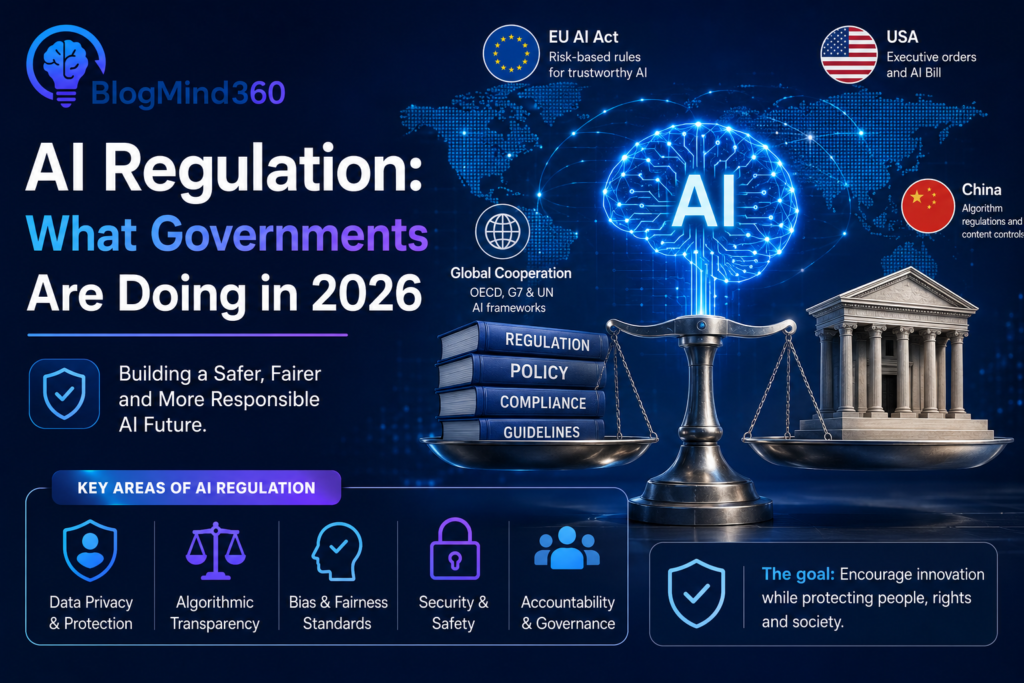
As AI systems become more capable and more deeply embedded in daily life, governments around the world have moved from discussing AI regulation in the abstract to actually implementing rules governing how AI can be developed and deployed. This article surveys the major regulatory approaches taken by different regions in 2026 and what they generally mean for businesses and individuals.
The European Union’s Approach
The European Union has taken one of the most comprehensive regulatory approaches globally, establishing a risk-based framework that applies different levels of scrutiny and requirements depending on how an AI system is used, with the strictest rules reserved for high-risk applications like those affecting employment, credit decisions, or law enforcement.
Certain AI applications considered to pose unacceptable risk, such as certain forms of biometric surveillance, face outright restrictions under this framework, while lower-risk AI applications face lighter transparency requirements.
The United States’ Approach
The United States has generally favored a more decentralized approach, combining sector-specific guidance from federal agencies, state-level initiatives, and voluntary commitments from major AI companies, rather than a single comprehensive federal AI law. This has resulted in a patchwork of rules that varies depending on industry and state.
Certain federal agencies have issued guidance on how existing laws — around discrimination, consumer protection, and safety — apply to AI systems, treating many AI-related harms as violations of existing legal frameworks rather than creating entirely new AI-specific rules in every case.
China’s Approach
China has implemented specific regulations targeting particular AI applications, including rules around generative AI content, recommendation algorithms, and requirements for AI-generated content to be clearly labeled. The government has generally combined promotion of domestic AI development with targeted content and safety regulations.
Common Themes Across Regulatory Approaches
Despite different regulatory philosophies, several themes appear across most major jurisdictions: requirements for transparency about when users are interacting with AI, particular scrutiny of AI use in high-stakes decisions like hiring or lending, growing requirements around labeling AI-generated content, and increased attention to protecting minors from potentially harmful AI applications.
What This Means for Businesses
Businesses deploying AI, particularly in high-stakes areas like hiring, lending, or healthcare, increasingly need to document how their AI systems work, test for bias and fairness, and maintain human oversight for significant decisions. Companies operating internationally often need to navigate multiple, sometimes conflicting regulatory frameworks.
What This Means for Individuals
For everyday users, growing AI regulation generally translates into more transparency about when AI is involved in a decision affecting them, clearer labeling of AI-generated content, and, in some jurisdictions, specific rights to understand or challenge AI-driven decisions in areas like credit or employment.
Frequently Asked Questions
Is there a single global AI law?
No, AI regulation varies significantly by country, with the EU, US, and China taking notably different approaches.
Does AI regulation apply to AI tools I use personally, or just businesses?
Most current regulation primarily targets organizations, though certain consumer protections directly affect individual users.
How do I know if an AI decision about me can be challenged?
This depends heavily on your jurisdiction and context, such as employment or lending decisions.
Are AI companies required to disclose how their models work?
Requirements vary, but growing regulation is pushing toward more transparency for high-risk applications.
Will AI regulation slow down AI innovation?
This is genuinely debated, with some arguing regulation builds trust while others worry it could push development elsewhere.
How can businesses stay compliant across different regions?
Many work with legal counsel and adopt the strictest applicable regional standard as a default.
Conclusion
AI regulation has moved from theoretical discussion to concrete policy in major economies worldwide, with the European Union, United States, and China each charting distinct regulatory paths. While specific rules continue to evolve, the overall direction points toward greater transparency, accountability, and oversight for AI systems, particularly in high-stakes applications affecting people’s lives directly.