Digital twin technology has moved from a niche engineering concept to a widely adopted tool across manufacturing, healthcare, urban planning, and more. This article explains what a digital twin actually is, how it works, and the practical ways organizations are using this technology in 2026.
What is a Digital Twin
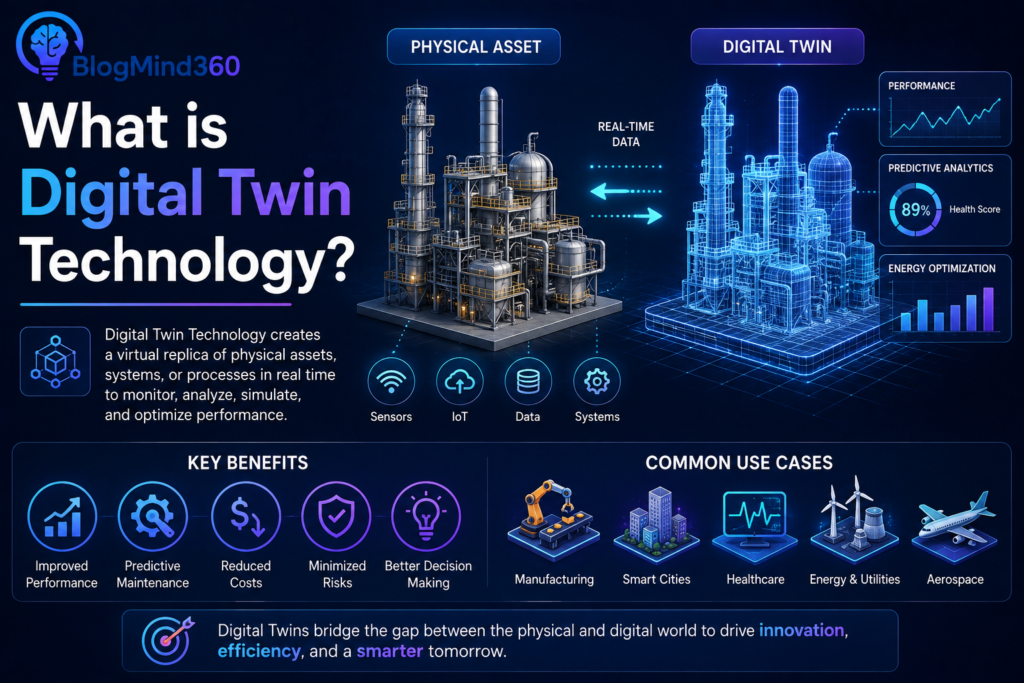
A digital twin is a virtual model of a physical object, system, or process, continuously updated with real-world data to mirror its real-world counterpart’s current state and behavior. Unlike a static 3D model, a digital twin is dynamic — connected to sensors and data feeds so it reflects real-time changes in the physical system it represents.
This allows engineers, planners, and analysts to test scenarios, predict problems, and optimize performance in the virtual model before making changes to the real, physical system.
How Digital Twins Work
Building a digital twin typically starts with a detailed model of the physical object or system, which is then connected to sensors that continuously feed real-world data — temperature, vibration, usage patterns, and more — back into the virtual model. This creates a living representation that updates as conditions change, rather than a one-time snapshot.
Advanced digital twins also incorporate simulation and AI capabilities, allowing them to predict how the physical system might behave under different conditions, not just reflect its current state.
Digital Twins in Manufacturing
Manufacturing has been one of the earliest and most enthusiastic adopters of digital twin technology, using virtual models of production lines and machinery to predict maintenance needs before a breakdown occurs, optimize production processes, and test changes virtually before implementing them on the physical factory floor.
Digital Twins in Healthcare
In healthcare, digital twin concepts are being applied to model individual patients’ physiology, helping doctors test how a specific patient might respond to different treatments before administering them. Hospital-level digital twins also help administrators optimize patient flow, staffing, and resource allocation.
Digital Twins in Urban Planning
Cities have begun building digital twins of urban infrastructure — traffic systems, utility networks, and building layouts — to test the impact of proposed changes, like a new transit line or building development, before committing to costly real-world construction.
Benefits and Challenges
The core benefit of digital twin technology is the ability to predict, test, and optimize in a virtual environment before making costly or risky changes in the real world. Building and maintaining an accurate digital twin requires significant upfront investment in sensors, data infrastructure, and modeling expertise, though costs have been gradually decreasing.
Frequently Asked Questions
Is a digital twin the same as a 3D model?
No, a 3D model is typically static, while a digital twin is continuously updated with real-world data.
Do I need IoT sensors to build a digital twin?
Generally yes, digital twins rely on continuous data feeds from sensors to stay accurate.
Are digital twins only used for large industrial systems?
No, digital twin concepts are also applied to smaller systems and even individual patients in healthcare.
How accurate are digital twin predictions?
Accuracy depends heavily on the quality of the underlying model and the data feeding it.
Is digital twin technology expensive to implement?
Costs vary by complexity, though they’ve been decreasing as sensor technology and cloud computing become more affordable.
Which industries benefit most from digital twins?
Manufacturing, healthcare, urban planning, energy, and aerospace see the most documented benefits today.
Conclusion
Digital twin technology offers a powerful way to predict, test, and optimize complex systems by mirroring them virtually with real-time data. As sensor technology and computing power continue to become more accessible, expect digital twins to expand beyond their current strongholds in manufacturing and infrastructure into an increasingly broad range of industries and applications.