
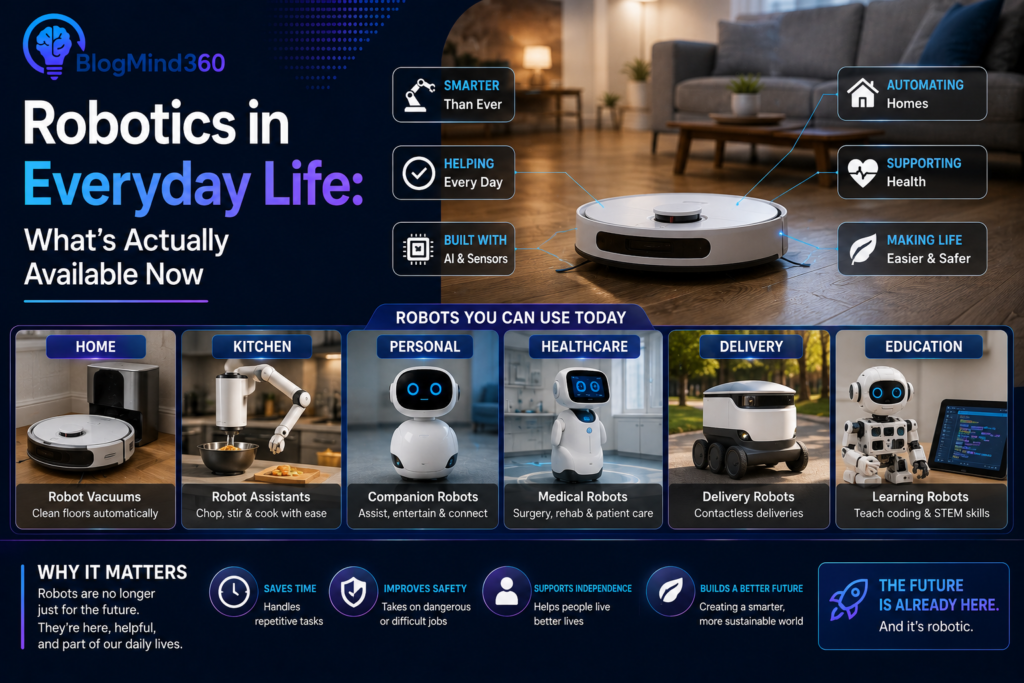
Robots have long been a staple of science fiction, but in 2026, a growing number of robotic systems have quietly become part of everyday life — not as humanoid companions, but as practical tools handling specific tasks. This article covers what robotics technology is genuinely available and in use today, separating real, deployed applications from technology that’s still mostly experimental.
Home Robots
Robotic vacuum cleaners remain the most widely adopted consumer robot, now commonly equipped with advanced mapping, obstacle avoidance, and self-emptying capabilities. Robotic lawn mowers have similarly grown in popularity, and a smaller but growing category of home robots now handles tasks like window cleaning and pool maintenance.
More advanced home robots — capable of complex household tasks like folding laundry or general tidying — remain largely in development or limited pilot stages rather than widely available consumer products.
Warehouse and Logistics Robots
Warehouse robotics has seen some of the most significant real-world deployment, with robots handling tasks like moving inventory shelves to human pickers, sorting packages, and transporting goods across large distribution centers. This has become a standard part of operations at major e-commerce and logistics companies, significantly speeding up order fulfillment.
Delivery Robots
Small autonomous delivery robots, navigating sidewalks to deliver food and packages over short distances, have expanded in several cities, alongside pilot programs for larger delivery robots and drones handling longer routes. Adoption remains regional and gradual rather than universal.
Robots in Manufacturing
Industrial robots have been a manufacturing staple for decades, but newer generations are increasingly flexible, able to be reprogrammed for different tasks more easily than older, single-purpose industrial robots. Collaborative robots, designed to work safely alongside human workers rather than in isolated safety cages, have grown particularly popular in smaller manufacturing operations that need flexibility.
Robots in Healthcare
Surgical robots, controlled by human surgeons, have become established tools for certain precision procedures, offering steadier control and smaller incisions than traditional surgery in many cases. Hospital logistics robots also handle tasks like transporting supplies and medications through hospital corridors.
Humanoid Robots: Promising but Early
Humanoid robots designed for general-purpose tasks have received significant investment and media attention, with several companies demonstrating prototypes capable of walking, manipulating objects, and performing simple tasks. However, widespread commercial deployment remains an early-stage goal rather than a current reality, with most current applications still limited to controlled pilot environments.
Frequently Asked Questions
Are humanoid robots available to buy for home use?
Not yet for general consumer use, current development remains focused on research and industrial pilots.
What’s the most common robot people actually own?
Robotic vacuum cleaners remain by far the most widely adopted consumer robot.
Are delivery robots available in most cities?
No, deployment remains regional, limited to specific cities or neighborhoods with pilot programs.
Do robots take jobs away from warehouse workers?
Robotics has changed the nature of many jobs, often shifting workers toward supervision roles rather than eliminating jobs entirely.
How safe are robots working alongside humans?
Collaborative robots are designed with safety sensors and speed limitations to work safely near humans.
What’s holding back more advanced home robots?
Complex, unstructured home environments present significant technical challenges compared to controlled warehouse settings.
Conclusion
Robotics has made genuine, practical inroads into everyday life — particularly in warehouses, manufacturing, healthcare, and increasingly in home cleaning and short-distance delivery — even as more ambitious applications like general-purpose humanoid robots remain in earlier stages of development. The steady, unglamorous progress happening in specific, well-defined tasks is likely to continue shaping how robotics actually reaches everyday life over the coming years.