| Quick Answer
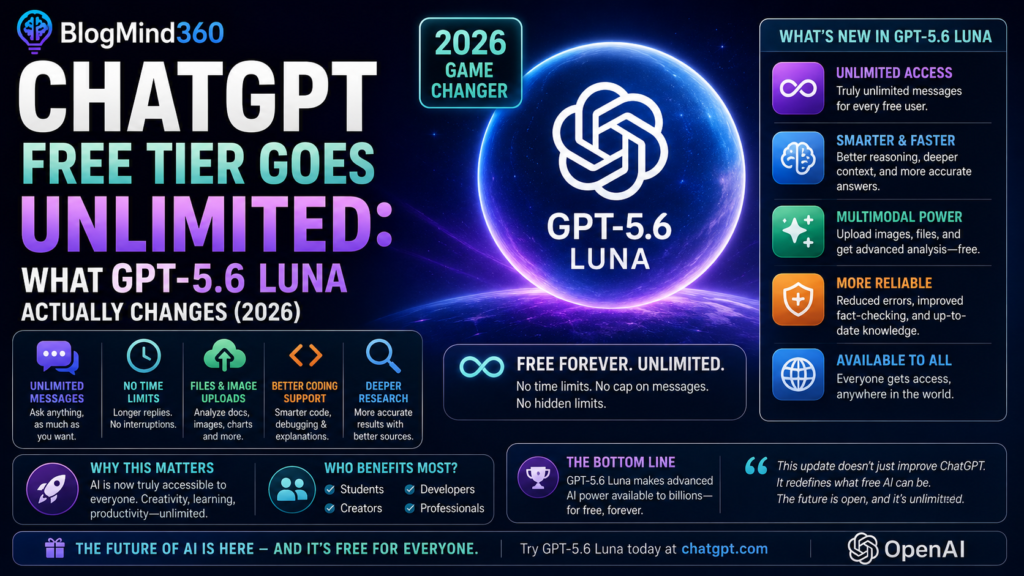
OpenAI announced on August 6, 2026 that GPT-5.6 Luna is now the default model for ChatGPT Free and Go users, and that the roughly 10-messages-per-5-hours cap is being removed the week of August 10, 2026. Free users get unlimited text chats and a new Think button, but file uploads, image generation, and voice mode remain capped. No credit card is required. |
If you’ve been rationing your ChatGPT messages, that habit just became unnecessary. OpenAI has quietly rolled out one of the biggest upgrades to its free tier since ChatGPT launched — and unlike most “free” upgrades, this one doesn’t come with a hidden catch pushing you toward a subscription.
Here’s exactly what changed, what OpenAI’s own numbers claim about the new model, what’s still locked behind a paywall, and whether Plus or Pro is still worth paying for in 2026.
What OpenAI Actually Announced
On August 6, 2026, OpenAI confirmed that GPT-5.6 Luna — the latest entry in its GPT-5.6 model family — is replacing GPT-5.5 Instant as the default model for Free and Go tier users. Alongside the model switch, OpenAI is removing the long-standing rate limit on text conversations, retiring the roughly 10-messages-per-5-hours cap that has quietly pushed casual users toward a paid plan for years.
The rollout is staged rather than instant: the model switch began the week of the announcement, while unlimited text chats and a new “Think” button started arriving for free users the week of August 10, 2026. With ChatGPT reportedly used by around 1 billion people every week, this is widely seen as a direct move to hold onto that audience against Google’s Gemini and Anthropic’s Claude, both of which already offer unlimited free text conversations.
Important nuance: “Unlimited” applies to text chats only. Image generation, file uploads, PDF analysis, voice mode, and custom GPTs all keep their own separate — and still limited — caps.
Meet GPT-5.6 Luna: The New Free Default
Luna is OpenAI’s entry-level model in the GPT-5.6 family, built for low latency and cost efficiency rather than maximum reasoning power. Think of it as the model optimized to answer a lot of everyday questions quickly and cheaply, rather than the model built to solve the hardest problems OpenAI can throw at it.
OpenAI’s internal evaluations claim Luna produces 62 to 68 percent fewer responses containing at least one factual error compared with the outgoing GPT-5.5 Instant model. That’s a notable claim, but it’s worth reading with a healthy dose of skepticism: the figure comes from OpenAI’s own internal testing, without a published, independently verifiable methodology. For everyday writing, quick research, and coding help, Luna is genuinely capable — but for high-stakes factual research, it’s still worth double-checking important claims against a primary source.
Free users also get access to a new “Think” button, sitting directly in the message composer. Tapping it triggers a higher-effort reasoning pass on that specific message, giving free users a taste of the step-by-step reasoning previously reserved for paid tiers — without needing to switch models manually.
What Changed for Paid Users: GPT-5.6 Sol
The free tier wasn’t the only thing OpenAI touched. Plus and Pro subscribers received an updated version of GPT-5.6 Sol, OpenAI’s higher-tier model built for reliability and factual accuracy. Previously, Plus and Pro users switched between separate “Instant” and “Thinking” experiences with noticeably different tones and capabilities; the updated Sol merges both into a single model.
According to OpenAI, the retuned Sol is designed to give more direct responses, use tighter formatting, and push back with a helpful correction rather than simply agreeing when that wouldn’t actually help. Paid users also get a new reasoning slider, letting them manually dial how much thinking effort the model applies to a given response — low for quick questions, higher for research, planning, or complex coding tasks.
One important carve-out: The updated Sol is scoped specifically to ChatGPT’s everyday Chat experience. OpenAI has confirmed that the version of GPT-5.6 Sol powering ChatGPT Work and Codex is not changing as part of this release.
OpenAI frames the goal of the updated Sol as giving a model that adapts its depth to the question rather than defaulting to either a rushed answer or an overly long one regardless of what’s actually being asked. In practice, that means a simple factual question should get a short, direct answer, while a request involving multi-step planning, research, or long-form writing should get a fuller response that still keeps the core recommendation easy to find rather than buried in extra padding.
What This Means for Businesses and Developers
For small businesses and independent developers who’ve been using the free tier to prototype ideas, draft customer messages, or get quick coding help, the removal of the message cap changes the day-to-day math meaningfully. Long troubleshooting sessions, iterative content drafts, and back-and-forth debugging no longer risk running into a cooldown timer partway through — a real productivity win for anyone not ready to commit to a monthly subscription.
That said, the carve-out for ChatGPT Work and Codex is a signal worth noting: OpenAI is treating its consumer chat experience and its professional developer tools as separate product tracks with separate upgrade timelines. Teams relying on Codex for coding workflows shouldn’t expect the same Sol updates to land automatically — those tools are being iterated on their own schedule, and it’s worth checking OpenAI’s official changelog before assuming a feature seen in ChatGPT’s chat interface is also live in Codex or the API.
ChatGPT Free vs Plus vs Pro: Full Comparison
With the free tier now offering unlimited text chats too, the real differences between plans come down to model quality, reasoning depth, and how generous the tool limits are:
ChatGPT Free, Plus and Pro plan comparison chart for August 2026
In practical terms: Free now genuinely covers most everyday use cases — writing help, brainstorming, general research, and casual coding questions. Plus becomes worth it once you regularly hit image, upload, or voice limits, want faster responses during peak hours, or want to remove the ads that have appeared for U.S. free users since February 2026. Pro remains a niche tier for people running heavy, sustained reasoning workloads who need maximum model effort on tap.
Before vs After: What the Free Tier Used to Look Like
To put the scale of this change in perspective, here’s a direct comparison between the free tier before August 10, 2026, and after:
ChatGPT free tier before and after comparison showing removal of the message limit
The gap is significant. Under the old system, a free user doing any kind of sustained work — debugging a script, working through a long writing project, or having an extended back-and-forth — would routinely hit the 5-hour cooldown and have to wait it out. That friction is now gone for text conversations entirely.
This kind of shift matters beyond just ChatGPT — it’s part of a broader trend of AI assistants becoming genuinely useful daily tools rather than novelty chatbots. If you’re exploring what else is available for free or low-cost right now, our roundup of the best AI tools for students and professionals in 2026 covers several other options worth comparing against ChatGPT.
What’s Still Limited on the Free Plan
Despite the headline change, several caps remain firmly in place for free accounts:
- Image generation via DALL-E 3 — still capped per day
- File uploads and PDF analysis — limited compared to Plus and Pro
- Voice mode — restricted usage windows
- Custom GPT agents — reduced access versus paid tiers
- Deep Research and Agent Mode — remain Plus/Pro exclusive features
- Ads — U.S. free users continue to see ads at the bottom of some answers, a change OpenAI introduced back in February 2026
It’s also worth knowing that free-tier conversations continue to feed OpenAI’s training data by default. If you’d prefer your chats not be used to train future models, you can opt out manually under Settings → Data Controls, though this doesn’t unlock any additional usage.
How to Start Using Unlimited ChatGPT Free
There’s no special setup required to get the updated free experience — if you already have a ChatGPT account, the change applies automatically as OpenAI rolls it out to your account. If you’re starting fresh, here’s the quick path:
- Go to chatgpt.com or open the ChatGPT app on iPhone or Android
- Sign up for a free account using an email address, Google account, or Apple ID — no credit card needed
- Start chatting — GPT-5.6 Luna is now the default model for new conversations
- Look for the new Think button in the message box when you want a deeper, more reasoned response
- If you don’t see unlimited chats yet, the rollout is staged — check back within a few days if you’re on an older app version
Existing conversations and chat history carry over automatically; there’s no need to start a new account or reset anything to get the updated model and limits.
ChatGPT Free vs Gemini vs Claude: How the Free Tiers Compare
OpenAI’s move doesn’t happen in isolation — it’s a direct response to how competitive the free tier of major AI assistants has become. Here’s a general sense of where things stand as of August 2026:
ChatGPT Free (GPT-5.6 Luna): Unlimited text chats, a Think button for on-demand reasoning, but capped image generation, uploads, and voice mode, plus ads for U.S. users.
Google Gemini Free: Also offers unlimited text conversations, with tight integration into Google’s own apps like Gmail, Docs, and Search — a strong pick if you’re already inside the Google ecosystem, including on a new Pixel phone with Gemini Intelligence built in.
Anthropic Claude Free: Known for strong writing quality and careful, well-reasoned responses, with its own usage limits that vary by demand rather than a fixed message count.
For most casual users, the practical difference between these free tiers now comes down to which ecosystem you’re already in and which model’s tone and style you personally prefer — the days of one assistant being dramatically more generous than the others on basic text chat are largely over.
This change didn’t happen in a vacuum. Google’s Gemini and Anthropic’s Claude have both offered unlimited free-tier text conversations for some time, and with ChatGPT sitting at roughly 1 billion weekly users, OpenAI has strong incentive to remove any friction that might push casual users toward a competitor’s free plan instead.
There’s also a product-strategy angle: by moving the current GPT-5.6 generation into the free tier rather than keeping free users on an older model indefinitely, OpenAI ensures more people experience its latest reasoning and accuracy improvements — which, in turn, shapes public perception of ChatGPT’s quality relative to rivals in an increasingly crowded AI assistant market.
It’s also a retention play aimed squarely at developers and power users who were hitting the old cap during long debugging sessions or multi-step writing projects, and who might otherwise have drifted toward a competitor’s app or a coding-specific assistant instead of paying for ChatGPT Plus. By removing that specific point of friction for free, OpenAI keeps more of its billion-plus weekly users inside its own ecosystem, where it can eventually convert a portion of them to paid plans once they hit the remaining image, upload, or voice limits.
This race between AI assistants is playing out alongside a wider shift in how software gets built and used — including a surge of AI-assisted “vibecoding” tools reshaping app stores. Our coverage of vibecoding apps flooding the App Store in 2026 looks at how accessible AI is changing who gets to build software in the first place.
Should You Upgrade to Plus or Pro?
With text chats now unlimited across every tier, the decision to pay comes down to a narrower set of questions:
Stick with Free if: you mainly use ChatGPT for everyday writing, quick research, casual coding help, or general questions, and you don’t regularly hit the image or upload limits.
Upgrade to Plus ($20/month) if: you frequently generate images, upload large files or PDFs for analysis, want faster responses during peak hours, want the manual reasoning slider for more control, or simply want the ads gone.
Upgrade to Pro ($200/month) if: your work depends on maximum reasoning effort for complex, high-stakes tasks — advanced coding, technical research, or detailed planning — where the cost of a wrong answer outweighs the subscription price many times over.
If you’re weighing ChatGPT Plus against other paid productivity tools for work, it’s worth comparing it against dedicated apps in specific categories — our guide to the top project management apps for small teams in 2026 is a useful reference point if AI chat isn’t the only tool you’re evaluating.
Frequently Asked Questions About ChatGPT’s Free Tier Update
Is ChatGPT really free with no message limit now?
Yes, for text chats specifically. As of the week of August 10, 2026, OpenAI removed the roughly 10-messages-per-5-hours cap for Free and Go users. Image generation, file uploads, and voice mode still have separate, lower limits.
What is GPT-5.6 Luna?
GPT-5.6 Luna is OpenAI’s entry-level model in the GPT-5.6 family, optimized for speed and low cost. It’s now the default model for ChatGPT Free and Go users, replacing GPT-5.5 Instant.
Do I need a credit card to use unlimited ChatGPT?
No. The unlimited text chat feature is available on the free plan with just a free account — no credit card or trial sign-up is required.
What is the difference between GPT-5.6 Luna and GPT-5.6 Sol?
Luna is the faster, lower-cost model used on the free tier, while Sol is OpenAI’s higher-accuracy model reserved for Plus and Pro subscribers, now updated with tighter formatting and a manual reasoning slider.
Does ChatGPT free tier still show ads?
Yes. U.S. free users have seen ads at the bottom of some ChatGPT answers since February 2026, and that hasn’t changed with this update. Upgrading to Plus removes ads.
What is the ChatGPT Think button?
The Think button is a new feature in the message composer that triggers a higher-effort reasoning pass for that specific message, giving free users on-demand access to deeper reasoning without switching models.
Is ChatGPT Plus still worth it in 2026?
It depends on usage. Since text chats are now unlimited on every tier, Plus is mainly worth it for higher image and file-upload limits, faster response times during peak hours, the reasoning slider, and an ad-free experience.
Does the free ChatGPT update work on mobile?
Yes. The unlimited text chat rollout applies across chatgpt.com and the official iPhone and Android apps, with no separate setup needed beyond having an updated app version.
Will my old ChatGPT free conversations still work with the new model?
Yes. Existing chat history carries over automatically, and new messages in old conversations will be answered using GPT-5.6 Luna going forward.
Final Thoughts
Removing the free-tier message cap is a bigger deal than it might first appear. It removes the single biggest daily annoyance free ChatGPT users dealt with, while quietly narrowing the gap between what free and paid users actually experience day to day. The real differentiators now live in the tools around the chat — images, uploads, voice, and reasoning depth — rather than in how many messages you’re allowed to send.
We’ll keep this page updated as OpenAI continues rolling out Luna and Sol updates across regions and platforms. Bookmark this article and check back for the latest on ChatGPT’s evolving free and paid plans.