Apple’s busiest month of the year is almost here, and the two devices everyone is searching for right now are the iPhone 18 Pro and the long-rumored, finally-real iPhone Fold. Between a new 2nm chip, a foldable design Apple has been quietly perfecting for years, and a major leadership change happening the same month, this fall’s Apple event is shaping up to be one of the most significant in years.
This guide pulls together everything confirmed and credibly rumored about the iPhone 18 Pro and iPhone Fold so far — release date, price, specs, colors, and how they compare to what you can already buy — so you know exactly what to expect before Apple takes the stage.
Quick Answer: When Is the iPhone 18 Pro Coming Out?
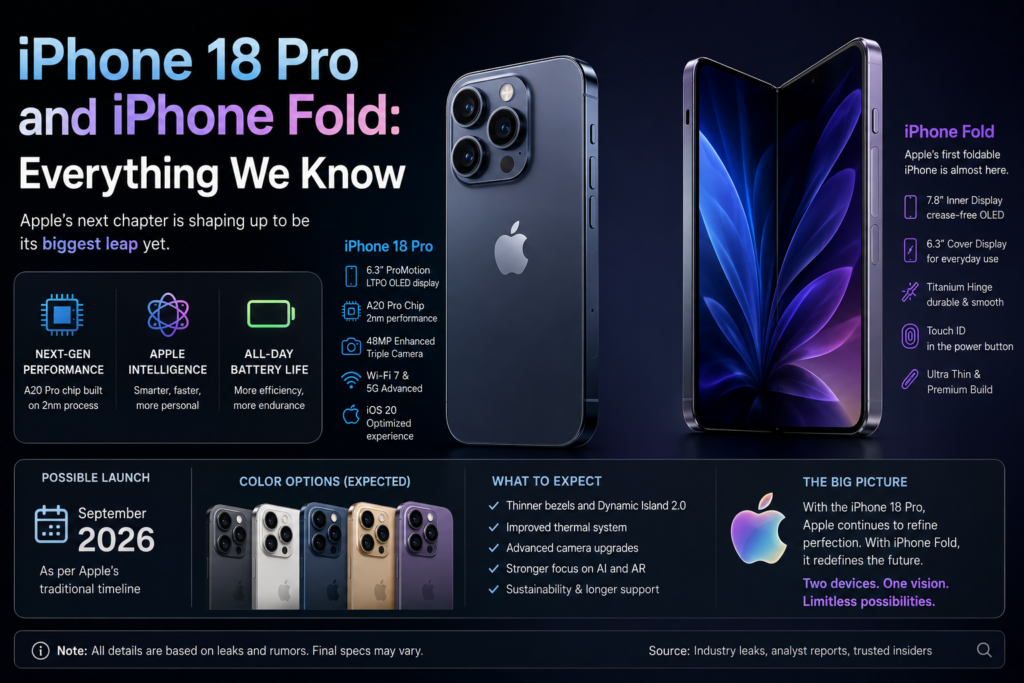
Apple is expected to hold its iPhone launch event in the second week of September 2026, following its usual annual pattern. The event will introduce the iPhone 18 Pro and iPhone 18 Pro Max, alongside the iPhone Fold (also rumored to be branded iPhone Ultra), Apple’s first-ever foldable phone. Notably, the standard non-Pro iPhone 18 will not launch this fall — Apple is splitting the lineup and delaying the base model until spring 2027. The iPhone 18 Pro is expected to carry a price increase of up to $300 over the iPhone 17 Pro, while the iPhone Fold is rumored to start somewhere between $2,000 and $2,900.
That’s the short version. Here’s the full breakdown of what’s changing, what’s staying the same, and what it means if you’re deciding whether to buy now or wait.
iPhone 18 Pro Release Date: When to Expect It
Apple traditionally holds its iPhone event in the second week of September, and this year should be no different. The event will also mark a symbolic moment for the company: John Ternus officially becomes Apple’s CEO on September 1, taking over from Tim Cook, who moves into a new executive chairman role. That means the iPhone 18 Pro launch will effectively be the first major keynote of the Ternus era, even though Cook’s fingerprints will still be all over the product roadmap for this cycle.
Following Apple’s usual rollout pattern, expect pre-orders to open within days of the announcement, with phones shipping to customers roughly a week to ten days later — putting the iPhone 18 Pro in customers’ hands by the third or fourth week of September.
Why the Standard iPhone 18 Isn’t Launching This Fall
One of the more unusual aspects of this year’s launch is what’s missing. Apple is expected to split the iPhone 18 generation across two release windows: the higher-end iPhone 18 Pro and Pro Max arrive in September 2026, while the standard iPhone 18 and a new iPhone 18e are delayed until spring 2027. This isn’t a delay caused by problems — it’s a deliberate strategy that lets Apple concentrate marketing and manufacturing capacity on its most profitable models during the critical holiday shopping season, while easing pressure on the supply chain for the more budget-friendly models.
iPhone 18 Pro Specs: What’s Actually Changing
If you’re expecting a dramatic redesign, temper your expectations. The iPhone 18 Pro is expected to look largely similar to the iPhone 17 Pro in construction and overall appearance, with a few notable internal and cosmetic updates.
The A20 Pro Chip
The headline change is under the hood: a new A20 Pro chip, reportedly manufactured on a more advanced 2nm process. Early leaks suggest this brings meaningful performance gains along with improved thermal efficiency — schematic leaks point to packaging changes designed to help the chip run cooler for longer, which should reduce the thermal throttling that can affect sustained performance during gaming or heavy video editing.
A New Modem and Possible Face ID Changes
The iPhone 18 Pro is also expected to adopt Apple’s in-house C2 modem, continuing the company’s push to reduce its reliance on third-party chip suppliers. Some rumors go further, suggesting the Pro models could introduce under-display Face ID, which would allow Apple to shrink the Dynamic Island — though this feature is considered less certain than the chip and modem upgrades.
Camera and Design Tweaks
Expect the camera bump to be slightly thicker than on the iPhone 17 Pro, likely to accommodate upgraded sensors or additional cooling for the new chip. On the color front, rumors point to Dark Cherry replacing Cosmic Orange as the new standout finish for the range, alongside the usual black, silver, and other standard options.
iPhone 18 Pro Specs Summary
| Feature | Expected iPhone 18 Pro | iPhone 17 Pro (Current) |
| Chip | A20 Pro (2nm process) | A19 Pro |
| Modem | Apple C2 | Qualcomm/Apple hybrid |
| Face ID | Possibly under-display | Dynamic Island-based |
| Camera bump | Slightly thicker | Standard |
| New color | Dark Cherry (rumored) | Cosmic Orange |
| Starting price | Up to $300 more than iPhone 17 Pro | Current pricing |
iPhone 18 Pro Price: How Much More Will It Cost?
Here’s the less exciting part of the story. The iPhone 18 Pro largely escaped Apple’s broader June 2026 price increases that hit other product lines, but analysts don’t expect that reprieve to last. Current estimates suggest the iPhone 18 Pro could cost up to $300 more than the equivalent iPhone 17 Pro model, largely driven by rising chip and memory costs amid an industry-wide RAM and component shortage that has been squeezing manufacturers throughout 2026.
If you’ve been holding off on upgrading, this is worth factoring into your decision — the iPhone 17 Pro, which remains an excellent phone in its own right, may represent significantly better value once the new pricing lands.
iPhone Fold: Everything We Know About Apple’s First Foldable
After years of rumors, patents, and speculation, Apple’s foldable iPhone finally appears ready for its debut. Code changes spotted in iOS 27 beta builds have provided some of the clearest evidence yet that a folding iPhone is genuinely coming this fall — though a full public release could still slip into 2027, even if the device is unveiled on stage in September.
Will It Be Called the iPhone Fold or iPhone Ultra?
Apple hasn’t confirmed a name, but rumors suggest the company may lean on its “Ultra” branding — already used across the Apple Watch and Mac lines — rather than calling it the “iPhone Fold” outright. Either name is plausible at this stage, and Apple has a track record of surprising everyone with its final naming choice.
iPhone Fold Display and Design
The iPhone Fold is expected to feature a dual-screen book-style design:
- A 3-inch external display for everyday use when the phone is closed
- A 8-inch internal display that unfolds to tablet-like proportions
The internal screen will reportedly use an under-display camera system, while the external display uses a more conventional punch-hole camera. On the back, expect a dual-camera system built around 48MP sensors. Powering the whole device will be the same A20 Pro chip found in the iPhone 18 Pro line, ensuring flagship-level performance despite the more complex form factor.
The Hinge Problem
If there’s one component that’s delayed foldable iPhones for years, it’s the hinge. Apple has reportedly gone through extensive rounds of engineering to develop a hinge mechanism that avoids the visible crease that has plagued foldable phones from other manufacturers since the category began. Some rumors even suggest Apple’s hinge technology could eventually be adapted for a foldable iPad, and that rival phone makers may attempt to copy the approach once it ships.
iPhone Fold Price
Early estimates put the iPhone Fold’s starting price between $2,000 and $2,500, though some analysts believe it could climb as high as $2,900 given the ongoing RAM and component shortage affecting the entire industry. That would make it comfortably the most expensive iPhone Apple has ever released — several hundred dollars above even the priciest iPhone 17 Pro Max configurations.
Could There Be a Launch-to-Ship Delay?
There’s meaningful precedent for Apple unveiling a product in September but not actually shipping it until later. The original iPhone X was announced in September 2017 but wasn’t available for pre-order until late October, with deliveries stretching into November. Given the complexity of the iPhone Fold’s hinge and display engineering, a similar staggered rollout wouldn’t be surprising — meaning the phone could be announced this September but not reach customers until closer to the end of the year, or even early 2027.
Beyond the iPhone: What Else Apple Is Expected to Announce
The September event is unlikely to be an iPhone-only affair. Based on current rumors, several other products could debut alongside the iPhone 18 Pro and iPhone Fold.
Apple Watch Series 12 and Apple Watch Ultra 4
Don’t expect a major design overhaul for the Apple Watch Series 12 — it’s expected to closely resemble the Apple Watch Series 11 externally. The more interesting rumor involves a new health sensor built into the band material itself, using a fluoroelastomer band design. Its exact function hasn’t been confirmed, but speculation points toward muscle movement or hydration sensing. Separately, the Apple Watch Ultra could be in line for its first major redesign in several generations, bringing new sensors alongside updated styling.
iPad mini 8
With a full iPad and iPad Air refresh not expected until 2027, the iPad mini is likely to be Apple’s only tablet update this fall — but it could be a significant one. Rumors and even earlier code leaks point to the eighth-generation iPad mini finally adopting OLED, with an 8.4-inch hybrid OLED panel. It won’t be a full Pro-level display, though — the refresh rate is expected to stay capped at 60Hz, meaning no ProMotion.
Siri AI and iOS 27
Perhaps the most consequential update won’t be hardware at all. iOS 27, arriving alongside the new iPhones, is expected to ship with a major overhaul of Siri — internally referred to as Siri AI — designed to make Apple’s assistant genuinely competitive with rivals like ChatGPT and Claude. This has been one of Apple’s most closely watched, and most delayed, software projects, and its execution could matter more to the company’s long-term AI positioning than any single piece of hardware this year.
AirPods Pro Update
Apple has reportedly been developing a version of AirPods Pro with built-in cameras, aimed at delivering smart-glasses-style AI features without actual glasses. However, production timelines suggest that camera-equipped version is more likely to land in 2027. A separate, camera-free AirPods Pro update — internally codenamed B790 — appears further along in development and could still arrive within 2026, offering general improvements over the current model rather than a headline new feature.
Smart Home Push: HomePod mini, Apple TV, and the New “Home Hub”
Apple’s smart home ambitions have been building for years, and this fall could finally bring some of that vision to life — though possibly in an October event rather than September, given how much stage time the iPhone Fold alone is likely to require. Expected updates include a refreshed HomePod mini (around $129) and an updated Apple TV box (around $199), both primarily focused on supporting the new Siri AI features rather than major hardware changes.
The most anticipated item is a rumored all-new device sometimes called the Home Hub — a roughly seven-inch square display mounted on a half-dome base, designed to serve as a central control point for smart home devices, an in-home intercom system, FaceTime calls, calendars, and reminders. Some reports suggest it may even support magnetic mounting to attach to different surfaces around the home.
iPhone 18 Pro vs iPhone Fold: Which Should You Wait For?
If you’re trying to decide whether to upgrade this fall, here’s how the two flagship options stack up on paper:
| Factor | iPhone 18 Pro | iPhone Fold |
| Design risk | Low — familiar, refined form factor | Higher — first-generation foldable hardware |
| Price | Up to $300 more than iPhone 17 Pro | $2,000–$2,900 (estimated) |
| Availability | Expected to ship on schedule in September | Possible gap between announcement and shipping |
| Best for | Buyers who want proven reliability and top performance | Early adopters who want the largest possible screen in pocket form |
| Chip | A20 Pro | A20 Pro (same chip) |
For most people, the iPhone 18 Pro is the safer, more practical choice — it uses the same next-generation chip as the Fold without the first-generation foldable risks around hinge durability, display creasing, and software optimization for the new form factor. The iPhone Fold will likely appeal most to early adopters with deep pockets who specifically want the productivity and media benefits of a larger unfolded display, and who don’t mind paying a significant premium — and potentially waiting longer — for it.
If your current phone is a few years old and you’re comparing today’s best options across brands rather than just Apple’s upcoming lineup, our guide to the best smartphones to buy in 2026, from budget to flagship, is a useful starting point before you commit to waiting for September.
Should You Buy an iPhone 17 Pro Now, or Wait for the iPhone 18 Pro?
This is the question most people actually searching for “iPhone 18 Pro” want answered. A few honest considerations:
- If you need a phone right now, the iPhone 17 Pro remains an excellent device, and current pricing is unlikely to get any better once the iPhone 18 Pro’s rumored price increase lands.
- If your upgrade cycle allows some flexibility, waiting a few weeks for official pricing and reviews of the iPhone 18 Pro is generally the safer move, given the meaningful chip and modem upgrades expected.
- If you’re curious about the iPhone Fold specifically, be prepared for a premium price, a longer potential wait between announcement and shipping, and the inherent risks of adopting first-generation foldable hardware — even from a company with Apple’s manufacturing track record.
- If budget is the deciding factor, remember that the standard iPhone 18 isn’t launching until spring 2027, so anyone hoping for a more affordable “iPhone 18” experience this fall will need to look at current iPhone 16 or iPhone 17 pricing instead.
What This Means for the Wider Tech and Gadget Market
Apple’s fall lineup rarely exists in a vacuum. A genuine foldable iPhone — even a first-generation, premium-priced one — is likely to accelerate competition across the smartphone industry, particularly among Android foldable makers who have had the category largely to themselves for several years. Expect rival manufacturers to respond quickly with their own updated foldables once Apple’s hinge and display approach becomes clearer.
The broader Siri AI overhaul in iOS 27 is arguably just as significant for the average buyer as any single piece of hardware. If Apple can meaningfully close the gap with ChatGPT and Claude-style assistants, it changes the calculus for millions of iPhone users who currently rely on third-party AI apps layered on top of their devices. For readers interested in how AI assistants actually work under the hood, our explainer on what artificial intelligence (AI) is is a good primer before Siri AI officially launches.
And for anyone whose next big purchase decision extends beyond phones — say, a new laptop to pair with this fall’s Apple ecosystem updates — our guide to the best laptops for students and professionals in 2026 covers the broader picture.
Deep Dive: Why the A20 Pro Chip Matters More Than You Think
It’s easy to skim past “new chip” as a routine yearly update, but the A20 Pro’s shift to a 2nm manufacturing process is a genuinely significant engineering milestone. Smaller process nodes allow chipmakers to pack more transistors into the same physical space, which typically translates into a combination of better raw performance and improved power efficiency — meaning the iPhone 18 Pro could plausibly deliver both faster processing and better battery life compared to its predecessor, rather than forcing a trade-off between the two.
The thermal packaging changes reportedly accompanying the A20 Pro are just as important as the node shrink itself. Sustained performance — the kind that matters during long gaming sessions, 4K video exports, or on-device AI processing — depends heavily on how well a chip can shed heat without throttling. If Apple has genuinely solved for better heat dissipation alongside the raw chip upgrade, the real-world performance gains could be more noticeable during demanding tasks than the on-paper spec bump alone would suggest.
This also matters because the same A20 Pro chip is expected to power the iPhone Fold. Given the added thermal challenges of cramming flagship silicon into a foldable chassis with two displays, any efficiency improvements in the chip itself become even more critical to the Fold’s day-to-day usability.
How the iPhone Fold Compares to Existing Android Foldables
Apple enters the foldable category several years after Samsung, Google, and various Chinese manufacturers already established the market, which means expectations are unusually high. Existing Android foldables have made real strides, but persistent complaints — a visible crease down the center of the internal display, concerns about long-term hinge durability, and software that doesn’t always adapt cleanly to the unfolded aspect ratio — have kept foldables a niche category rather than a mainstream one.
Apple’s approach, based on current rumors, seems deliberately conservative in some ways and ambitious in others. The extended hinge development timeline suggests the company is prioritizing a crease-free (or nearly crease-free) folding experience over rushing to market, a pattern consistent with how Apple has approached other genuinely new hardware categories in the past — arriving late, but aiming to set a new baseline for the category once it does. Whether that patience translates into a meaningfully better folding experience than what’s currently available from Samsung’s Galaxy Z Fold line remains one of the biggest open questions heading into September.
If Apple’s execution lives up to the pre-launch hype, it could do for foldables what earlier Apple product categories have done before: legitimize a niche hardware category for a much broader mainstream audience, even at a steep starting price.
Frequently Asked Questions About the iPhone 18 Pro and iPhone Fold
When will the iPhone 18 Pro be released?
Apple is expected to hold its iPhone launch event in the second week of September 2026, with the iPhone 18 Pro and iPhone 18 Pro Max shipping to customers within one to two weeks of the announcement.
Is Apple releasing a regular iPhone 18 this fall?
No. Apple is expected to split the iPhone 18 generation across two launch windows — the iPhone 18 Pro and Pro Max arrive in September 2026, while the standard iPhone 18 and a new iPhone 18e are delayed until spring 2027.
How much will the iPhone 18 Pro cost?
Exact pricing hasn’t been confirmed, but analysts expect the iPhone 18 Pro to cost up to $300 more than the equivalent iPhone 17 Pro model, driven largely by rising chip and memory costs.
What chip will the iPhone 18 Pro use?
The iPhone 18 Pro is expected to use Apple’s new A20 Pro chip, built on a more advanced 2nm manufacturing process, along with Apple’s in-house C2 modem.
Is the iPhone Fold really happening this year?
Code found in iOS 27 beta builds strongly suggests a foldable iPhone is coming this fall. However, there’s a real possibility Apple could announce the device in September but delay its actual shipping date, similar to how the original iPhone X was unveiled in September 2017 but didn’t ship until November.
What will the iPhone Fold be called?
Apple hasn’t confirmed an official name. While “iPhone Fold” is the most commonly used placeholder, rumors suggest Apple could use “iPhone Ultra” branding instead, consistent with how it names top-tier products elsewhere in its lineup.
How much will the iPhone Fold cost?
Early estimates put the starting price between $2,000 and $2,500, with some analysts suggesting it could reach as high as $2,900 due to ongoing RAM and component shortages across the industry.
What screen sizes will the iPhone Fold have?
The iPhone Fold is rumored to feature a 5.3-inch external display for everyday use and a 7.8-inch internal display that unfolds to a larger, tablet-like size.
Will the iPhone 18 Pro look different from the iPhone 17 Pro?
Not dramatically. The overall design is expected to stay largely similar, with a slightly thicker camera bump and a new color option — rumored to be called Dark Cherry — as the most visible external changes.
What other Apple products are expected this fall alongside the iPhone 18 Pro?
Rumored fall 2026 releases include the Apple Watch Series 12, a redesigned Apple Watch Ultra, an OLED iPad mini 8, updated HomePod mini and Apple TV hardware, and possibly a new smart home “Home Hub” display, alongside iOS 27’s major Siri AI overhaul.
Conclusion: A Genuinely Big Apple Fall Ahead
Between a next-generation A20 Pro chip, Apple’s first real foldable device after years of speculation, a major CEO transition, and a Siri overhaul aimed squarely at catching up in the AI race, this September’s Apple event has more riding on it than most recent years. The iPhone 18 Pro looks like a safe, meaningful upgrade for anyone due for a new phone, while the iPhone Fold represents a genuinely new category for Apple — exciting for early adopters, but carrying the usual first-generation risks and a price tag that puts it well out of reach for casual upgraders.
Whichever way you’re leaning, the smartest move right now is to wait for Apple’s official announcement before making any final decisions — rumors have a strong track record this close to launch, but pricing and exact specs can still shift until Apple actually takes the stage.
For more gadget breakdowns, buying guides, and the latest tech coverage, explore our full Technology section or check out our current picks for the best smartphones to buy in 2026.