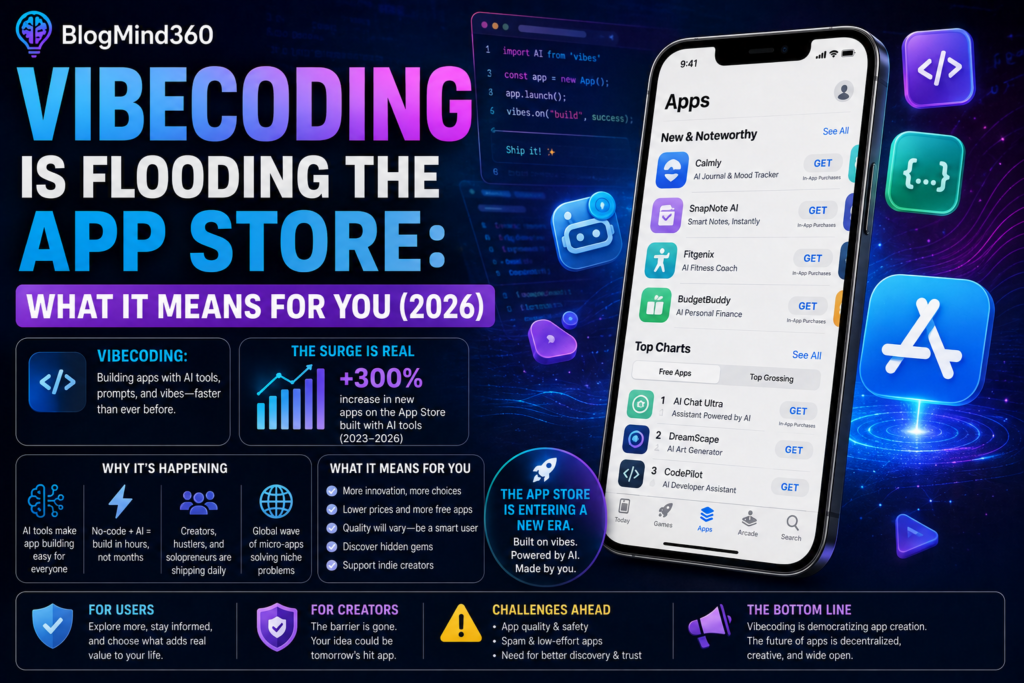
Something unusual is happening on Apple’s App Store. In the first half of 2026 alone, developers released almost as many new apps as they did in all of 2025 — but downloads barely budged. The reason, according to new industry data, is vibecoding: using AI tools to describe an app in plain English and have the AI build it, no traditional programming required.
This guide breaks down what’s actually happening, the real numbers behind the trend, who’s making money from it, which tools people are using, and whether it’s worth trying to build your own app this way.
Quick Answer: What Is the Vibecoding App Store Trend?
New App Store app releases doubled in the first half of 2026, reaching roughly 560,000 new apps — nearly matching the 600,000 total new apps released in all of 2025, according to app analytics firm Sensor Tower, as reported by The New York Times. Despite that surge in submissions, App Store downloads grew just 2% in the same period, reaching 17.6 billion. The gap is largely attributed to “vibecoding” — building apps using conversational AI tools like Lovable, Replit, Bolt.new, and Cursor, which let people with little or no traditional coding experience turn an app idea into a working, published product in days or even hours rather than months.
That’s the short version. Here’s the full picture, including real examples of what people are building, which tools are actually worth using, and what this trend means for the App Store’s future.
The Numbers: How Big Is the Vibecoding Surge, Really?
The data behind this story comes from app analytics firm Sensor Tower, cited in a New York Times report on the trend:
| Metric | 2025 (Full Year) | H1 2026 (First Half) |
| New apps released on the App Store | ~600,000 (up 30% year-over-year) | ~560,000 (already nearly matching all of 2025) |
| Total App Store downloads | 35.4 billion (up 3%) | 17.6 billion (up just 2%) |
Put simply: the number of new apps hitting the App Store has roughly doubled, while the number of people actually downloading apps has stayed almost completely flat. That disconnect is the central story here — a flood of new supply meeting essentially unchanged demand.
This isn’t the first sign of the trend, either. An earlier report from April 2026 had already flagged an 84% surge in new apps tied to the growing accessibility of AI coding tools — meaning the acceleration seen in this more recent data represents a continuation of a pattern that’s been building for months, not a sudden one-off spike.
What Is Vibecoding, Exactly?
“Vibecoding” refers to building software — including full mobile apps — primarily by describing what you want in natural language and letting an AI tool generate, test, and often deploy the actual code, rather than writing it manually yourself. The term has become shorthand for a broader shift: AI tools capable enough that someone with no formal programming background can go from an idea to a published, functioning app.
Vibecoding tools generally fall into two categories:
- AI app builders — platforms like Lovable, Bolt.new, and Replit that generate a complete application from a written project description and handle hosting automatically, requiring no coding knowledge at all.
- AI coding assistants — tools like Cursor and Claude Code that live inside a more traditional development environment, helping people who already have some coding background write, debug, and ship code significantly faster than working unassisted.
The App Store surge is being driven primarily by the first category — accessible, no-code-required app builders that have made “I have an idea for an app” and “I have a published app” a much shorter distance apart than it used to be.
Real Examples: Who’s Actually Building These Apps?
The New York Times’ reporting on this trend highlighted specific developers whose experiences illustrate exactly how this is playing out in practice.
From Five Weeks of Tinkering to a Published App
One developer profiled in the report — a software engineer with no prior mobile app experience — spent five weeks over the winter experimenting with vibecoding tools to build a prototype, then another two weeks preparing it for App Store submission. The resulting app, a modest utility called InfoDrizzle, has generated 1,300 downloads and roughly $500 in profit. Not life-changing money, but a real, published, revenue-generating app built without traditional software engineering experience.
A Week of Work, 20,000 Downloads
The same developer’s follow-up project performed considerably better. Released in May 2026 after about a week of development work, a scrapbooking app that turns photos into digital postage stamps has since been downloaded roughly 20,000 times, generating approximately $3,000 in profit — a striking illustration of how quickly a well-targeted, niche app idea can find an audience once vibecoding removes most of the traditional development bottleneck.
The Hobbyist Angle
Not everyone building these apps is chasing a business. Another developer cited in the reporting released 11 niche apps over five months, treating vibecoding as a hobby rather than a revenue strategy — a reminder that part of what’s driving the App Store surge is simply more people experimenting and shipping small, personal projects that would never have been worth the traditional development investment required a few years ago.
The Best Vibecoding Tools in 2026
If you’re considering trying this yourself, here’s how the major players in the space break down, based on current tool comparisons across the vibecoding ecosystem:
| Tool | Best For | Coding Knowledge Required | Notes |
| Lovable | Complete app builder experience for non-technical founders | None | Full-stack apps generated from prompts, with code ownership exportable via GitHub |
| Bolt.new | Fast prototyping and scaffolding | Minimal | Quick working scaffolds you can refine directly in the browser |
| Replit | Learning while shipping | None to minimal | All-in-one browser IDE with built-in hosting, database, and authentication; its Agent can plan and build entire apps autonomously |
| Cursor | Developers wanting more control | Some | Built on VS Code, offers deep AI integration while keeping you closer to the actual codebase |
| v0 (by Vercel) | Frontend component generation | Some | Generates polished interface elements rather than complete, functioning applications |
| Claude Code | Terminal-based power users and complex projects | Significant | Agentic coding for professional developers handling more complex refactoring work |
Choosing the Right Tool for You
The general guidance from developers who’ve tested multiple platforms extensively: if you have zero coding background, tools like Lovable and Replit offer the most guided, conversational experience, generating working apps from a written description alone. If you already know how to code and want to move faster rather than start from zero, Cursor and similar AI-assisted code editors let you keep more direct control over your codebase while still dramatically speeding up development.
One useful pattern several experienced builders report: many people start with a fully guided tool like Lovable, then graduate to something like Cursor once they want finer control over their app’s architecture, performance, or specific technical decisions the guided builders abstract away.
Why More Apps Doesn’t Mean More Downloads
The core tension in this story — a doubling of new apps against nearly flat download growth — comes down to a few converging factors.
The App Store Was Already Saturated
Total App Store downloads have been growing at a slow, single-digit pace for years now, reflecting a broadly saturated market where most smartphone users already have the apps they regularly use. A flood of new submissions doesn’t change how many total downloads people are collectively willing to make — it just means each individual new app is competing for a smaller slice of relatively fixed overall demand.
Most Vibecoded Apps Are Niche by Design
Many of the specific examples emerging from this trend — a scrapbooking tool, a collection of small hobbyist utilities — are intentionally narrow, solving very specific problems for relatively small audiences rather than chasing mass-market appeal. That’s part of what makes vibecoding valuable (it makes previously uneconomical niche ideas viable to build at all), but it also means many of these apps were never going to generate huge download numbers regardless of build method.
Discovery Remains the Real Bottleneck
Building an app has become dramatically faster and more accessible. Getting it discovered by users hasn’t gotten any easier — App Store search, category rankings, and featured placement remain just as competitive as ever, meaning the bottleneck in indie app success has shifted from “can I build this” to “can anyone find this.”
Apple’s Response to the Vibecoding Surge
With submission volume climbing sharply, Apple has faced questions about whether its app review process — historically built around reviewing roughly 90% of submissions within 48 hours — can keep pace with the surge. Apple spokesperson Peter Ajemian addressed this directly in comments to The New York Times, stating that Apple continues to review 90% of app submissions within 48 hours despite the volume increase, and characterized the trend positively: Apple is “thrilled to see a new generation of developers embracing the latest tools to build and ship apps faster than ever.”
Apple also emphasized that quality and safety standards haven’t been relaxed to accommodate the volume increase, stating that “all apps are held to the same high standards for quality, privacy and security that users have come to trust,” regardless of whether an app was built through traditional development or AI-assisted vibecoding tools.
Should You Try Building a Vibecoded App?
If the examples above have you curious about trying this yourself, here’s a realistic framework for thinking it through:
Good Reasons to Try It
- You have a specific, niche problem you personally want solved, and no existing app does it well
- You’re willing to treat it as a learning experience rather than expecting guaranteed income
- You have a genuinely underserved audience in mind — a hobby community, a local business need, a specific workflow — rather than trying to compete in an already-crowded mainstream category
- You want to test an idea cheaply before committing to a larger, more traditional development investment
Reasons to Be Realistic About Expectations
- Most apps, vibecoded or not, get very few downloads. The standout examples that generate meaningful revenue are exceptions, not the norm, in an ecosystem now seeing hundreds of thousands of new entrants per year.
- Discovery is still hard. Building the app is no longer the bottleneck — getting anyone to find it, download it, and keep using it remains genuinely difficult regardless of how the app was built.
- Quality still matters. Apple’s review standards haven’t loosened, and users can tell the difference between a polished, useful app and a rushed one, regardless of what tool built it.
A Practical Starting Path
For anyone genuinely interested in trying vibecoding for the first time, a reasonable starting sequence looks like: pick a narrow, specific problem you understand well (ideally one you personally have), try a fully guided tool like Lovable or Replit to get a working prototype without needing to learn to code first, and treat your first app as a learning project rather than a business plan. If you find you enjoy the process and want more control over the result, tools like Cursor offer a natural next step once you’re ready to get closer to the underlying code.
If you’re weighing which AI tools are actually worth your time across writing, coding, and other everyday tasks, our comparison of top AI writing assistants covers the broader landscape of accessible AI tools beyond just app building.
What This Means for the Broader App Store Ecosystem
The vibecoding surge represents a genuine structural shift in who can participate in app development, not just a temporary spike. Lowering the barrier from “months of learning to code, or a significant budget to hire developers” down to “a clear idea and a few days of iteration” fundamentally changes who’s able to bring a software idea to life — bringing in career-changers, hobbyists, and small business owners who previously would have had no realistic path to building their own app.
At the same time, this shift raises longer-term questions worth watching:
- Will App Store discovery mechanisms evolve to help genuinely useful niche apps surface amid a much larger pool of submissions, or will discovery become even harder as volume keeps climbing?
- Will quality concerns grow as the ratio of AI-assisted apps to traditionally developed ones continues shifting, even with Apple’s stated commitment to consistent review standards?
- Will more experienced developers increasingly adopt these same tools to accelerate their own work, further blurring the line between “vibecoded” and “traditionally developed” software as the underlying AI tools keep improving?
None of these questions have clear answers yet, but the underlying trend — AI dramatically lowering the barrier to shipping software — shows no sign of slowing down, and the App Store’s H1 2026 numbers are likely just an early chapter in a much longer story.
For more app comparisons, software guides, and productivity tool roundups, explore our full Apps section, or check out our guide to the best project management apps for small teams in 2026 if you’re managing a growing app idea alongside other work.
Vibecoding vs. Traditional App Development: A Direct Comparison
For anyone weighing whether to try vibecoding versus pursuing a more traditional development path — either learning to code yourself or hiring developers — here’s how the two approaches actually compare in practice.
| Factor | Vibecoding | Traditional Development |
| Time to first working prototype | Hours to days | Weeks to months |
| Upfront cost | Often free to under $50/month for most tools | Thousands of dollars if hiring developers, or months of your own time learning to code |
| Technical skill required | None to minimal, depending on tool | Significant, or budget to hire someone who has it |
| Code ownership and portability | Varies by tool — some export clean code, others lock you into their platform | Full ownership and control by default |
| Best suited for | Niche ideas, prototypes, MVPs, learning projects, solo builders | Complex apps, apps requiring deep customization, teams with existing technical resources |
| Long-term maintainability | Can require cleanup or refactoring as the app grows, depending on tool quality | Generally more maintainable from the start, assuming solid initial architecture |
The honest takeaway from developers who’ve used both approaches extensively: vibecoding is exceptional for getting an idea from concept to working product fast, and for validating whether an idea has any traction before investing more heavily. But for apps that need to scale significantly, integrate deeply with other systems, or maintain complex custom logic over years of development, many builders eventually find value in either graduating to more hands-on tools like Cursor, or bringing in traditional development expertise once the concept has proven itself.
The Economics: What Does It Actually Cost to Vibecode an App?
One of the more practical questions for anyone considering this path is cost. Most leading vibecoding platforms follow a similar pricing pattern: a free tier sufficient for learning the tool and building a basic prototype, followed by paid plans typically in the $10 to $25 per month range for serious individual use, with usage-based components on some platforms for more resource-intensive projects. Compared to the cost of hiring even a single freelance developer for a comparable project — often running into the thousands of dollars — the economics of trying an idea through vibecoding first, before committing more significant resources, are hard to argue with for most early-stage concepts.
Where costs can add up is in the App Store submission process itself: Apple’s standard developer account fee, along with any backend services (databases, authentication, hosting) not bundled into your chosen vibecoding platform. Tools like Replit that include hosting, database, and authentication in one package tend to minimize these additional costs compared to platforms that export code you then need to deploy and host separately.
Frequently Asked Questions About the Vibecoding App Store Trend
What is vibecoding?
Vibecoding refers to building software, including full mobile apps, primarily by describing what you want in natural language and having an AI tool generate, test, and often deploy the code — rather than writing the code manually yourself.
How many new apps were released on the App Store in 2026?
According to Sensor Tower data reported by The New York Times, roughly 560,000 new apps were released on the App Store in just the first half of 2026, nearly matching the approximately 600,000 new apps released across all of 2025.
Did App Store downloads increase along with new app releases?
No. While new app releases roughly doubled, total App Store downloads grew by just 2% in the first half of 2026, reaching 17.6 billion, reflecting a largely saturated download market despite the surge in new submissions.
What tools do people use for vibecoding?
Popular vibecoding tools include AI app builders like Lovable, Bolt.new, and Replit, which generate complete applications from a written description with no coding required, and AI coding assistants like Cursor and Claude Code, which help developers with some technical background write and ship code faster.
Can someone with no coding experience actually build and publish an app?
Yes. Multiple real-world examples, including developers profiled by The New York Times, show individuals with no prior mobile app development experience successfully building and publishing apps using vibecoding tools, some generating real download numbers and modest profit.
Has Apple changed its app review process because of the surge in submissions?
Apple has stated that it continues to review approximately 90% of app submissions within 48 hours despite the volume increase, and says it has not lowered its quality, privacy, or security standards to accommodate the growth in AI-assisted app submissions.
Is vibecoding a good way to make money?
It can be, but expectations should be realistic. The standout examples that generate meaningful downloads and profit are exceptions rather than the norm, given how many new apps are now entering an already competitive marketplace. Vibecoding lowers the barrier to building an app, but discovery and finding an audience remain just as challenging as before.
What’s the difference between an AI app builder and an AI coding assistant?
AI app builders like Lovable and Replit generate complete, functioning applications from a plain-language description and require no coding knowledge. AI coding assistants like Cursor work within a more traditional development environment and are better suited to people who already have some programming background and want to move faster.
Why are App Store downloads not growing as fast as new app submissions?
The App Store download market is largely saturated, growing only a few percentage points per year regardless of how many new apps are submitted. A surge in new apps means more competition for a relatively fixed pool of overall downloads, rather than a corresponding surge in total demand.
Should I try building my own app with a vibecoding tool?
If you have a specific, niche problem you understand well and are willing to treat the process as a learning experience rather than a guaranteed income source, trying a guided tool like Lovable or Replit is a low-risk way to explore vibecoding for the first time.
Conclusion: A New Era for Who Gets to Build Software
The numbers behind this trend tell a clear story: AI vibecoding tools have made building and publishing a mobile app dramatically more accessible than it’s ever been, and hundreds of thousands of people are taking advantage of that shift. But the flat download growth alongside that surge is an important reality check — building the app was never really the hardest part of succeeding on the App Store, and that remains just as true now as it was before AI tools made the building itself so much easier.
Whether you’re considering building your own app for the first time, or simply curious about how AI is reshaping who gets to participate in software development, the vibecoding trend is worth watching closely. It’s still early days for this shift, and based on the trajectory so far, 2026’s numbers are unlikely to represent a peak.
For more app comparisons, AI tool roundups, and practical tech guides, explore our full Apps section or check out our comparison of top AI writing assistants for more on the broader AI tools landscape.