
| Quick Answer
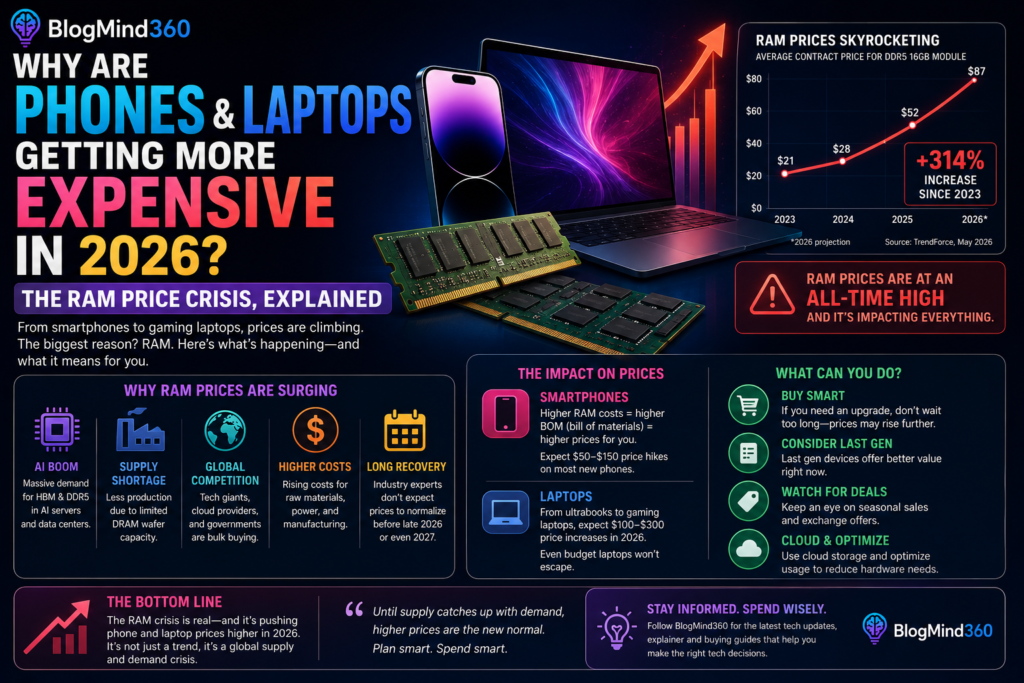
Phones and laptops are getting more expensive in 2026 mainly because of a global DRAM and NAND flash memory shortage. AI data centers need enormous amounts of high-bandwidth memory, and chipmakers like Samsung, SK hynix, and Micron are prioritizing that high-margin business over consumer RAM and storage. Analyst firm Gartner estimates combined memory prices could rise around 130% by the end of 2026, pushing PC prices up roughly 17% and smartphone prices up roughly 13% compared with 2025. |
If it feels like every new phone and laptop launch this year comes with a bigger price tag than last year’s model, you’re not imagining it. From the Galaxy Z Fold 8’s higher starting prices to reports pointing toward pricier Pixel 11 models, 2026 has quietly become one of the most expensive years in recent memory to buy a new device — and the reason has almost nothing to do with the phones or laptops themselves.
The real culprit is sitting inside every device you own: RAM and storage chips. Here’s a plain-English breakdown of what’s actually happening, why it’s happening now, and what it means for your next upgrade.
The Short Version: AI Data Centers Are Eating the World’s Memory Supply
Modern AI systems don’t just need powerful processors — they need enormous amounts of high-bandwidth memory (HBM) to keep those processors fed with data. That memory is made by essentially three companies worldwide: Samsung, SK hynix, and Micron. In 2026, all three are pouring their manufacturing capacity into HBM for AI accelerators, because AI companies will pay premium prices for as much of it as can be produced.
The problem is that HBM and standard consumer memory are made using overlapping manufacturing capacity. Every wafer devoted to HBM for a data center is a wafer not making the ordinary DRAM and NAND flash chips that go into phones, laptops, and game consoles. Micron has reportedly said it is essentially sold out of memory production for the year, and SK hynix has said its DRAM and NAND output is already fully claimed by customer demand.
The Numbers: How Bad Is the Memory Shortage?
This isn’t a minor supply hiccup — it’s one of the steepest component price surges the consumer electronics industry has seen in years. Here’s how the key figures stack up:
| Metric | 2026 Figure |
| Gartner’s projected DRAM + SSD price surge by end of 2026 | ~130% |
| Projected increase in average PC prices (2026 vs 2025) | ~17% |
| Projected increase in average smartphone prices (2026 vs 2025) | ~13% |
| LPDDR5X (mobile RAM) price jump, Q2 2026 alone | ~89% |
| Memory’s share of a $800 smartphone’s total cost, early 2025 | ~14% |
| Memory’s share of a $800 smartphone’s total cost, 2026 | ~40% |
| Projected global PC shipment decline in 2026 | ~10.4% |
| Projected global smartphone shipment decline in 2026 | ~8.4% |
Analyst firm TrendForce has echoed this trajectory, warning that DRAM and NAND flash contract prices are expected to keep climbing through at least Q3 2026, even as the pace of increases slows slightly as manufacturers and consumers reach their affordability limits.
Why Notebooks and Budget Phones Get Hit Hardest
Not every device feels this shortage equally. High-end ultrathin laptops, where mobile DRAM is soldered directly onto the motherboard, can’t cut costs by simply offering a lower-RAM configuration the way older, more modular laptops could — so those models tend to absorb price increases early and directly.
Budget and mid-range Android phones are arguably hit even harder. For a mid-range device, memory can represent 15 to 20 percent of the total bill of materials, compared with roughly 10 to 15 percent for a high-end flagship. That means the segment of the market built around affordability — phones that compete mainly on specs-per-dollar — has the least room to absorb rising memory costs without either raising prices or quietly cutting RAM and storage specs.
Industry analysts describe this as a reversal of a decade-long trend: flagship features steadily trickling down to affordable phones. In 2026, that democratization is running in reverse, at least temporarily, as brands protect margins on premium devices first.
How This Connects to Recent Launches
This memory crunch isn’t an abstract industry story — it’s already visible in the pricing of phones launching right now. Our coverage of the Pixel 11 launch and its expected pricing noted that Google is reportedly making 256GB the new minimum storage tier across the lineup — a welcome spec bump on paper, but one that arrives specifically because rising memory costs make it harder to justify keeping a cheaper, lower-storage base model around at all.
Samsung’s Galaxy Z Fold 8 series tells a similar story from a different angle. Leaked and later confirmed pricing showed the base 256GB models holding relatively steady, while higher-storage configurations — 512GB and 1TB — saw disproportionately larger price increases. Storage upgrade surcharges that used to add a predictable amount to the price jumped by as much as 60 to 70 percent compared with the prior generation, directly reflecting how much more expensive the underlying NAND flash has become.
A Timeline: How We Got Here
The current crisis didn’t appear overnight — it built steadily over several quarters as AI demand outpaced anyone’s expectations:
- Late 2025: IDC and other analysts flag an unprecedented memory shortage entering its early stages, driven by AI data-center buildouts
- Q4 2025: DRAM contract prices grow more than 75% year-over-year; TrendForce revises 2026 smartphone and notebook production forecasts downward
- Q1 2026: Memory prices rise sharply again; brands begin visibly raising prices and downgrading specs on new phone and laptop launches
- Q2 2026: The sharpest quarter yet — LPDDR5X mobile RAM jumps roughly 89%, and memory’s share of a mid-range smartphone’s total cost approaches 40%
- Q3 2026 (current): Price growth begins to moderate as manufacturers and consumers hit affordability limits, though prices are still climbing overall
This kind of sustained, multi-quarter escalation is unusual — most component shortages in the smartphone and PC industry historically resolve within one or two quarters as manufacturers ramp up supply. The fact that this one has persisted for nearly a full year, with major suppliers warning it could last into 2027 or beyond, is what separates it from a typical cyclical shortage.
Winners and Losers in the Memory Crisis
Not every company in the device industry is affected equally. A few clear patterns have emerged:
Premium brands with pricing power (Apple, Samsung’s high-end Ultra tier): These brands can pass costs onto buyers with less resistance, since flagship customers are generally less price-sensitive. Apple has reportedly raised prices across parts of its lineup rather than cutting specs, protecting its premium positioning.
Budget and mid-range Android brands: These companies face the toughest squeeze, since their entire value proposition depends on competitive specs at low prices — exactly the segment where rising memory costs bite hardest, relative to the total device price.
Memory manufacturers themselves (Samsung, SK hynix, Micron): Ironically, the same three companies supplying phone and laptop makers are also benefiting enormously from the crisis. Samsung has disclosed dramatic growth in semiconductor operating profit, driven largely by high-bandwidth memory sales to AI customers.
Consumers looking to upgrade: The clearest losers. Buyers face higher prices, smaller spec jumps generation over generation, and — in some cases — brands quietly removing lower-storage configurations that used to offer a genuinely affordable entry point.
Not soon, according to most industry forecasts. Several major memory manufacturers have publicly signaled that this isn’t a short-term spike:
- SK hynix has reportedly warned that 2027 could be the “worst year” for memory shortages, with tightness potentially lasting until 2030
- Micron has completed pricing agreements for its full 2026 high-bandwidth memory supply and expects tightness to persist beyond 2027
- Samsung expects its high-bandwidth memory sales to more than triple, reflecting how firmly its production priorities have shifted toward AI customers
- NAND flash shortages specifically aren’t expected to ease until 2027 at the earliest, according to industry reporting
In other words, this looks less like a temporary supply hiccup and more like a structural shift in how the world’s memory supply gets allocated — with AI data centers now permanently competing with, and often outbidding, consumer electronics manufacturers for the same limited factory capacity.
What This Means for Your Next Upgrade
If you’re planning to buy a new phone or laptop, the memory shortage changes the calculus in a few practical ways:
Base storage tiers are safer than upgrades. Manufacturers are generally protecting entry-level pricing while pushing the steepest increases onto higher-capacity configurations. If you don’t need 1TB of storage, paying for it right now costs disproportionately more than it used to.
Buying sooner rather than later may save money. With most forecasts pointing to continued price increases through 2026 and into 2027, devices launching later this year or next are likely to cost more, not less, for comparable specs.
The used and refurbished market becomes more attractive. As new-device prices climb, buying a well-maintained previous-generation phone or laptop offers a way to sidestep the current pricing environment entirely.
Expect slower spec growth at every price point. Brands are widely expected to hold specs flatter for longer, rather than the usual pattern of RAM and storage increasing year over year at the same price.
If you’re shopping around right now, it’s worth comparing multiple options rather than assuming any single flagship is the best value — our guides to the best smartphones to buy in 2026 and the best laptops for students and professionals in 2026 both factor in how current pricing pressure affects which specs are actually worth paying extra for.
How Brands Are Coping With the Shortage
Device makers aren’t just passively raising sticker prices — they’re using a mix of strategies to manage the hit without scaring away buyers entirely:
- Segmented pricing: keeping entry-level storage tiers relatively stable while pushing steeper increases onto higher-capacity configurations, as seen with the Galaxy Z Fold 8 series
- Spec downgrades: quietly shipping slightly less RAM or storage at the same price point instead of raising the price outright, particularly in the budget segment
- Heavier EMI and financing pushes: promoting installment plans and trade-in credits more aggressively to soften the perceived cost of a price increase
- Regional price differentiation: absorbing more of the cost increase in price-sensitive markets while passing on the full increase in markets with stronger purchasing power
- Extending device lifecycles: encouraging longer software support windows so consumers feel less pressure to upgrade annually, partially offsetting higher per-device costs with less frequent purchases
None of these strategies make the underlying problem disappear — they mostly just determine who feels the pain first and how visibly. For buyers, understanding these tactics makes it easier to spot when a “new feature” is really a cost-management decision in disguise, like a storage tier disappearing or a charger no longer being included in the box.
A little. TrendForce’s more recent reporting suggests the pace of price increases is beginning to cool — not because supply has improved, but because consumer electronics manufacturers are increasingly unwilling or unable to absorb further cost increases after several consecutive quarters of steep hikes. Quarter-over-quarter DRAM contract price growth is projected to slow from roughly 60 percent jumps earlier in the year to a still-significant but more manageable 13 to 18 percent range in Q3 2026.
That’s cold comfort if you’re shopping for a new device this month, but it does suggest the most extreme phase of the surge may be behind us, even if a return to 2024-era pricing looks unlikely for at least another year or two. The squeeze isn’t limited to phones and laptops either — accessory categories built around chips and onboard memory, like fast chargers and power banks, have seen smaller but similar cost pressure; see our picks for the best power banks and fast chargers of 2026 if you’re stocking up before prices climb further.
Frequently Asked Questions About the 2026 Memory Price Crisis
Why are phone and laptop prices going up in 2026?
Prices are rising mainly because of a global shortage of DRAM and NAND flash memory chips, driven by AI data centers buying up the majority of available high-bandwidth memory production from Samsung, SK hynix, and Micron.
How much have memory prices increased in 2026?
Analyst firm Gartner estimates combined DRAM and SSD prices could rise around 130% by the end of 2026 compared with 2025 levels, with LPDDR5X mobile RAM specifically jumping around 89% in just the second quarter.
Will smartphone and laptop prices go back down?
Not in the near term. Major memory manufacturers including SK hynix and Micron have indicated tight supply could persist through 2027 or beyond, though the pace of price increases is expected to slow somewhat in the second half of 2026.
Which devices are most affected by the memory shortage?
Budget and mid-range smartphones, and thin laptops with memory soldered to the motherboard, tend to be hit hardest, since memory makes up a larger share of their total cost and they have less flexibility to offset the increase.
Should I buy a phone or laptop now or wait?
Most forecasts point to continued price pressure through 2026 and into 2027, so buying sooner rather than later — and choosing base storage configurations over expensive upgrades — is generally the more cost-effective approach right now.
What is the difference between DRAM and NAND flash?
DRAM is the fast, temporary working memory a device uses while running apps — commonly called RAM. NAND flash is the long-term storage that holds your photos, apps, and files. Both have become significantly more expensive in 2026, but for slightly different reasons tied to AI demand.
Why don’t memory makers just build more factories?
Building new semiconductor fabrication capacity typically takes several years and billions of dollars, so manufacturers can’t simply scale up production to meet a sudden demand spike. Most of the new capacity being built right now is also being dedicated to high-margin AI memory rather than standard consumer DRAM and NAND, which is part of why analysts expect the shortage to persist rather than resolve quickly.
Are all phone brands raising prices because of the memory shortage?
Most are affected to some degree, but not equally. Premium brands with strong pricing power tend to absorb costs more easily, while budget and mid-range Android brands — where memory makes up a larger share of the total device cost — are generally under the most pressure to either raise prices or reduce specs.
What is causing the DRAM and NAND shortage specifically?
AI accelerators require large amounts of high-bandwidth memory (HBM), and producing HBM consumes manufacturing capacity that would otherwise go toward standard consumer DRAM and NAND flash, creating a direct supply tradeoff between AI hardware and everyday devices.
Final Thoughts
The next time you notice a new phone or laptop costing more than its predecessor, there’s a good chance the real story isn’t about greedy pricing or a lack of competition — it’s a handful of memory manufacturers quietly redirecting their factories toward the AI boom, with consumer electronics absorbing the squeeze that leaves behind.
We’ll continue tracking how this plays out across new launches throughout the rest of 2026. Bookmark this page and check back as we update it with the latest pricing data and analyst forecasts.